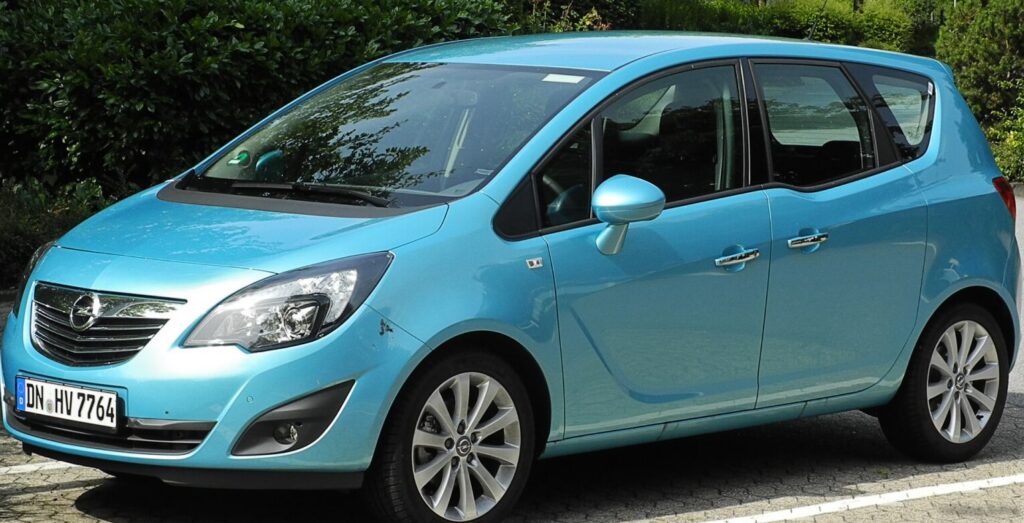
The Opel Meriva B 1.3 CDTI (95 hp) ecoFLEX, produced from July 2010 to 2014, represented an entry-level diesel option within the second generation of the Opel/Vauxhall Meriva (B platform). Positioned as a fuel-efficient and practical family vehicle, this variant aimed to appeal to budget-conscious buyers seeking a compact minivan. The ecoFLEX designation signified Opel’s efforts to improve fuel economy and reduce emissions. It was a key model in the European market, where smaller, fuel-efficient vehicles are highly valued, and offered a balance between practicality and running costs.
Technical Specifications
| Brand | Opel |
| Model | Meriva |
| Generation | Meriva B |
| Type (Engine) | 1.3 CDTI (95 Hp) ecoFLEX |
| Start of production | July, 2010 |
| End of production | 2014 |
| Powertrain Architecture | Internal Combustion engine |
| Body type | Minivan |
| Seats | 5 |
| Doors | 5 |
| Fuel consumption (urban) | 5.6 l/100 km (42 US mpg, 50.4 UK mpg, 17.9 km/l) |
| Fuel consumption (extra urban) | 3.9 l/100 km (60.3 US mpg, 72.4 UK mpg, 25.6 km/l) |
| Fuel consumption (combined) | 4.5 l/100 km (52.3 US mpg, 62.8 UK mpg, 22.2 km/l) |
| CO2 emissions | 119 g/km |
| Fuel Type | Diesel |
| Acceleration 0 – 100 km/h | 13.8 sec |
| Acceleration 0 – 62 mph | 13.8 sec |
| Acceleration 0 – 60 mph | 13.1 sec |
| Maximum speed | 168 km/h (104.39 mph) |
| Emission standard | Euro 5 |
| Weight-to-power ratio | 15 kg/Hp, 66.5 Hp/tonne |
| Weight-to-torque ratio | 7.9 kg/Nm, 126.1 Nm/tonne |
| Power | 95 Hp @ 4000 rpm |
| Power per litre | 76.1 Hp/l |
| Torque | 180 Nm @ 1750-3500 rpm (132.76 lb.-ft. @ 1750-3500 rpm) |
| Engine layout | Front, Transverse |
| Engine Model/Code | A13DTE |
| Engine displacement | 1248 cm3 (76.16 cu. in.) |
| Number of cylinders | 4 |
| Engine configuration | Inline |
| Compression ratio | 16.8:1 |
| Number of valves per cylinder | 4 |
| Fuel injection system | Diesel Commonrail |
| Engine aspiration | Turbocharger, Intercooler |
| Engine oil capacity | 3.5 l (3.7 US qt | 3.08 UK qt) |
| Coolant capacity | 6.2 l (6.55 US qt | 5.46 UK qt) |
| Kerb Weight | 1428 kg (3148.2 lbs.) |
| Max. weight | 2025 kg (4464.36 lbs.) |
| Max load | 597 kg (1316.16 lbs.) |
| Trunk (boot) space – minimum | 400 l (14.13 cu. ft.) |
| Trunk (boot) space – maximum | 1500 l (52.97 cu. ft.) |
| Fuel tank capacity | 54 l (14.27 US gal | 11.88 UK gal) |
| Length | 4288 mm (168.82 in.) |
| Width | 1994 mm (78.5 in.) |
| Height | 1615 mm (63.58 in.) |
| Wheelbase | 2644 mm (104.09 in.) |
| Front track | 1488 mm (58.58 in.) |
| Rear (Back) track | 1509 mm (59.41 in.) |
| Minimum turning circle | 11.06 m (36.29 ft.) |
| Drivetrain | Front wheel drive |
| Number of gears | 5 |
| Gearbox type | Manual transmission |
INTRODUCTION
The Opel Meriva B, launched in 2010, represented a significant step forward for the Meriva line, moving away from the more utilitarian first generation. The 1.3 CDTI ecoFLEX variant, producing 95 horsepower, was a core offering, designed to provide economical motoring for families. It slotted into the Meriva B range as the entry-level diesel, positioned below the more powerful 1.7 CDTI models. The Meriva B was built on the General Motors Gamma platform, shared with other models like the Opel Corsa D and Fiat Punto Evo, and aimed to compete with vehicles like the Renault Modus and Ford Fusion in the European mini-MPV segment.
Powertrain & Engine Architecture
The heart of the Meriva B 1.3 CDTI ecoFLEX is the A13DTE engine, a 1.3-liter inline-four cylinder diesel. This engine is part of Opel’s family of small-displacement diesel engines, known for their fuel efficiency. It features a common rail direct injection system, delivering fuel directly into the combustion chamber at high pressure for improved combustion and reduced emissions. The engine is turbocharged and intercooled, enhancing power output and torque. The turbocharger provides increased air intake, while the intercooler cools the compressed air, further improving efficiency. The engine utilizes four valves per cylinder, contributing to improved breathing and performance. The 5-speed manual transmission was standard, chosen for its efficiency and cost-effectiveness. This transmission was a conventional design, prioritizing reliability and ease of maintenance.
Driving Characteristics
The 95 hp output of the 1.3 CDTI engine, coupled with the 5-speed manual transmission, resulted in a driving experience focused on economy rather than outright performance. Acceleration from 0-60 mph took around 13.1 seconds, and top speed was limited to 104.39 mph. The engine’s 180 Nm (132.76 lb-ft) of torque, available from 1750-3500 rpm, provided adequate pulling power for everyday driving situations, including overtaking and climbing hills. However, it required frequent gear changes to maintain momentum, especially when fully loaded. Compared to the more powerful 1.7 CDTI variants, the 1.3 CDTI felt noticeably slower, but offered significantly better fuel economy. The gear ratios were tuned for efficiency, with a relatively long fifth gear designed to reduce engine speed at highway cruising speeds.
Equipment & Trim Levels
The Meriva B 1.3 CDTI ecoFLEX typically came with a reasonable level of standard equipment, focusing on practicality and comfort. Standard features included air conditioning, power steering, electric front windows, and a basic audio system with MP3 compatibility. Safety features such as ABS brakes, electronic stability control (ESP), and front airbags were also standard. Higher trim levels, such as Enjoy and Cosmo, added features like alloy wheels, rear electric windows, cruise control, and a more advanced audio system. Optional extras included parking sensors, a panoramic sunroof, and leather upholstery. Interior upholstery was typically cloth, with a durable and practical design. The dashboard layout was functional and user-friendly, with clearly labeled controls.
Chassis & Braking
The Meriva B featured a MacPherson strut front suspension and a torsion beam rear suspension. This setup provided a comfortable ride quality, suitable for everyday driving. The torsion beam rear suspension was a cost-effective solution, offering a good balance between comfort and handling. The front brakes were ventilated discs, while the rear brakes were typically drum brakes on the base models, with disc brakes available on higher trim levels. The steering was a rack and pinion system, providing precise and responsive steering feel. Stabilizer bars were fitted to both the front and rear axles to reduce body roll during cornering.
Market Reception & Comparison
The Opel Meriva B 1.3 CDTI ecoFLEX was generally well-received by critics for its fuel efficiency and practicality. It was praised for its spacious interior, flexible seating arrangements, and low running costs. However, some critics noted that the engine lacked power, particularly when fully loaded. Compared to the 1.7 CDTI variants, the 1.3 CDTI offered significantly better fuel economy – around 4.5 l/100 km (52.3 US mpg) combined – but at the expense of performance. The 1.3 CDTI was also more affordable to purchase and insure, making it an attractive option for budget-conscious buyers. Its main competitors, such as the Renault Modus and Ford Fusion, offered similar levels of practicality and fuel efficiency, but the Meriva B stood out with its innovative FlexSpace seating system.
Legacy
The Opel Meriva B 1.3 CDTI ecoFLEX has proven to be a relatively reliable powertrain, with many examples still on the road today. The A13DTE engine is known for its durability, although regular maintenance is essential to prevent issues such as turbocharger failure and injector problems. The 5-speed manual transmission is also generally reliable. In the used car market, the 1.3 CDTI ecoFLEX remains a popular choice for buyers seeking an affordable and economical family vehicle. Its low running costs and practical features continue to appeal to a wide range of buyers. However, potential buyers should be aware of the engine’s limited power output and the potential for diesel particulate filter (DPF) issues, particularly on vehicles that have primarily been used for short journeys.