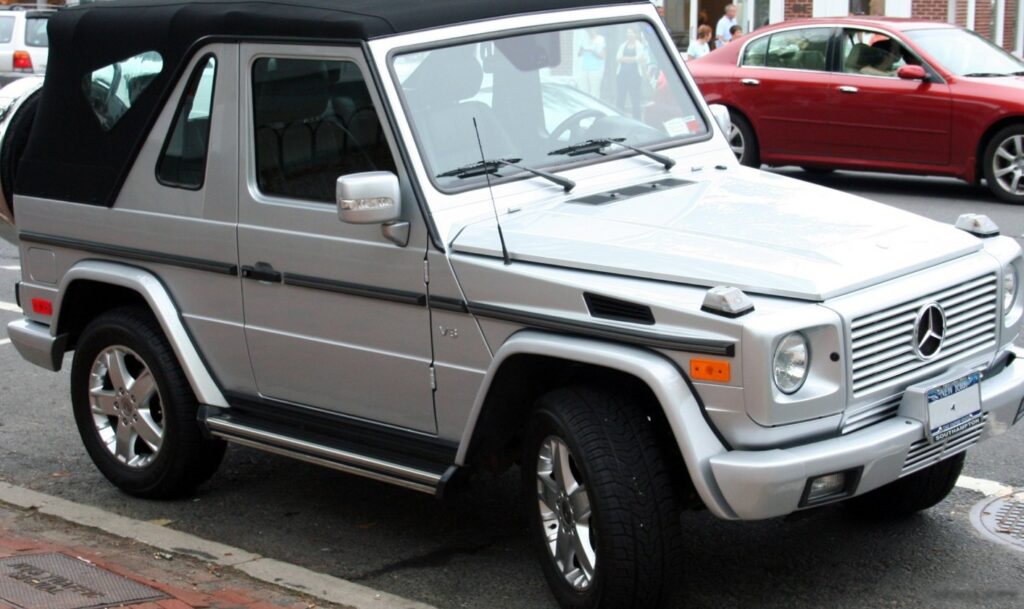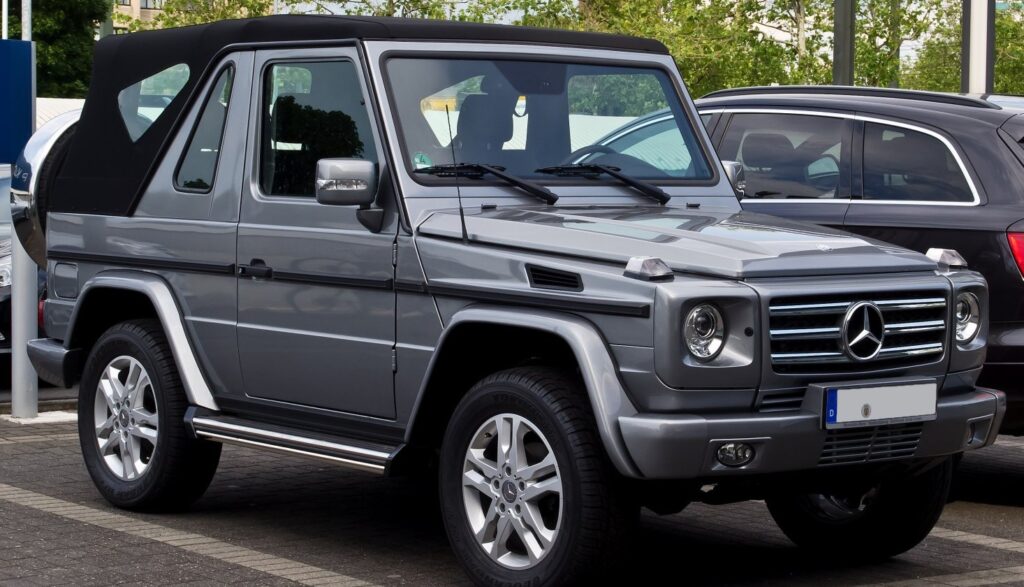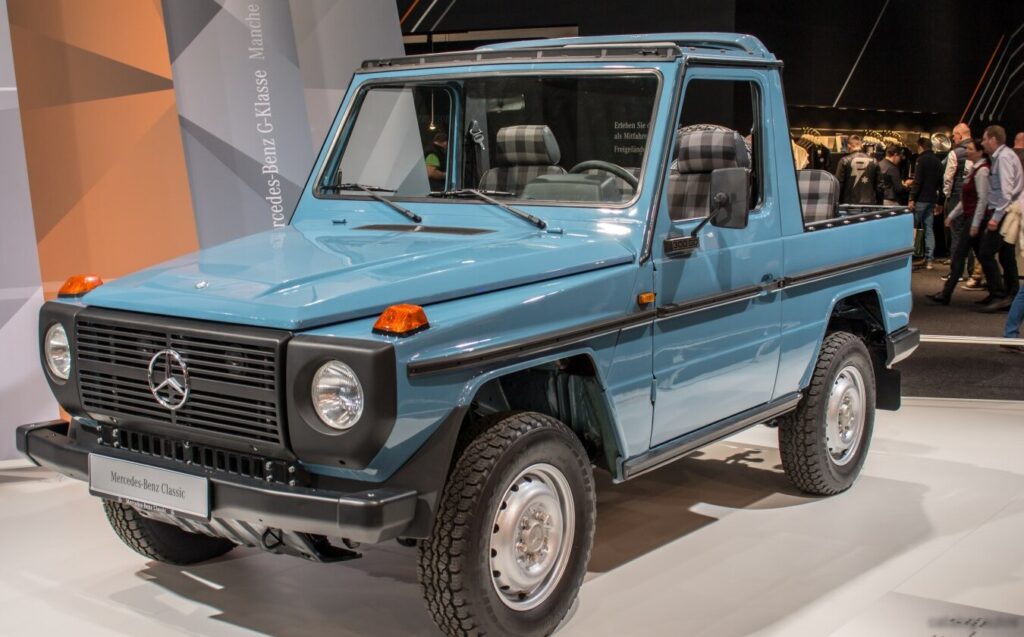
The Mercedes-Benz G-Class Cabriolet 230 G, produced from 1979 to 1982, represents an early iteration of the iconic G-Wagen. This variant, part of the W460 series, was designed primarily for military and utilitarian purposes, but also offered as a civilian model, including the open-top Cabriolet. The 230 G, powered by a 2.3-liter inline-four engine producing 90 horsepower, served as an entry point into the G-Class range, offering a blend of off-road capability and relatively accessible pricing. It played a crucial role in establishing the G-Class’s reputation for ruggedness and durability, particularly in the challenging terrains of Europe and beyond.
Technical Specifications
| Brand | Mercedes-Benz |
| Model | G-Class |
| Generation | G-Class Cabriolet (W460) |
| Type (Engine) | 230 G (90 Hp) 4WD |
| Start of production | 1979 |
| End of production | 1982 |
| Powertrain Architecture | Internal Combustion engine |
| Body type | Off-road vehicle, Cabriolet |
| Seats | 5 |
| Doors | 3 |
| Fuel consumption (urban) | 19.5 l/100 km (12.1 US mpg, 14.5 UK mpg, 5.1 km/l) |
| Fuel consumption (extra urban) | 13.5 l/100 km (17.4 US mpg, 20.9 UK mpg, 7.4 km/l) |
| Fuel Type | Petrol (Gasoline) |
| Maximum speed | 128 km/h (79.54 mph) |
| Weight-to-power ratio | 18.8 kg/Hp, 53.1 Hp/tonne |
| Weight-to-torque ratio | 10.1 kg/Nm, 98.5 Nm/tonne |
| Power | 90 Hp @ 5000 rpm |
| Power per litre | 39 Hp/l |
| Torque | 167 Nm @ 2500 rpm (123.17 lb.-ft. @ 2500 rpm) |
| Engine layout | Front, Longitudinal |
| Engine Model/Code | M 115.973 |
| Engine displacement | 2307 cm3 (140.78 cu. in.) |
| Number of cylinders | 4 |
| Engine configuration | Inline |
| Cylinder Bore | 93.7 mm (3.69 in.) |
| Piston Stroke | 83.6 mm (3.29 in.) |
| Compression ratio | 8:1 |
| Number of valves per cylinder | 2 |
| Fuel injection system | Carburettor |
| Engine aspiration | Naturally aspirated engine |
| Valvetrain | SOHC |
| Engine oil capacity | 5.5 l (5.81 US qt, 4.84 UK qt) |
| Coolant capacity | 10.7 l (11.31 US qt, 9.41 UK qt) |
| Kerb Weight | 1695 kg (3736.84 lbs.) |
| Max. weight | 2500 kg (5511.56 lbs.) |
| Max load | 805 kg (1774.72 lbs.) |
| Trunk (boot) space – minimum | 765 l (27.02 cu. ft.) |
| Trunk (boot) space – maximum | 1740 l (61.45 cu. ft.) |
| Fuel tank capacity | 75 l (19.81 US gal, 16.5 UK gal) |
| Permitted trailer load with brakes (12%) | 2500 kg (5511.56 lbs.) |
| Permitted trailer load without brakes | 750 kg (1653.47 lbs.) |
| Length | 4145 mm (163.19 in.) |
| Width | 1700 mm (66.93 in.) |
| Height | 2000 mm (78.74 in.) |
| Wheelbase | 2400 mm (94.49 in.) |
| Front track | 1425 mm (56.1 in.) |
| Rear track | 1425 mm (56.1 in.) |
| Front overhang | 745 mm (29.33 in.) |
| Rear overhang | 800 mm (31.5 in.) |
| Ride height (ground clearance) | 215 mm (8.46 in.) |
| Minimum turning circle | 11.4 m (37.4 ft.) |
| Approach angle | 45° |
| Departure angle | 40° |
| Ramp-over angle | 31° |
| Climb angle | 38.7° |
| Wading depth | 600 mm (23.62 in.) |
| Drivetrain Architecture | All wheel drive (4×4). ICE drives rear wheels, front wheels engaged via clutch. |
| Drive wheel | All wheel drive (4×4) |
| Number of gears and type of gearbox | 4 gears, manual transmission |
| Front suspension | Coil spring, Rigid axle, Transverse stabilizer, Trailing arm |
| Rear suspension | Rigid axle, Trailing arm, Coil spring |
| Front brakes | Disc, 303 mm |
| Rear brakes | Drum, 260 mm |
| Steering type | Cone worm with recirculation balls |
| Tires size | 205/80 R16 |
| Wheel rims size | 5.5J x 16 |
Powertrain & Engine Architecture
The 230 G was powered by the Mercedes-Benz M 115.973 engine, a 2.3-liter inline-four cylinder gasoline engine. This engine, while relatively simple by modern standards, was known for its durability and torque delivery at low RPMs. It utilized a single overhead camshaft (SOHC) valvetrain and a compression ratio of 8:1. Fuel delivery was managed by a carburetor, a common feature for the era, rather than fuel injection. The engine produced 90 horsepower at 5000 rpm and 167 Nm (123.17 lb-ft) of torque at 2500 rpm. The engine was mounted longitudinally in the front of the vehicle. The transmission was a four-speed manual, providing direct control over the engine’s power.
Driving Characteristics
The 230 G Cabriolet, with its 90 horsepower and manual transmission, offered a driving experience focused on capability rather than outright speed. Acceleration was modest, and the top speed was limited to around 128 km/h (79.54 mph). However, the engine’s torque characteristics made it well-suited for off-road driving, providing sufficient power to navigate challenging terrain. The manual transmission allowed for precise gear selection, crucial for maintaining control in difficult conditions. Compared to later, more powerful G-Class variants, the 230 G felt less refined and required more driver involvement. The gear ratios were optimized for low-speed crawling and maintaining traction, rather than highway cruising.
Equipment & Trim Levels
The 230 G Cabriolet was relatively sparsely equipped compared to modern vehicles, reflecting its utilitarian origins. Standard features included basic instrumentation, cloth upholstery, and a simple dashboard layout. The Cabriolet top was typically a manually operated canvas soft top. Optional extras included upgraded seating materials, a radio, and additional lighting. The interior was designed for functionality and ease of cleaning, prioritizing durability over luxury. Trim levels were minimal, with most variations stemming from optional equipment choices.
Chassis & Braking
The W460 G-Class featured a robust ladder-frame chassis, providing exceptional strength and rigidity. The suspension consisted of coil springs and rigid axles front and rear, offering substantial wheel articulation for off-road performance. A transverse stabilizer bar was fitted to the front axle to reduce body roll. Braking was accomplished via disc brakes on the front wheels (303mm diameter) and drum brakes on the rear wheels (260mm diameter). The steering system was a cone worm type with recirculation balls, providing a direct but somewhat heavy steering feel.
Market Reception & Comparison
The 230 G Cabriolet was viewed as a niche vehicle, appealing to buyers seeking a rugged and capable off-road vehicle with a unique open-air experience. Critics acknowledged its off-road prowess but noted its relatively slow performance and basic interior. Compared to other G-Class variants, such as the later 280 GE or 300 GD, the 230 G offered a more affordable entry point but lacked the refinement and power of its siblings. Fuel economy was relatively poor, typical for vehicles of that era, with around 19.5 l/100 km (12.1 US mpg) in urban driving.
Legacy
The 230 G Cabriolet, while not the most powerful or luxurious G-Class variant, holds a significant place in the model’s history. It established the G-Class’s reputation for off-road capability and durability, paving the way for the more sophisticated and powerful models that followed. Today, the W460 230 G is a sought-after classic among collectors and enthusiasts, prized for its simplicity, ruggedness, and iconic design. The M 115 engine, while aging, is generally considered reliable if properly maintained. Finding well-preserved examples can be challenging, as many were used extensively in demanding conditions. The 230 G represents a pivotal moment in the G-Class’s evolution, embodying the original spirit of the vehicle.