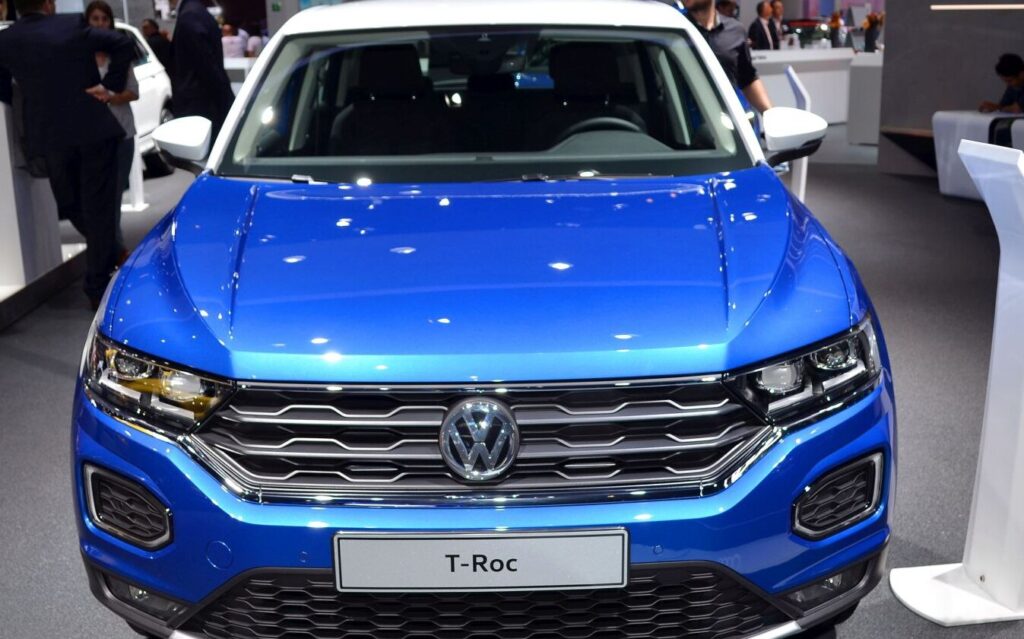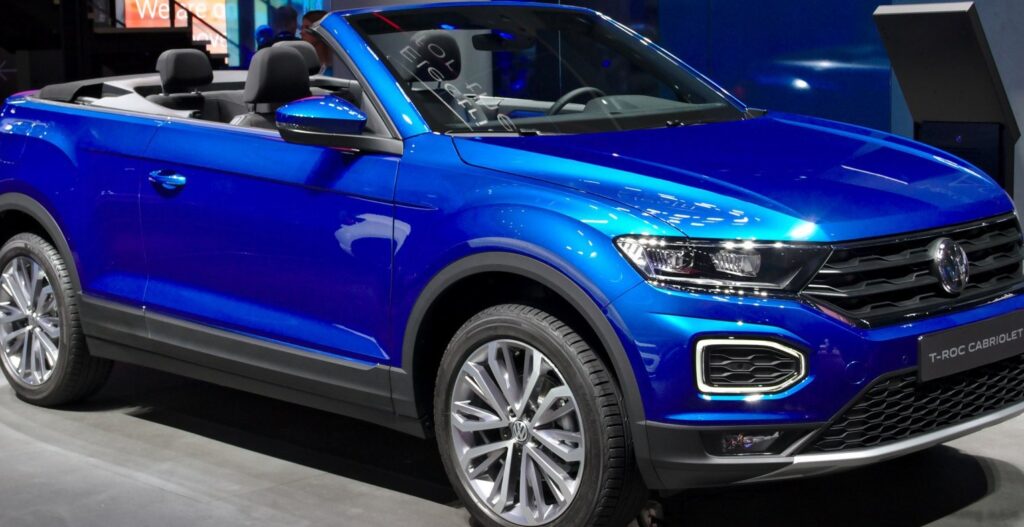
The Volkswagen T-Roc Cabriolet 1.5 TSI (150 hp) ACT OPF represents a unique offering within the compact SUV segment, blending open-top motoring with the practicality of a crossover. Introduced in 2019 and produced through 2020, this variant aimed to capitalize on the growing demand for stylish, versatile vehicles, particularly in the European market. It’s built on the Volkswagen Group’s MQB A0 platform, shared with models like the Volkswagen Polo and Audi A1. The T-Roc Cabriolet distinguished itself as the first convertible SUV from Volkswagen, targeting a younger demographic seeking a fashionable and fun-to-drive vehicle.
Technical Specifications
| Brand | Volkswagen |
| Model | T-Roc |
| Generation | T-Roc I Cabriolet |
| Type (Engine) | 1.5 TSI (150 Hp) ACT OPF |
| Start of production | 2019 |
| End of production | 2020 |
| Powertrain Architecture | Internal Combustion engine |
| Body type | Cabriolet, SUV |
| Seats | 4 |
| Doors | 2 |
| Fuel consumption (urban) | 6.7-6.9 l/100 km (35.1 – 34.1 US mpg, 42.2 – 40.9 UK mpg, 14.9 – 14.5 km/l) |
| Fuel consumption (extra urban) | 4.8-5.0 l/100 km (49 – 47 US mpg, 58.9 – 56.5 UK mpg, 20.8 – 20 km/l) |
| Fuel consumption (combined) | 5.5-5.7 l/100 km (42.8 – 41.3 US mpg, 51.4 – 49.6 UK mpg, 18.2 – 17.5 km/l) |
| CO2 emissions | 125-130 g/km |
| Fuel Type | Petrol (Gasoline) |
| Maximum speed | 250 km/h (155.34 mph) |
| Emission standard | Euro 6d – TEMP – EVAP – ISC |
| Weight-to-power ratio | 9.7 kg/Hp, 103.5 Hp/tonne |
| Weight-to-torque ratio | 5.8 kg/Nm, 172.5 Nm/tonne |
| Power | 150 Hp |
| Power per litre | 100.1 Hp/l |
| Torque | 250 Nm @ 1500-3500 rpm (184.39 lb.-ft. @ 1500-3500 rpm) |
| Engine layout | Front, Transverse |
| Engine Model/Code | DPCA |
| Engine displacement | 1498 cm3 (91.41 cu. in.) |
| Number of cylinders | 4 |
| Engine configuration | Inline |
| Number of valves per cylinder | 4 |
| Fuel injection system | Direct injection |
| Engine aspiration | Turbocharger, Intercooler |
| Engine oil capacity | 4.3 l (4.54 US qt | 3.78 UK qt) |
| Kerb Weight | 1449 kg (3194.5 lbs.) |
| Max. weight | 1880 kg (4144.69 lbs.) |
| Max load | 431 kg (950.19 lbs.) |
| Trunk (boot) space – minimum | 280 l (9.89 cu. ft.) |
| Fuel tank capacity | 50 l (13.21 US gal | 11 UK gal) |
| Max. roof load | 75 kg (165.35 lbs.) |
| Permitted trailer load with brakes (8%) | 1700 kg (3747.86 lbs.) |
| Permitted trailer load with brakes (12%) | 1500 kg (3306.93 lbs.) |
| Permitted trailer load without brakes | 750 kg (1653.47 lbs.) |
| Permitted towbar download | 80 kg (176.37 lbs.) |
| Length | 4268 mm (168.03 in.) |
| Width | 1811 mm (71.3 in.) |
| Width including mirrors | 1998 mm (78.66 in.) |
| Height | 1522 mm (59.92 in.) |
| Wheelbase | 2630 mm (103.54 in.) |
| Front track | 1538-1546 mm (60.55 – 60.87 in.) |
| Rear (Back) track | 1539-1547 mm (60.59 – 60.91 in.) |
| Minimum turning circle (turning diameter) | 11 m (36.09 ft.) |
| Drivetrain Architecture | The Internal combustion engine (ICE) drives the front wheels of the vehicle. |
| Drive wheel | Front wheel drive |
| Number of gears and type of gearbox | 6 gears, manual transmission |
| Front suspension | Independent type McPherson |
| Rear suspension | Independent multi-link suspension |
| Front brakes | Ventilated discs |
| Rear brakes | Disc |
| Assisting systems | ABS (Anti-lock braking system) |
| Steering type | Steering rack and pinion |
| Power steering | Electric Steering |
| Tires size | 215/55 R17 |
| Wheel rims size | 7J x 17 |
Powertrain & Engine Architecture
The T-Roc Cabriolet 1.5 TSI utilizes the Volkswagen Group’s DPCA engine, a 1.5-liter turbocharged inline-four cylinder gasoline engine. This engine is part of the EA211 family and features direct fuel injection, a single turbocharger with an intercooler, and variable valve timing on both intake and exhaust sides. A key technology incorporated is Active Cylinder Technology (ACT), which allows the engine to deactivate two cylinders under light load conditions to improve fuel efficiency. The engine produces 150 horsepower and 250 Nm (184 lb-ft) of torque between 1500 and 3500 rpm. The engine is transversely mounted at the front of the vehicle. The 6-speed manual transmission was standard, delivering power to the front wheels. This transmission was chosen for its balance of efficiency and driver engagement.
Driving Characteristics
The 1.5 TSI engine, paired with the manual transmission, provided adequate performance for everyday driving. Acceleration was respectable, though not particularly sporty. The turbocharger provided a noticeable boost in power, but the engine felt somewhat strained at higher speeds. The manual gearbox offered precise shifts, but the gear ratios were tuned for fuel economy rather than outright performance. Compared to higher-output T-Roc variants, such as those with the 2.0 TSI engine, this version felt less responsive. However, it offered a more economical and accessible entry point into the T-Roc Cabriolet range.
Equipment & Trim Levels
The T-Roc Cabriolet 1.5 TSI typically came with a reasonable level of standard equipment. This included air conditioning, a touchscreen infotainment system with Apple CarPlay and Android Auto compatibility, alloy wheels, and a suite of safety features like ABS, ESC, and multiple airbags. Higher trim levels offered options such as automatic climate control, a larger touchscreen display, navigation system, park assist, and premium upholstery. The Cabriolet’s interior design was modern and functional, with a focus on user-friendliness. The fabric roof was electrically operated and could be opened or closed in around nine seconds, even while driving at speeds up to 30 km/h (19 mph).
Chassis & Braking
The T-Roc Cabriolet’s chassis was based on the MQB A0 platform, featuring independent suspension at all four wheels. The front suspension utilized a McPherson strut setup, while the rear employed a multi-link system. This configuration provided a comfortable ride quality, although the Cabriolet’s open-top design necessitated additional bracing to maintain structural rigidity. The braking system consisted of ventilated discs at the front and solid discs at the rear, providing adequate stopping power for the vehicle’s weight and performance. Electronic Stability Control (ESC) and Anti-lock Braking System (ABS) were standard safety features.
Market Reception & Comparison
The T-Roc Cabriolet 1.5 TSI was generally well-received by automotive critics, who praised its stylish design, comfortable ride, and practical features. However, some reviewers noted that the performance of the 1.5 TSI engine was somewhat underwhelming, particularly when compared to more powerful engine options. Fuel economy was considered to be good, but not exceptional. Compared to other compact SUVs, the T-Roc Cabriolet stood out for its unique open-top design, which set it apart from the competition. It was positioned as a lifestyle vehicle, appealing to buyers who prioritized style and fun over outright performance.
Legacy
The Volkswagen T-Roc Cabriolet 1.5 TSI, while only produced for a short period, has established itself as a desirable and relatively reliable used car. The 1.5 TSI engine has proven to be generally durable, although regular maintenance is essential to prevent issues with the turbocharger and direct injection system. The Cabriolet’s unique design and open-top experience continue to appeal to buyers seeking a distinctive and enjoyable driving experience. As a relatively recent model, parts availability is generally good, and the T-Roc Cabriolet remains a popular choice in the used car market.