
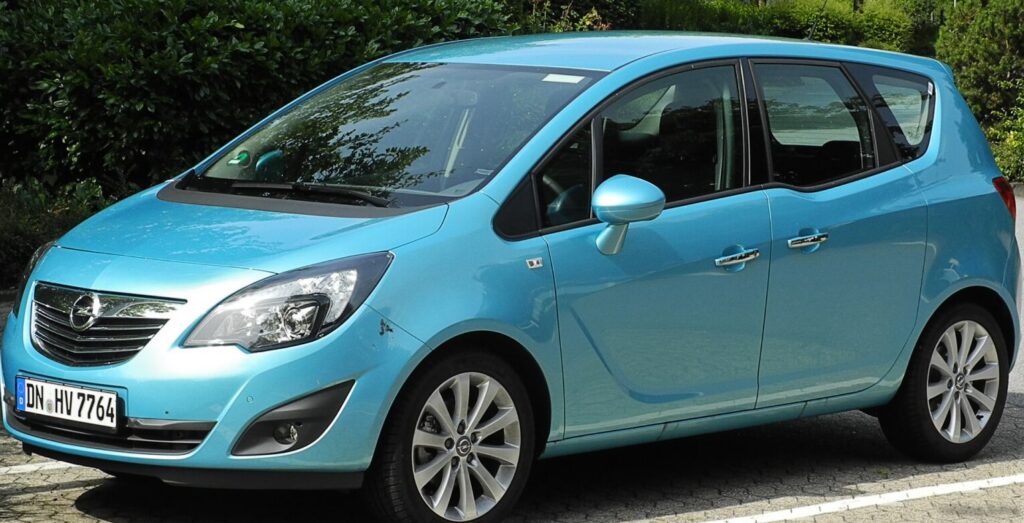
The Opel Meriva B 1.4 Turbo, produced from June 2010 to October 2013, represented a significant step forward for Opel’s compact minivan offering. Positioned as a mid-range trim within the Meriva B generation (based on the 1HX0/A3 platform), this variant combined a turbocharged engine with a five-speed manual transmission, aiming to balance fuel efficiency with acceptable performance for family transport. It was primarily marketed in Europe, where the compact MPV segment was, and remains, quite popular. The Meriva B, in general, aimed to provide a spacious and practical interior with innovative features like the FlexSpace rear seating system, setting it apart from more conventional hatchback options.
Technical Specifications
| Brand | Opel |
| Model | Meriva |
| Generation | Meriva B |
| Type (Engine) | 1.4 Turbo (120 Hp) |
| Start of production | June, 2010 |
| End of production | October, 2013 |
| Powertrain Architecture | Internal Combustion engine |
| Body type | Minivan |
| Seats | 5 |
| Doors | 5 |
| Fuel consumption (urban) | 8 l/100 km (29.4 US mpg, 35.3 UK mpg, 12.5 km/l) |
| Fuel consumption (extra urban) | 5 l/100 km (47 US mpg, 56.5 UK mpg, 20 km/l) |
| Fuel consumption (combined) | 6.1 l/100 km (38.6 US mpg, 46.3 UK mpg, 16.4 km/l) |
| CO2 emissions | 151 g/km |
| Fuel Type | Petrol (Gasoline) |
| Acceleration 0 – 100 km/h | 11.5 sec |
| Acceleration 0 – 62 mph | 11.5 sec |
| Acceleration 0 – 60 mph | 10.9 sec |
| Maximum speed | 188 km/h (116.82 mph) |
| Emission standard | Euro 5 |
| Weight-to-power ratio | 10.7 kg/Hp, 93.3 Hp/tonne |
| Weight-to-torque ratio | 7.3 kg/Nm, 136.1 Nm/tonne |
| Power | 120 Hp @ 4800-6000 rpm |
| Power per litre | 88 Hp/l |
| Torque | 175 Nm @ 1750-4800 rpm (129.07 lb.-ft. @ 1750-4800 rpm) |
| Engine layout | Front, Transverse |
| Engine Model/Code | A14NEL |
| Engine displacement | 1364 cm3 (83.24 cu. in.) |
| Number of cylinders | 4 |
| Engine configuration | Inline |
| Cylinder Bore | 72.5 mm (2.85 in.) |
| Piston Stroke | 82.6 mm (3.25 in.) |
| Compression ratio | 9.5:1 |
| Number of valves per cylinder | 4 |
| Fuel injection system | Direct injection |
| Engine aspiration | Turbocharger, Intercooler |
| Valvetrain | DOHC |
| Engine oil capacity | 4 l (4.23 US qt | 3.52 UK qt) |
| Coolant | 6.2 l (6.55 US qt | 5.46 UK qt) |
| Kerb Weight | 1286 kg (2835.14 lbs.) |
| Max. weight | 1890 kg (4166.74 lbs.) |
| Max load | 604 kg (1331.59 lbs.) |
| Trunk (boot) space – minimum | 400 l (14.13 cu. ft.) |
| Trunk (boot) space – maximum | 1500 l (52.97 cu. ft.) |
| Fuel tank capacity | 54 l (14.27 US gal | 11.88 UK gal) |
| Length | 4288 mm (168.82 in.) |
| Width | 1994 mm (78.5 in.) |
| Height | 1615 mm (63.58 in.) |
| Wheelbase | 2644 mm (104.09 in.) |
| Front track | 1488 mm (58.58 in.) |
| Rear (Back) track | 1509 mm (59.41 in.) |
| Minimum turning circle | 11.48 m (37.66 ft.) |
| Drivetrain Architecture | The Internal combustion engine (ICE) drives the front wheels of the vehicle. |
| Drive wheel | Front wheel drive |
| Number of gears | 5 gears, manual transmission |
| Front brakes | Ventilated discs |
| Rear brakes | Disc |
| Assisting systems | ABS (Anti-lock braking system) |
| Steering type | Steering rack and pinion |
| Tires size | 225/45 R17 |
| Wheel rims size | 17 |
Powertrain & Engine Architecture
The heart of the Meriva B 1.4 Turbo is the A14NEL engine, a 1.4-liter inline-four cylinder gasoline engine. This engine utilizes direct fuel injection and a turbocharger with an intercooler to boost power and efficiency. The direct injection system, a key feature, allows for more precise fuel delivery, improving combustion and reducing emissions. The engine employs a double overhead camshaft (DOHC) valvetrain, optimizing airflow into and out of the cylinders. The five-speed manual transmission was the standard pairing for this engine, offering a balance between fuel economy and driver engagement. The transmission’s gear ratios were tuned for everyday driving, prioritizing acceleration in the lower gears and comfortable cruising at highway speeds. The A14NEL engine is part of Opel/Vauxhall’s family of small displacement turbocharged engines, designed to offer a compelling alternative to larger, naturally aspirated engines.
Driving Characteristics
The 120 horsepower and 175 Nm (129 lb-ft) of torque provided by the 1.4 Turbo engine delivered adequate performance for the Meriva B. Acceleration from 0-60 mph took around 10.9 seconds, which was competitive within its class, but noticeably slower than the higher-output 1.6L turbo or diesel variants. The turbocharger did provide a noticeable boost in power during acceleration, but turbo lag was present, particularly at lower engine speeds. The five-speed manual transmission allowed drivers to keep the engine in its optimal power band, but required more frequent shifting compared to a six-speed gearbox. Compared to the 1.6L naturally aspirated engine, the 1.4 Turbo offered more responsive acceleration, while the diesel options provided superior fuel economy but less outright power. The overall driving experience was comfortable and refined, typical of a compact MPV, with a focus on practicality rather than sporty handling.
Equipment & Trim Levels
The 1.4 Turbo trim of the Meriva B typically included standard features such as air conditioning, power windows, power mirrors, a CD/MP3 stereo system, and ABS brakes. Higher trim levels added features like alloy wheels, fog lights, cruise control, and a more advanced infotainment system. Interior upholstery was typically cloth, with options for upgraded materials. The FlexSpace rear seating system, a defining feature of the Meriva B, allowed for versatile configuration of the rear seats, providing increased cargo space or accommodating passengers comfortably. Optional extras included parking sensors, a panoramic sunroof, and a navigation system.
Chassis & Braking
The Meriva B 1.4 Turbo utilized a MacPherson strut front suspension and a torsion beam rear suspension. This setup provided a good balance between ride comfort and handling. The front brakes were ventilated discs, offering good stopping power, while the rear brakes were solid discs. ABS (Anti-lock Braking System) was standard, enhancing safety during emergency braking situations. The suspension was tuned for comfort, prioritizing a smooth ride over sporty handling. Stabilizer bars were fitted to both the front and rear axles to reduce body roll during cornering.
Market Reception & Comparison
The Opel Meriva B 1.4 Turbo was generally well-received by automotive critics as a practical and efficient family vehicle. Its fuel economy of around 38.6 US mpg combined was a significant selling point, particularly in Europe where fuel prices are high. However, some critics noted that the engine could feel strained when fully loaded or driving uphill. Compared to the 1.6L petrol version, the 1.4 Turbo offered better performance, but at a slightly higher price point. The diesel variants were praised for their superior fuel economy, but were often more expensive to purchase and maintain. The Meriva B, as a whole, was seen as a strong competitor in the compact MPV segment, offering a compelling combination of practicality, versatility, and affordability.
Legacy
The A14NEL engine, while generally reliable, is known to require regular maintenance, particularly regarding the timing chain. Some owners have reported issues with oil consumption and turbocharger failure over time. However, with proper care and maintenance, the engine can provide many years of reliable service. On the used car market, the Meriva B 1.4 Turbo represents a relatively affordable and practical option for families. Its spacious interior, versatile seating, and decent fuel economy make it a popular choice for those seeking a compact MPV. The Meriva B, in general, has established a reputation as a dependable and well-rounded vehicle, and the 1.4 Turbo variant remains a viable option for budget-conscious buyers.