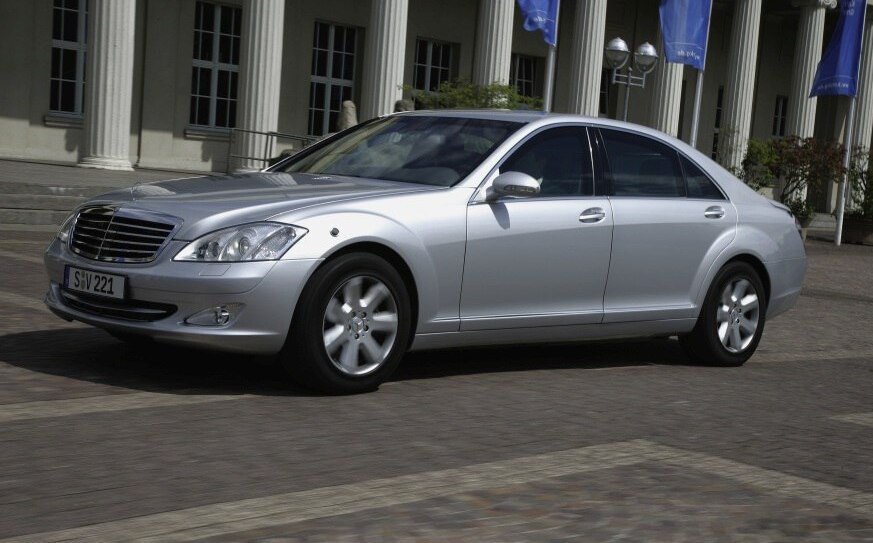
The Mercedes-Benz S-Class Long (V221) S 500 7G-TRONIC, produced from 2005 to 2009, represented a pinnacle of luxury and technology within the flagship S-Class range. This extended-wheelbase variant, designated internally as the V221, was primarily aimed at markets where rear passenger space was highly valued, such as China and other parts of Asia, though it was also available in North America and Europe. The S 500, positioned as a mid-to-upper trim level within the V221 lineup, offered a compelling blend of performance, comfort, and advanced features, establishing itself as a benchmark in the full-size luxury sedan segment.
Technical Specifications
| Brand | Mercedes-Benz |
| Model | S-class |
| Generation | S-class Long (V221) |
| Type (Engine) | S 500 (388 Hp) 7G-TRONIC |
| Start of production | 2005 |
| End of production | 2009 |
| Powertrain Architecture | Internal Combustion engine |
| Body type | Sedan |
| Seats | 5 |
| Doors | 4 |
| Fuel consumption (urban) | 17.5-17.7 l/100 km (13.4 – 13.3 US mpg, 16.1 – 16 UK mpg, 5.7 – 5.6 km/l) |
| Fuel consumption (extra urban) | 8.6-8.8 l/100 km (27.4 – 26.7 US mpg, 32.8 – 32.1 UK mpg, 11.6 – 11.4 km/l) |
| Fuel consumption (combined) | 11.8-12 l/100 km (19.9 – 19.6 US mpg, 23.9 – 23.5 UK mpg, 8.5 – 8.3 km/l) |
| CO2 emissions | 281-286 g/km |
| Fuel Type | Petrol (Gasoline) |
| Acceleration 0 – 100 km/h | 5.4 sec |
| Acceleration 0 – 62 mph | 5.4 sec |
| Acceleration 0 – 60 mph | 5.1 sec |
| Maximum speed | 250 km/h (155.34 mph) |
| Weight-to-power ratio | 4.9 kg/Hp, 203.1 Hp/tonne |
| Weight-to-torque ratio | 3.6 kg/Nm, 277.5 Nm/tonne |
| Power | 388 Hp @ 6000 rpm |
| Power per litre | 71 Hp/l |
| Torque | 530 Nm @ 2800-4800 rpm (390.91 lb.-ft. @ 2800-4800 rpm) |
| Engine layout | Front, Longitudinal |
| Engine Model/Code | M 273.961 |
| Engine displacement | 5461 cm3 (333.25 cu. in.) |
| Number of cylinders | 8 |
| Engine configuration | V-engine |
| Cylinder Bore | 98 mm (3.86 in.) |
| Piston Stroke | 90.5 mm (3.56 in.) |
| Compression ratio | 10.7:1 |
| Number of valves per cylinder | 4 |
| Fuel injection system | Multi-port manifold injection |
| Engine aspiration | Naturally aspirated engine |
| Valvetrain | DOHC |
| Engine oil capacity | 8.5 l (8.98 US qt | 7.48 UK qt) |
| Coolant | 8.5 l (8.98 US qt | 7.48 UK qt) |
| Kerb Weight | 1910 kg (4210.83 lbs.) |
| Max. weight | 2565 kg (5654.86 lbs.) |
| Max load | 655 kg (1444.03 lbs.) |
| Trunk (boot) space – minimum | 560 l (19.78 cu. ft.) |
| Fuel tank capacity | 90 l (23.78 US gal | 19.8 UK gal) |
| Length | 5209 mm (205.08 in.) |
| Width | 1872 mm (73.7 in.) |
| Width including mirrors | 2115 mm (83.27 in.) |
| Height | 1473 mm (57.99 in.) |
| Wheelbase | 3165 mm (124.61 in.) |
| Front track | 1604 mm (63.15 in.) |
| Rear (Back) track | 1606 mm (63.23 in.) |
| Front overhang | 871 mm (34.29 in.) |
| Rear overhang | 1173 mm (46.18 in.) |
| Minimum turning circle | 12.2 m (40.03 ft.) |
| Drivetrain Architecture | Rear wheel drive |
| Drive wheel | Rear wheel drive |
| Number of gears | 7 |
| Gearbox type | automatic transmission G-TRONIC |
| Front suspension | Air suspension |
| Rear suspension | Air suspension |
| Front brakes | Ventilated discs |
| Rear brakes | Ventilated discs |
| Assisting systems | ABS (Anti-lock braking system) |
| Steering type | Steering rack and pinion |
| Tires size | 235/55 R17 |
| Wheel rims size | 8J x 17 |
Powertrain & Engine Architecture
The S 500 was powered by the M273.961 5.5-liter naturally aspirated V8 engine. This engine, a cornerstone of Mercedes-Benz’s powertrain lineup during this period, featured all-aluminum construction, three valves per cylinder, and a sophisticated multi-port fuel injection system. The engine produced 388 horsepower at 6000 rpm and 530 Nm (390.91 lb-ft) of torque between 2800 and 4800 rpm. The engine’s design prioritized smooth power delivery and refinement over outright performance, aligning with the S-Class’s focus on luxurious transportation. Paired with the engine was the 7G-TRONIC seven-speed automatic transmission, a significant advancement over previous five-speed automatics. The 7G-TRONIC offered smoother shifts, improved fuel efficiency, and a wider range of gear ratios, enhancing both performance and comfort.
Driving Characteristics
The S 500 7G-TRONIC delivered a driving experience characterized by effortless power and exceptional smoothness. While not as overtly sporty as some of its competitors, the S 500 offered brisk acceleration – 0 to 60 mph in approximately 5.1 seconds – and ample power for confident highway cruising and overtaking. The 7G-TRONIC transmission played a crucial role in this, providing seamless gear changes and keeping the engine within its optimal power band. Compared to the S 350, the S 500 offered a noticeable increase in performance, while remaining more refined and less focused on outright speed than the higher-performance S 600 models with their V12 engines. The long wheelbase contributed to a remarkably comfortable ride, absorbing bumps and imperfections in the road with ease.
Equipment & Trim Levels
The S 500 came standard with a comprehensive array of luxury features, including leather upholstery, wood trim, dual-zone automatic climate control, a premium sound system, and power-adjustable front seats with memory function. The extended wheelbase provided significantly more rear legroom than the standard S-Class, making it particularly appealing to chauffeur-driven buyers. Optional extras included a rear entertainment system, massaging seats, a panoramic sunroof, and advanced driver-assistance systems such as Distronic adaptive cruise control and Parktronic parking assist. Interior color schemes were customizable, allowing buyers to personalize their S 500 to their preferences.
Chassis & Braking
The V221 S-Class featured an advanced chassis design incorporating an air suspension system on both the front and rear axles. This air suspension, coupled with Mercedes-Benz’s Active Body Control (ABC) system, provided a remarkably smooth and controlled ride, minimizing body roll and pitch. The S 500 was equipped with ventilated disc brakes on all four wheels, providing ample stopping power. Anti-lock braking system (ABS) and electronic stability control (ESP) were standard features, enhancing safety and stability. The suspension was tuned to prioritize comfort, but still offered a secure and planted feel during spirited driving.
Market Reception & Comparison
The S 500 was generally well-received by automotive critics, who praised its luxurious interior, comfortable ride, and refined powertrain. However, some reviewers noted that its styling was somewhat conservative compared to its rivals. Fuel economy, while respectable for a vehicle of its size and performance, was a common criticism. Compared to the S 350, the S 500 offered a significant performance upgrade, justifying its higher price tag for buyers seeking more power. Against competitors like the BMW 750i and Audi A8, the S 500 held its own in terms of luxury and technology, though some found the BMW to be more engaging to drive.
Legacy
The M273 engine, while known for its reliability, can require maintenance as it ages, particularly regarding valve cover gaskets and oil leaks. The 7G-TRONIC transmission is generally robust, but fluid changes are crucial for long-term durability. Today, the V221 S 500 represents a compelling value in the used luxury car market. Its combination of comfort, technology, and prestige makes it an attractive option for buyers seeking a luxurious and reliable full-size sedan. While newer S-Class models offer even more advanced features, the V221 S 500 remains a testament to Mercedes-Benz’s engineering prowess and commitment to luxury.