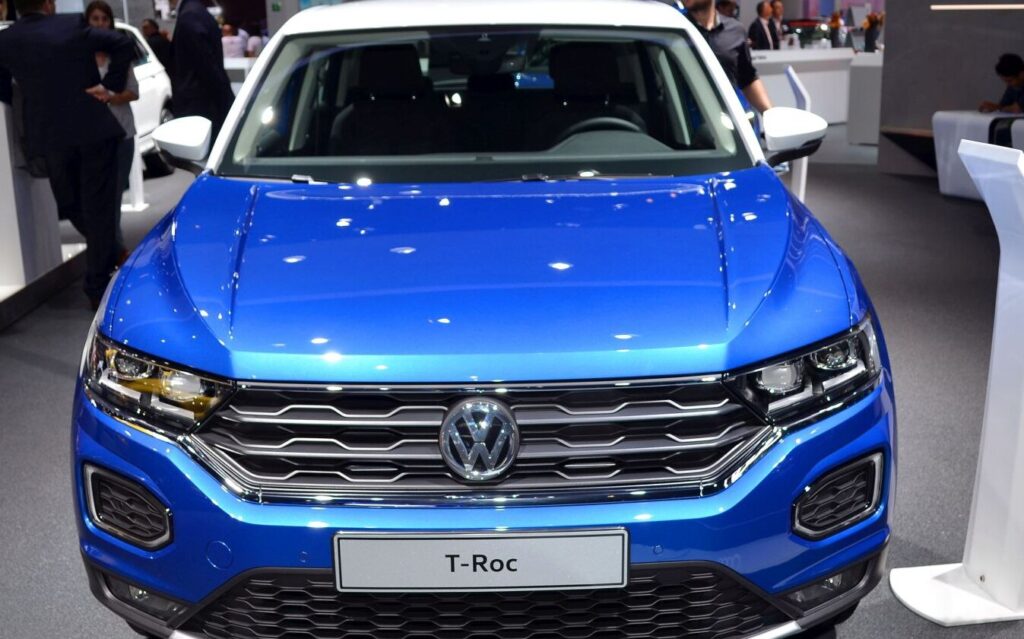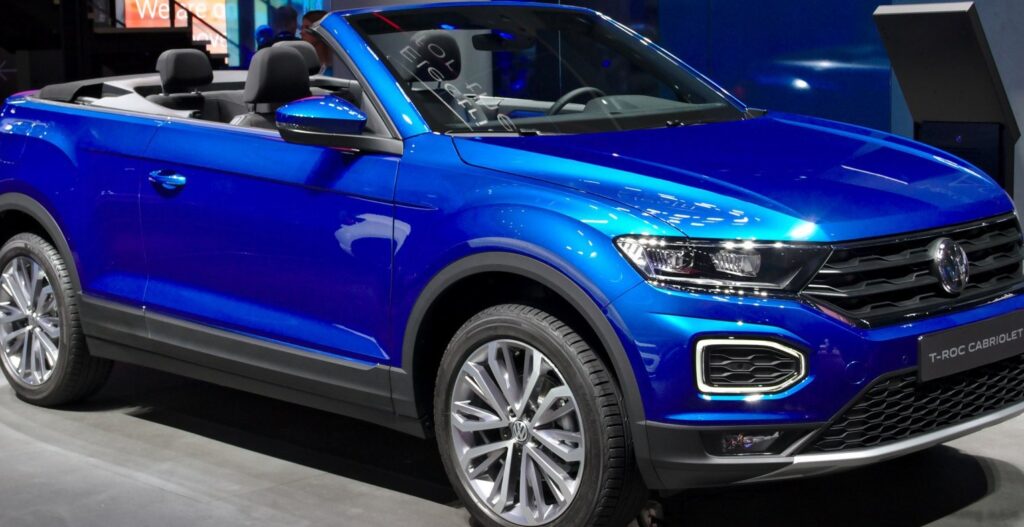
The Volkswagen T-Roc Cabriolet 1.5 TSI (150 hp) ACT OPF DSG represents a unique offering within the broader T-Roc range, produced from 2020 to October 2021. This variant combined the popular compact SUV silhouette with the open-air enjoyment of a convertible, targeting a market segment seeking a stylish and versatile vehicle. It’s built on the Volkswagen Group’s MQB A0 platform, shared with models like the Audi A1 and SEAT Ibiza, and positioned as a mid-range option within the T-Roc Cabriolet lineup, offering a balance between performance, fuel efficiency, and features. The “ACT” designation refers to Active Cylinder Technology, a fuel-saving feature, while “OPF” denotes the Otto Particulate Filter, a component designed to reduce particulate emissions, meeting stringent European emission standards.
Technical Specifications
| Brand | Volkswagen |
| Model | T-Roc |
| Generation | T-Roc I Cabriolet |
| Type (Engine) | 1.5 TSI (150 Hp) ACT OPF DSG |
| Start of production | 2020 |
| End of production | October, 2021 |
| Powertrain Architecture | Internal Combustion engine |
| Body type | Cabriolet, SUV |
| Seats | 4 |
| Doors | 2 |
| Fuel consumption at Low speed (WLTP) | 8.7 l/100 km (27 US mpg, 32.5 UK mpg, 11.5 km/l) |
| Fuel consumption at Medium speed (WLTP) | 6.5 l/100 km (36.2 US mpg, 43.5 UK mpg, 15.4 km/l) |
| Fuel consumption at high speed (WLTP) | 5.7 l/100 km (41.3 US mpg, 49.6 UK mpg, 17.5 km/l) |
| Fuel consumption at very high speed (WLTP) | 7.0 l/100 km (33.6 US mpg, 40.4 UK mpg, 14.3 km/l) |
| Combined fuel consumption (WLTP) | 6.7 l/100 km (35.1 US mpg, 42.2 UK mpg, 14.9 km/l) |
| CO2 emissions (WLTP) | 153 g/km |
| Fuel consumption (economy) – urban (NEDC) | 6.3-6.5 l/100 km (37.3 – 36.2 US mpg, 44.8 – 43.5 UK mpg, 15.9 – 15.4 km/l) |
| Fuel consumption (economy) – extra urban (NEDC) | 5.0-5.3 l/100 km (47 – 44.4 US mpg, 56.5 – 53.3 UK mpg, 20 – 18.9 km/l) |
| Fuel consumption (economy) – combined (NEDC) | 5.5-5.7 l/100 km (42.8 – 41.3 US mpg, 51.4 – 49.6 UK mpg, 18.2 – 17.5 km/l) |
| CO2 emissions (NEDC) | 126-131 g/km |
| Fuel Type | Petrol (Gasoline) |
| Acceleration 0 – 100 km/h | 9.5 sec |
| Acceleration 0 – 62 mph | 9.5 sec |
| Acceleration 0 – 60 mph | 9 sec (Calculated) |
| Maximum speed | 205 km/h (127.38 mph) |
| Emission standard | Euro 6d-ISC-FCM |
| Weight-to-power ratio | 9.8 kg/Hp, 102.4 Hp/tonne |
| Weight-to-torque ratio | 5.9 kg/Nm, 170.6 Nm/tonne |
| Power | 150 Hp @ 5000 rpm |
| Power per litre | 100.1 Hp/l |
| Torque | 250 Nm @ 1500-3500 rpm (184.39 lb.-ft. @ 1500-3500 rpm) |
| Engine layout | Front, Transverse |
| Engine Model/Code | DPCA |
| Engine displacement | 1498 cm3 (91.41 cu. in.) |
| Number of cylinders | 4 |
| Engine configuration | Inline |
| Number of valves per cylinder | 4 |
| Fuel injection system | Direct injection |
| Engine aspiration | Turbocharger, Intercooler |
| Engine oil capacity | 4.3 l (4.54 US qt, 3.78 UK qt) |
| Kerb Weight | 1465 kg (3229.77 lbs.) |
| Max. weight | 1900 kg (4188.78 lbs.) |
| Max load | 435 kg (959.01 lbs.) |
| Trunk (boot) space – minimum | 284 l (10.03 cu. ft.) |
| Fuel tank capacity | 50 l (13.21 US gal, 11 UK gal) |
| Permitted trailer load with brakes (8%) | 1700 kg (3747.86 lbs.) |
| Permitted trailer load with brakes (12%) | 1500 kg (3306.93 lbs.) |
| Permitted trailer load without brakes | 750 kg (1653.47 lbs.) |
| Permitted towbar download | 80 kg (176.37 lbs.) |
| Length | 4268 mm (168.03 in.) |
| Width | 1811 mm (71.3 in.) |
| Width including mirrors | 1998 mm (78.66 in.) |
| Height | 1522 mm (59.92 in.) |
| Wheelbase | 2630 mm (103.54 in.) |
| Front track | 1538-1546 mm (60.55 – 60.87 in.) |
| Rear (Back) track | 1539-1547 mm (60.59 – 60.91 in.) |
| Minimum turning circle | 11 m (36.09 ft.) |
| Drivetrain Architecture | Front wheel drive |
| Number of gears and type of gearbox | 7 gears, automatic transmission DSG |
| Front suspension | Independent type McPherson |
| Rear suspension | Independent multi-link suspension |
| Front brakes | Ventilated discs |
| Rear brakes | Disc |
| Assisting systems | ABS (Anti-lock braking system) |
| Steering type | Steering rack and pinion |
| Power steering | Electric Steering |
| Tires size | 215/55 R17 |
| Wheel rims size | 7J x 17 |
Powertrain & Engine Architecture
The heart of the T-Roc Cabriolet 1.5 TSI is the DPCA engine code, a 1.5-liter turbocharged inline-four cylinder gasoline engine. This engine is part of Volkswagen’s EA211 family, known for its compact design and efficiency. It utilizes direct fuel injection, delivering fuel directly into the combustion chamber for improved combustion and power output. A key feature is the Active Cylinder Technology (ACT), which can deactivate two cylinders under light load conditions to reduce fuel consumption. The engine also incorporates an intercooler to cool the intake air, increasing its density and further enhancing performance. The engine produces 150 horsepower at 5000 rpm and 250 Nm (184 lb-ft) of torque between 1500 and 3500 rpm. This power is delivered to the front wheels through a seven-speed dual-clutch transmission (DSG), known for its quick and smooth gear changes. The DSG transmission contributes to both performance and fuel efficiency.
Driving Characteristics
The 1.5 TSI with the DSG transmission provides a comfortable and responsive driving experience. Acceleration from 0 to 100 km/h (0-62 mph) takes approximately 9.5 seconds, which is adequate for everyday driving but doesn’t offer particularly sporty performance. The DSG transmission is well-tuned, providing seamless shifts and contributing to a smooth ride. Compared to a manual transmission version, the DSG offers convenience and ease of use, particularly in urban environments. However, some drivers may prefer the more engaging feel of a manual gearbox. The engine’s torque delivery is strong throughout the mid-range, making it easy to overtake and maintain speed on the highway. The ACT system is generally unobtrusive, and its fuel-saving benefits are noticeable during relaxed cruising.
Equipment & Trim Levels
The T-Roc Cabriolet 1.5 TSI typically came equipped with a good level of standard features. These included air conditioning, a touchscreen infotainment system with Apple CarPlay and Android Auto compatibility, alloy wheels, and a suite of safety features such as ABS, electronic stability control, and multiple airbags. Higher trim levels offered additional features like automatic climate control, a larger touchscreen display, navigation system, parking sensors, and upgraded interior upholstery. Optional extras included a panoramic sunroof, adaptive cruise control, and a premium sound system. Interior materials were generally of good quality, with a focus on practicality and durability.
Chassis & Braking
The T-Roc Cabriolet utilizes an independent McPherson strut suspension at the front and an independent multi-link suspension at the rear, providing a comfortable and controlled ride. The suspension is tuned to balance handling and comfort, making it suitable for both city driving and longer journeys. The braking system consists of ventilated discs at the front and solid discs at the rear, providing adequate stopping power. ABS (Anti-lock Braking System) is standard, enhancing safety during emergency braking situations. The steering is electrically assisted, offering a light and precise feel.
Market Reception & Comparison
The T-Roc Cabriolet 1.5 TSI was generally well-received by automotive critics, who praised its stylish design, comfortable ride, and fuel efficiency. However, some reviewers noted that the performance was not particularly exciting, and the rear seat space was limited. Compared to other T-Roc variants, the 1.5 TSI offered a good balance between performance and economy. The 1.0-liter TSI engine provided even better fuel economy but lacked the power of the 1.5-liter, while the more powerful 2.0-liter TSI offered more performance but at the expense of fuel efficiency. The 1.6 TDI diesel variant offered excellent fuel economy but was less refined than the gasoline engines.
Legacy
The Volkswagen T-Roc Cabriolet 1.5 TSI, while a relatively short-lived model, has established itself as a desirable and practical open-top SUV in the used car market. The 1.5 TSI engine and DSG transmission have proven to be generally reliable, although regular maintenance is essential. Common issues reported include occasional DSG transmission glitches and potential problems with the particulate filter, particularly on vehicles that have primarily been used for short journeys. Overall, the T-Roc Cabriolet 1.5 TSI remains a popular choice for buyers seeking a stylish, versatile, and relatively fuel-efficient convertible SUV.