
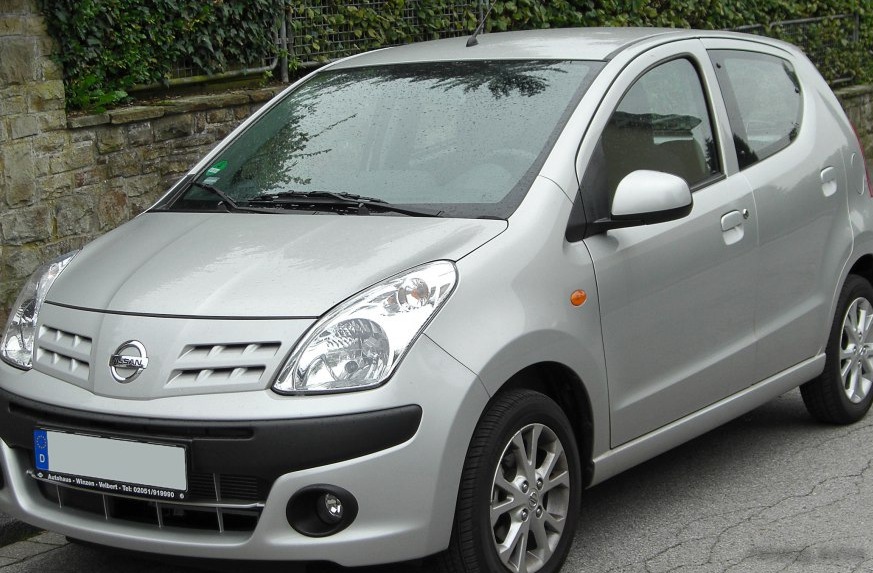
The Nissan Pixo 1.0, producing 68 horsepower, was a city car marketed primarily in Europe from June 2009 to October 2013. It represented Nissan’s entry into the ultra-compact segment, a market dominated by vehicles like the Fiat 500 and Toyota Aygo. The Pixo was essentially a rebadged Suzuki Alto (specifically the Japanese Kei car version), a result of a joint venture between Renault-Nissan and Suzuki. This collaboration allowed Nissan to offer an affordable and fuel-efficient vehicle without significant independent development costs. The Pixo occupied the entry-level position within Nissan’s European lineup, targeting buyers seeking a low-cost, economical, and easy-to-park vehicle for urban environments.
Technical Specifications
| Brand | Nissan |
| Model | Pixo |
| Generation | Pixo |
| Type (Engine) | 1.0 (68 Hp) |
| Start of production | June, 2009 |
| End of production | October, 2013 |
| Powertrain Architecture | Internal Combustion engine |
| Body type | Hatchback |
| Seats | 4 |
| Doors | 5 |
| Fuel consumption (urban) | 5.2 l/100 km (45.2 US mpg, 54.3 UK mpg, 19.2 km/l) |
| Fuel consumption (extra urban) | 3.8 l/100 km (61.9 US mpg, 74.3 UK mpg, 26.3 km/l) |
| Fuel consumption (combined) | 4.3 l/100 km (54.7 US mpg, 65.7 UK mpg, 23.3 km/l) |
| CO2 emissions | 99 g/km |
| Fuel Type | Petrol (Gasoline) |
| Acceleration 0 – 100 km/h | 14 sec |
| Acceleration 0 – 62 mph | 14 sec |
| Acceleration 0 – 60 mph | 13.3 sec |
| Maximum speed | 155 km/h (96.31 mph) |
| Emission standard | Euro 5 |
| Weight-to-power ratio | 13 kg/Hp, 76.8 Hp/tonne |
| Weight-to-torque ratio | 9.8 kg/Nm, 101.7 Nm/tonne |
| Power | 68 Hp @ 6000 rpm |
| Power per litre | 68.3 Hp/l |
| Torque | 90 Nm @ 3400 rpm (66.38 lb.-ft. @ 3400 rpm) |
| Engine layout | Front, Transverse |
| Engine Model/Code | K10B |
| Engine displacement | 996 cm3 (60.78 cu. in.) |
| Number of cylinders | 3 |
| Engine configuration | Inline |
| Cylinder Bore | 73 mm (2.87 in.) |
| Piston Stroke | 79.4 mm (3.13 in.) |
| Compression ratio | 11:1 |
| Number of valves per cylinder | 4 |
| Fuel injection system | Multi-port manifold injection |
| Engine aspiration | Naturally aspirated engine |
| Engine oil capacity | 3.1 l (3.28 US qt | 2.73 UK qt) |
| Coolant | 4.3 l (4.54 US qt | 3.78 UK qt) |
| Kerb Weight | 885 kg (1951.09 lbs.) |
| Max. weight | 1250 kg (2755.78 lbs.) |
| Max load | 365 kg (804.69 lbs.) |
| Trunk (boot) space – minimum | 129 l (4.56 cu. ft.) |
| Trunk (boot) space – maximum | 367 l (12.96 cu. ft.) |
| Fuel tank capacity | 35 l (9.25 US gal | 7.7 UK gal) |
| Max. roof load | 35 kg (77.16 lbs.) |
| Permitted trailer load with brakes (12%) | 200 kg (440.92 lbs.) |
| Permitted trailer load without brakes | 100 kg (220.46 lbs.) |
| Permitted towbar download | 50 kg (110.23 lbs.) |
| Length | 3565 mm (140.35 in.) |
| Width | 1600 mm (62.99 in.) |
| Height | 1470 mm (57.87 in.) |
| Wheelbase | 2360 mm (92.91 in.) |
| Front track | 1405 mm (55.31 in.) |
| Rear (Back) track | 1400 mm (55.12 in.) |
| Drag coefficient (Cd) | 0.3 |
| Drivetrain Architecture | The Internal combustion engine (ICE) drives the front wheels of the vehicle. |
| Drive wheel | Front wheel drive |
| Number of gears and type of gearbox | 5 gears, manual transmission |
| Front suspension | Independent type McPherson |
| Assisting systems | ABS (Anti-lock braking system) |
| Steering type | Steering rack and pinion |
| Power steering | Electric Steering |
| Tires size | 55/65 R14 |
| Wheel rims size | 4J x 14 |
Powertrain & Engine Architecture
The Nissan Pixo 1.0 was powered by the Suzuki K10B engine, a 996cc inline-three cylinder petrol engine. This engine was a staple in Suzuki’s Kei car lineup and known for its simplicity and fuel efficiency. The K10B utilizes a multi-point fuel injection system and a single overhead camshaft (SOHC) operating four valves per cylinder. The engine’s modest output of 68 horsepower at 6000 rpm and 90 Nm (66 lb-ft) of torque at 3400 rpm was sufficient for city driving but limited its performance on highways or when fully loaded. The Pixo exclusively came with a five-speed manual transmission in most European markets. This transmission was chosen to maximize fuel economy and keep costs down. The engine’s design prioritized reliability and low maintenance, making it a practical choice for budget-conscious buyers.
Driving Characteristics
The Pixo 1.0’s driving experience was defined by its lightweight construction and small engine. Acceleration was leisurely, taking approximately 14 seconds to reach 62 mph (100 km/h). The five-speed manual transmission required frequent shifting to maintain momentum, especially when climbing hills or overtaking. The gear ratios were optimized for fuel efficiency rather than performance. Steering was light and precise, making it easy to maneuver in tight urban spaces. The suspension, while basic, provided a reasonably comfortable ride on smooth roads. Compared to potential upgrades within a broader Nissan range, the Pixo lacked the power and refinement of larger-engined models like the Note or Micra. However, its nimble handling and low running costs made it a compelling option for those prioritizing practicality over performance.
Equipment & Trim Levels
The Nissan Pixo 1.0 was offered with a relatively basic level of equipment, reflecting its position as an entry-level vehicle. Standard features typically included power steering, central locking, electric front windows, and an ABS anti-lock braking system. Air conditioning was often an optional extra. Interior upholstery was typically cloth, and the dashboard featured a simple, functional design. Higher trim levels, if available, might have added features like alloy wheels, a CD player, and remote central locking. The focus was on providing essential features at an affordable price point.
Chassis & Braking
The Pixo’s chassis was a typical monocoque construction, prioritizing lightweight and rigidity. Front suspension utilized an independent McPherson strut setup, while the rear employed a torsion beam axle. Brakes were disc brakes on the front wheels and drum brakes on the rear, a cost-saving measure common in this segment. The steering system was a rack and pinion type with electric power assistance. The Pixo’s relatively low weight contributed to its nimble handling and acceptable braking performance for its class.
Market Reception & Comparison
The Nissan Pixo 1.0 was generally well-received by critics as an affordable and fuel-efficient city car. Its low price, combined with its compact size and ease of parking, made it a popular choice for urban dwellers. However, its limited performance and basic equipment levels were often noted. Compared to rivals like the Fiat 500 and Toyota Aygo, the Pixo offered a more utilitarian experience, prioritizing practicality over style and refinement. Its fuel economy was competitive, and its reliability was generally good, thanks to the proven Suzuki K10B engine.
Legacy
The Nissan Pixo, while not a groundbreaking vehicle, served as a valuable entry point into the Nissan brand for many European buyers. The K10B engine proved to be a durable and reliable unit, and many examples remain on the road today. In the used car market, the Pixo 1.0 is known for its low running costs and affordability. While it may not offer the performance or features of more modern city cars, its simplicity and practicality continue to appeal to those seeking a basic, economical, and reliable mode of transportation. The Pixo’s success demonstrated the viability of the ultra-compact car segment and paved the way for future Nissan models in this category.
