
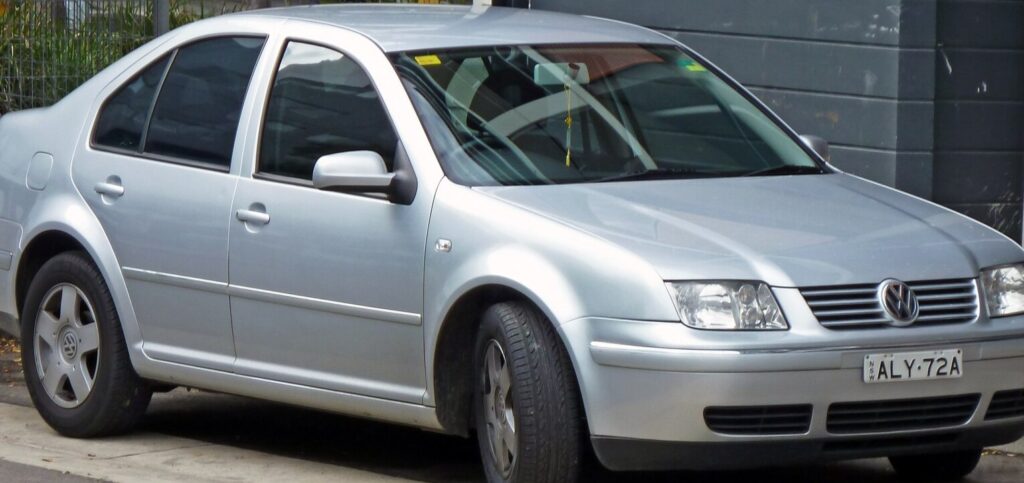
The Volkswagen Bora 2.0 (115 hp) 4MOTION, produced between 2000 and 2003, represented a compelling all-wheel-drive option within the Bora (1J2) lineup. Positioned as a mid-range offering, it bridged the gap between the more economical base models and the performance-oriented variants. The Bora itself was Volkswagen’s replacement for the Jetta in Europe, sharing its platform (the 1HX0/A3) with the Golf Mk4, Audi A3, and SEAT Leon. This variant aimed to provide enhanced traction and stability, particularly appealing to drivers in regions experiencing inclement weather or seeking added security. It was primarily sold in Europe and other markets where compact sedans with all-wheel drive were in demand.
Technical Specifications
| Brand | Volkswagen |
| Model | Bora |
| Generation | Bora (1J2) |
| Type (Engine) | 2.0 (115 Hp) 4MOTION |
| Start of production | 2000 year |
| End of production | 2003 year |
| Powertrain Architecture | Internal Combustion engine |
| Body type | Sedan |
| Seats | 5 |
| Doors | 4 |
| Fuel consumption (economy) – urban | 11.7 l/100 km (20.1 US mpg, 24.1 UK mpg, 8.5 km/l) |
| Fuel consumption (economy) – extra urban | 7 l/100 km (33.6 US mpg, 40.4 UK mpg, 14.3 km/l) |
| Fuel consumption (economy) – combined | 8.8 l/100 km (26.7 US mpg, 32.1 UK mpg, 11.4 km/l) |
| CO2 emissions | 211 g/km |
| Fuel Type | Petrol (Gasoline) |
| Acceleration 0 – 100 km/h | 11.7 sec |
| Acceleration 0 – 62 mph | 11.7 sec |
| Acceleration 0 – 60 mph | 11.1 sec |
| Maximum speed | 192 km/h (119.3 mph) |
| Emission standard | Euro 4 |
| Weight-to-power ratio | 11.8 kg/Hp, 84.9 Hp/tonne |
| Weight-to-torque ratio | 7.9 kg/Nm, 127 Nm/tonne |
| Power | 115 Hp @ 5400 rpm |
| Power per litre | 58 Hp/l |
| Torque | 172 Nm @ 3200 rpm (126.86 lb.-ft. @ 3200 rpm) |
| Engine layout | Front, Transverse |
| Engine Model/Code | APK, AQY |
| Engine displacement | 1984 cm3 (121.07 cu. in.) |
| Number of cylinders | 4 |
| Engine configuration | Inline |
| Cylinder Bore | 82.5 mm (3.25 in.) |
| Piston Stroke | 92.8 mm (3.65 in.) |
| Compression ratio | 10:1 |
| Number of valves per cylinder | 2 |
| Fuel injection system | Multi-port manifold injection |
| Engine aspiration | Naturally aspirated engine |
| Valvetrain | OHC |
| Engine oil capacity | 4 l (4.23 US qt | 3.52 UK qt) |
| Coolant | 5 l (5.28 US qt | 4.4 UK qt) |
| Kerb Weight | 1354 kg (2985.06 lbs.) |
| Max. weight | 1900 kg (4188.78 lbs.) |
| Max load | 546 kg (1203.72 lbs.) |
| Trunk (boot) space – minimum | 340 l (12.01 cu. ft.) |
| Trunk (boot) space – maximum | 670 l (23.66 cu. ft.) |
| Fuel tank capacity | 63 l (16.64 US gal | 13.86 UK gal) |
| Max. roof load | 75 kg (165.35 lbs.) |
| Permitted trailer load with brakes (12%) | 1400 kg (3086.47 lbs.) |
| Permitted trailer load without brakes | 650 kg (1433 lbs.) |
| Permitted towbar download | 75 kg (165.35 lbs.) |
| Length | 4376 mm (172.28 in.) |
| Width | 1735 mm (68.31 in.) |
| Width including mirrors | 2018 mm (79.45 in.) |
| Height | 1446 mm (56.93 in.) |
| Wheelbase | 2519 mm (99.17 in.) |
| Front track | 1513 mm (59.57 in.) |
| Rear (Back) track | 1494 mm (58.82 in.) |
| Minimum turning circle (turning diameter) | 10.9 m (35.76 ft.) |
| Drive wheel | All wheel drive (4×4) |
| Number of gears and type of gearbox | 5 gears, manual transmission |
| Front suspension | Independent, type McPherson with coil spring and anti-roll bar |
| Rear suspension | Semi-independent, coil spring |
| Front brakes | Ventilated discs |
| Rear brakes | Disc |
| Assisting systems | ABS (Anti-lock braking system) |
| Steering type | Steering rack and pinion |
| Power steering | Hydraulic Steering |
| Tires size | 195/65 R15 |
| Wheel rims size | 15 |
Powertrain & Engine Architecture
The Bora 2.0 4MOTION utilized the Volkswagen Group’s APK or AQY engine code, a 1.984-liter inline-four cylinder gasoline engine. This engine featured multi-port fuel injection and a single overhead camshaft (OHC) valvetrain with two valves per cylinder. The engine’s design prioritized reliability and fuel efficiency over outright performance. The 4MOTION system employed a viscous coupling to distribute power between the front and rear axles, providing all-wheel drive capability without the complexity of more advanced systems. The standard transmission was a five-speed manual, although an optional four-speed automatic transmission was available. The automatic, while offering convenience, did impact acceleration and fuel economy compared to the manual version.
Driving Characteristics
The 115 hp output and 172 Nm (126.86 lb-ft) of torque delivered by the 2.0-liter engine, coupled with the all-wheel-drive system, resulted in a competent but not particularly sporty driving experience. Acceleration from 0-60 mph took around 11.1 seconds, and top speed was approximately 119.3 mph. The 4MOTION system provided noticeably improved traction, especially on slippery surfaces, making it a safer and more confident vehicle in adverse weather conditions. The automatic transmission, while smooth, had relatively long gear ratios, which contributed to a somewhat sluggish feel during acceleration. Compared to the higher-output 1.8T or VR6 versions of the Bora, this variant offered less exhilarating performance but a more economical and predictable driving experience.
Equipment & Trim Levels
The Bora 2.0 4MOTION typically came equipped with features such as power windows, central locking, and an anti-lock braking system (ABS). Interior upholstery was generally cloth, with options for upgraded materials. Depending on the market and optional packages, features like air conditioning, a radio/cassette player, and alloy wheels could be added. The trim level often included body-colored bumpers and side mirrors. The focus was on providing a well-equipped, practical, and safe vehicle rather than a luxurious one.
Chassis & Braking
The Bora 2.0 4MOTION utilized an independent McPherson strut suspension at the front and a semi-independent coil spring suspension at the rear. This setup provided a reasonable balance between ride comfort and handling. The braking system consisted of ventilated discs at the front and solid discs at the rear, providing adequate stopping power for the vehicle’s weight and performance. The all-wheel-drive system added weight, which slightly impacted handling agility compared to front-wheel-drive Boras.
Market Reception & Comparison
The Bora 2.0 4MOTION was generally well-received as a practical and safe all-weather vehicle. Critics praised its improved traction and stability, particularly in comparison to front-wheel-drive competitors. However, the relatively modest power output and the availability of more exciting engine options within the Bora range meant it wasn’t always the first choice for driving enthusiasts. Fuel economy was reasonable for its class, but not exceptional. Compared to the 1.8T models, the 2.0 4MOTION offered less performance but greater reliability and potentially lower maintenance costs. The 1.9 TDI diesel variants were also popular, offering superior fuel economy but a different driving experience.
Legacy
The Volkswagen Bora 2.0 4MOTION has proven to be a relatively reliable vehicle, with the 2.0-liter engine and 4MOTION system generally holding up well over time. However, like all vehicles of this age, regular maintenance is crucial to prevent issues. Common problems can include wear and tear on suspension components, corrosion, and occasional issues with the automatic transmission. In the used car market, these Boras are often sought after by buyers looking for a dependable and capable all-wheel-drive sedan at an affordable price. While not a collector’s item, it remains a practical and appreciated vehicle for those needing all-weather capability.
