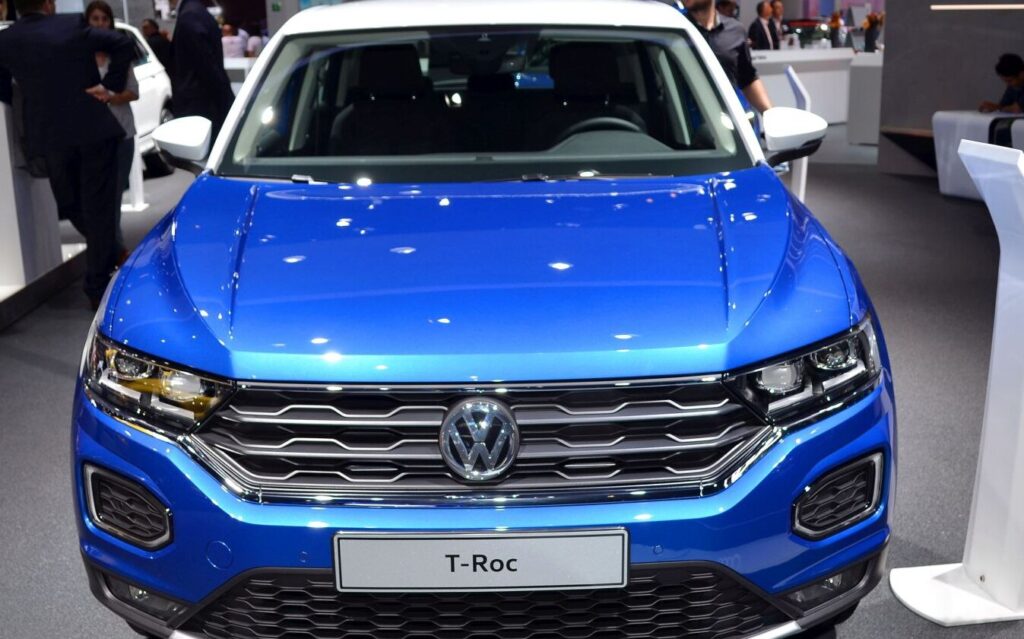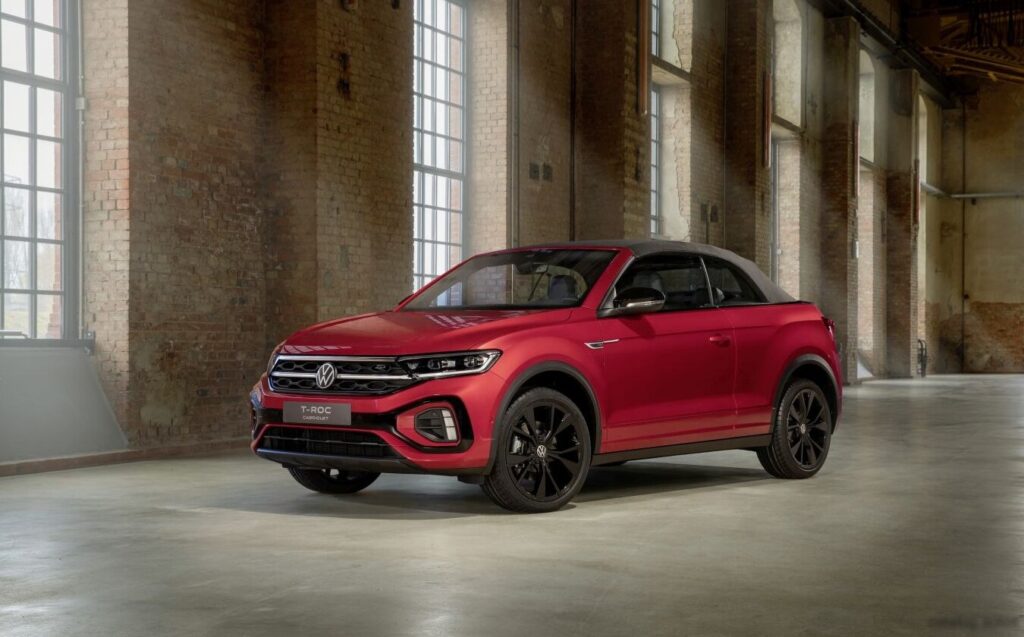
The Volkswagen T-Roc Cabriolet, introduced in 2020, brought open-top motoring to Volkswagen’s popular subcompact SUV range. The facelifted version, launched in March 2022, refined the styling and technology of the original. Among the engine options available was the 1.0 TSI, producing 110 horsepower. This variant occupied the entry-level position in the T-Roc Cabriolet lineup, aimed at buyers prioritizing fuel efficiency and affordability over outright performance. Production of this specific configuration continued through 2024, catering primarily to the European market where compact convertibles remain a popular choice.
Technical Specifications
| Brand | Volkswagen |
| Model | T-Roc |
| Generation | T-Roc I Cabriolet (facelift 2022) |
| Type (Engine) | 1.0 TSI (110 Hp) |
| Start of production | March, 2022 |
| End of production | 2024 |
| Powertrain Architecture | Internal Combustion engine |
| Body type | Cabriolet, SUV |
| Seats | 4 |
| Doors | 2 |
| Fuel consumption at Low speed (WLTP) | 7.8 l/100 km (30.2 US mpg, 36.2 UK mpg, 12.8 km/l) |
| Fuel consumption at Medium speed (WLTP) | 6.1 l/100 km (38.6 US mpg, 46.3 UK mpg, 16.4 km/l) |
| Fuel consumption at high speed (WLTP) | 5.4 l/100 km (43.6 US mpg, 52.3 UK mpg, 18.5 km/l) |
| Fuel consumption at very high speed (WLTP) | 6.5 l/100 km (36.2 US mpg, 43.5 UK mpg, 15.4 km/l) |
| Combined fuel consumption (WLTP) | 6.3 l/100 km (37.3 US mpg, 44.8 UK mpg, 15.9 km/l) |
| CO2 emissions (WLTP) | 142 g/km |
| Fuel consumption (economy) – urban (NEDC) | 6.5 l/100 km (36.2 US mpg, 43.5 UK mpg, 15.4 km/l) |
| Fuel consumption (economy) – extra urban (NEDC) | 4.8 l/100 km (49 US mpg, 58.9 UK mpg, 20.8 km/l) |
| Fuel consumption (economy) – combined (NEDC) | 5.4 l/100 km (43.6 US mpg, 52.3 UK mpg, 18.5 km/l) |
| CO2 emissions (NEDC) | 124 g/km |
| Fuel Type | Petrol (Gasoline) |
| Acceleration 0 – 100 km/h | 12.3 sec |
| Acceleration 0 – 62 mph | 12.3 sec |
| Acceleration 0 – 60 mph | 11.7 sec |
| Maximum speed | 185 km/h (114.95 mph) |
| Emission standard | EURO 6d-ISC FCM |
| Weight-to-power ratio | 13.6 kg/Hp, 73.5 Hp/tonne |
| Weight-to-torque ratio | 6.8 kg/Nm, 147.1 Nm/tonne |
| Power | 110 Hp @ 5000 rpm |
| Power per litre | 110.1 Hp/l |
| Torque | 220 Nm @ 2000-3000 rpm (162.26 lb.-ft. @ 2000-3000 rpm) |
| Engine layout | Front, Transverse |
| Engine displacement | 999 cm3 (60.96 cu. in.) |
| Number of cylinders | 3 |
| Engine configuration | Inline |
| Number of valves per cylinder | 4 |
| Fuel injection system | Direct injection |
| Engine aspiration | Turbocharger, Intercooler |
| Valvetrain | DOHC |
| Kerb Weight | 1496 kg (3298.12 lbs.) |
| Max. weight | 1860 kg (4100.6 lbs.) |
| Max load | 364 kg (802.48 lbs.) |
| Trunk (boot) space – minimum | 284 l (10.03 cu. ft.) |
| Fuel tank capacity | 50 l (13.21 US gal | 11 UK gal) |
| Permitted trailer load with brakes (8%) | 1500 kg (3306.93 lbs.) |
| Permitted trailer load with brakes (12%) | 1300 kg (2866.01 lbs.) |
| Permitted trailer load without brakes | 740 kg (1631.42 lbs.) |
| Permitted towbar download | 80 kg (176.37 lbs.) |
| Length | 4271-4286 mm (168.15 – 168.74 in.) |
| Width | 1811 mm (71.3 in.) |
| Height | 1527 mm (60.12 in.) |
| Wheelbase | 2630 mm (103.54 in.) |
| Front track | 1538-1548 mm (60.55 – 60.94 in.) |
| Rear (Back) track | 1541-1551 mm (60.67 – 61.06 in.) |
| Minimum turning circle (turning diameter) | 10.9 m (35.76 ft.) |
| Drivetrain Architecture | The Internal combustion engine (ICE) drives the front wheels of the vehicle. |
| Drive wheel | Front wheel drive |
| Number of gears and type of gearbox | 6 gears, manual transmission |
| Front suspension | Independent, type McPherson with coil spring and anti-roll bar |
| Rear suspension | Semi-dependent beam with stabilizer lateral stability |
| Front brakes | Ventilated discs |
| Rear brakes | Disc |
| Assisting systems | ABS (Anti-lock braking system) |
| Steering type | Steering rack and pinion |
| Power steering | Electric Steering |
| Tires size | 215/55 R17; 215/50 R18; 255/40 R19 |
| Wheel rims size | 7J x 17; 7J x 18; 8J x 19 |
Powertrain & Engine Architecture
The 1.0 TSI engine powering this T-Roc Cabriolet is a three-cylinder, turbocharged gasoline engine, identified by engine code DJH. This engine is part of Volkswagen’s EA211 family, known for its compact size and efficiency. It utilizes direct fuel injection, delivering fuel directly into the combustion chamber for improved combustion control and power output. The engine features a single scroll turbocharger with an intercooler to manage intake air temperature. The valvetrain employs a dual overhead camshaft (DOHC) configuration with four valves per cylinder, optimizing gas flow for enhanced performance. The 1.0 TSI is paired with a six-speed manual transmission, sending power to the front wheels. This transmission was chosen to balance fuel economy with acceptable performance for the vehicle’s intended use.
Driving Characteristics
The 110 horsepower and 220 Nm (162 lb-ft) of torque produced by the 1.0 TSI engine in the T-Roc Cabriolet provide adequate, though not exhilarating, performance. Acceleration from 0 to 100 km/h (0-62 mph) takes around 12.3 seconds. The engine feels responsive at lower RPMs thanks to the turbocharger, but power does taper off as the revs climb. The six-speed manual transmission is well-matched to the engine’s characteristics, allowing drivers to keep the engine in its optimal power band. Compared to higher-output versions of the T-Roc, such as those with the 1.5 TSI engine, this variant feels noticeably slower, particularly during overtaking maneuvers. However, the 1.0 TSI prioritizes fuel efficiency, offering a more economical driving experience.
Equipment & Trim Levels
The 1.0 TSI Cabriolet typically came equipped with a reasonable level of standard features. These included air conditioning, a touchscreen infotainment system with Apple CarPlay and Android Auto compatibility, alloy wheels, and a suite of safety features like ABS, electronic stability control, and multiple airbags. Interior upholstery was typically cloth, with options for upgraded materials available. Higher trim levels added features such as automatic climate control, parking sensors, a rearview camera, and more advanced infotainment options. The overall interior design was modern and functional, reflecting Volkswagen’s typically understated aesthetic.
Chassis & Braking
The T-Roc Cabriolet utilizes a front-wheel-drive chassis with independent McPherson strut suspension at the front and a semi-independent torsion beam setup at the rear. This suspension configuration provides a comfortable ride quality, suitable for everyday driving. The front brakes are ventilated discs, while the rear brakes are solid discs. The steering is electrically assisted, providing light and precise control. Stabilizer bars are fitted to both the front and rear axles to reduce body roll during cornering. The chassis was tuned to prioritize comfort and stability over sporty handling, reflecting the car’s intended role as a stylish and practical open-top SUV.
Market Reception & Comparison
The 1.0 TSI T-Roc Cabriolet was generally well-received by critics as an affordable and fuel-efficient entry point into the T-Roc Cabriolet range. It was praised for its stylish design and comfortable ride. However, some reviewers noted that the engine lacked the punch of more powerful options. Compared to the 1.5 TSI variant, the 1.0 TSI offered significantly lower running costs but at the expense of performance. In terms of reliability, the EA211 engine family has proven to be generally robust, although some owners have reported issues with the timing chain. Overall, the 1.0 TSI offered a compelling package for buyers seeking a stylish and economical open-top SUV.
Legacy
The 1.0 TSI engine has become a mainstay in Volkswagen’s lineup, known for its fuel efficiency and relatively low maintenance costs. The T-Roc Cabriolet, while a niche model, has proven popular in Europe, offering a unique combination of practicality and open-air enjoyment. On the used car market, the 1.0 TSI variants tend to be more affordable than their higher-powered counterparts, making them an attractive option for budget-conscious buyers. With proper maintenance, the 1.0 TSI engine is expected to provide reliable service for many years, solidifying its position as a sensible and economical choice in the compact SUV segment.