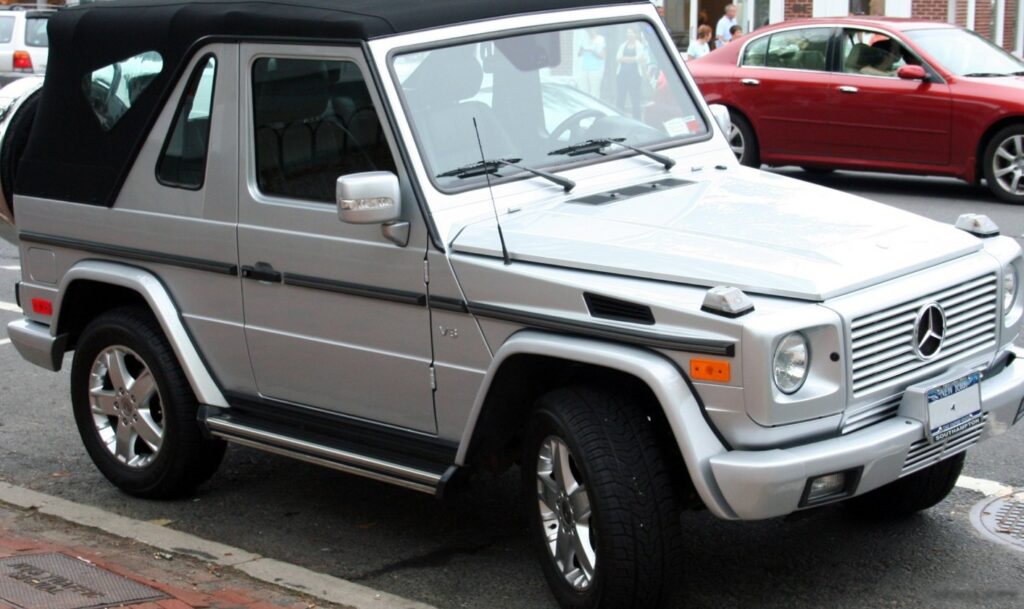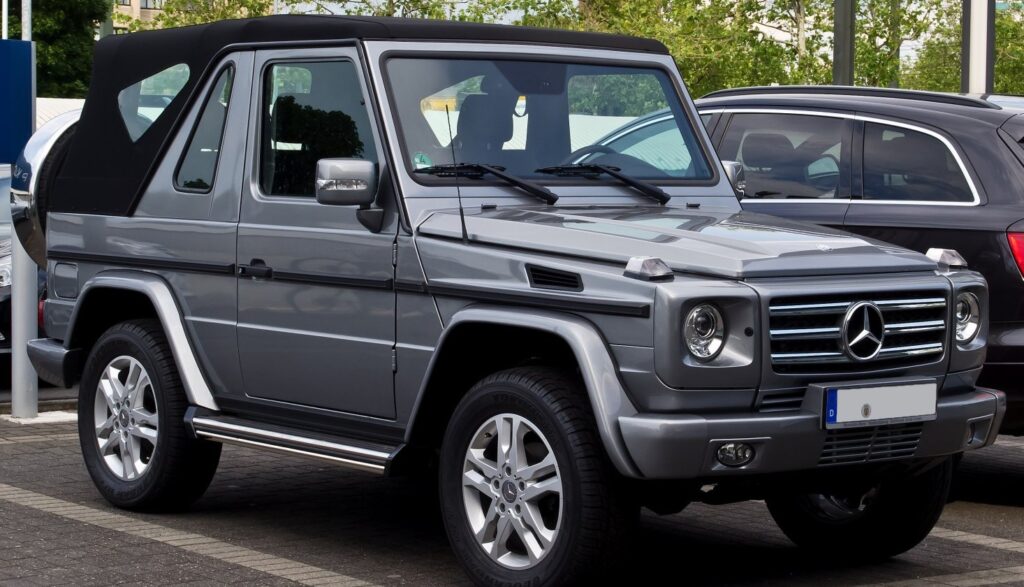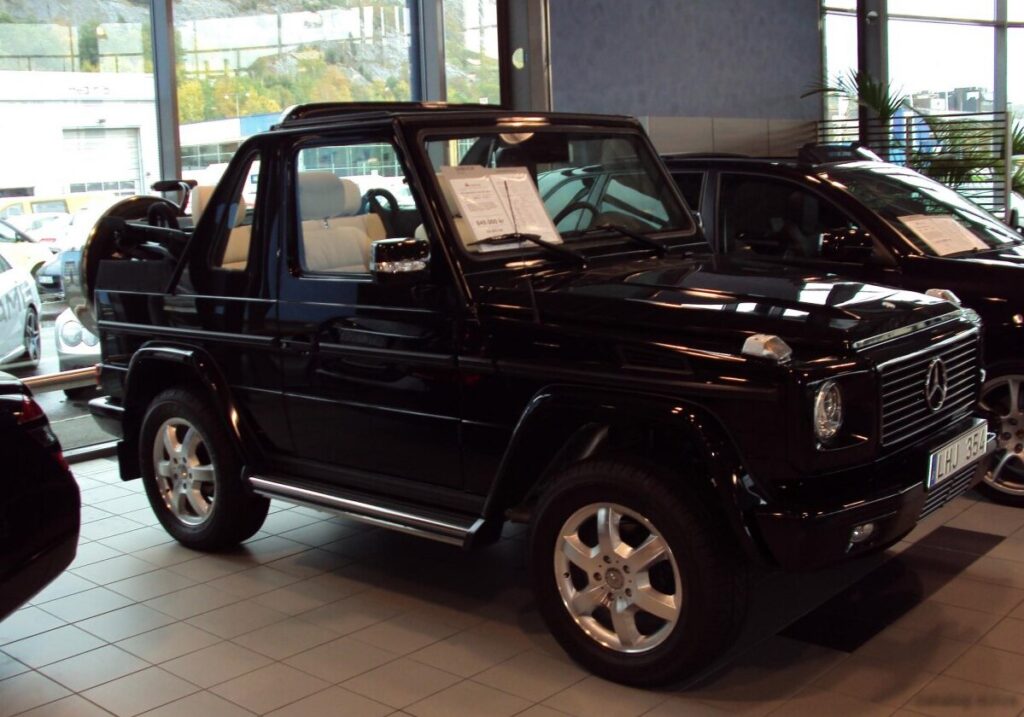
The Mercedes-Benz G-Class Cabriolet G 320 CDI, produced from April 2007 to June 2008, represents a unique blend of luxury, off-road capability, and open-air motoring within the iconic G-Wagen lineage. Falling within the W463 facelift generation, this variant offered a diesel-powered alternative to the gasoline models, appealing to buyers seeking both performance and fuel efficiency. Positioned as a mid-range offering in the Cabriolet lineup, it slotted between the base G 320 and the higher-performance G 55 AMG, providing a compelling option for those prioritizing torque and practicality. The G 320 CDI combined the G-Class’s legendary robustness with a more economical engine, making it a surprisingly versatile vehicle.
Technical Specifications
| Brand | Mercedes-Benz |
| Model | G-class |
| Generation | G-class Cabriolet (W463, facelift 2007) |
| Type (Engine) | G 320 CDI V6 (224 Hp) 4MATIC 7G-TRONIC |
| Start of production | April, 2007 |
| End of production | June, 2008 |
| Powertrain Architecture | Internal Combustion engine |
| Body type | Off-road vehicle, Cabriolet |
| Seats | 4 |
| Doors | 2 |
| Fuel consumption (economy) – urban (NEDC) | 13.4 l/100 km (17.6 US mpg, 21.1 UK mpg, 7.5 km/l) |
| Fuel consumption (economy) – extra urban (NEDC) | 9.7 l/100 km (24.2 US mpg, 29.1 UK mpg, 10.3 km/l) |
| Fuel consumption (economy) – combined (NEDC) | 11 l/100 km (21.4 US mpg, 25.7 UK mpg, 9.1 km/l) |
| CO2 emissions (NEDC) | 302 g/km |
| Fuel Type | Diesel |
| Acceleration 0 – 100 km/h | 8.8 sec |
| Acceleration 0 – 62 mph | 8.8 sec |
| Acceleration 0 – 60 mph | 8.4 sec |
| Maximum speed | 177 km/h (109.98 mph) |
| Emission standard | Euro 4 |
| Weight-to-power ratio | 9.8 kg/Hp, 102.5 Hp/tonne |
| Weight-to-torque ratio | 4 kg/Nm, 247.1 Nm/tonne |
| Power | 224 Hp @ 3800 rpm |
| Power per litre | 75 Hp/l |
| Torque | 540 Nm @ 1600-2400 rpm (398.28 lb.-ft. @ 1600-2400 rpm) |
| Maximum engine speed | 4400 rpm |
| Engine layout | Front, Longitudinal |
| Engine Model/Code | OM 642.970 |
| Engine displacement | 2987 cm3 (182.28 cu. in.) |
| Number of cylinders | 6 |
| Engine configuration | V-engine |
| Cylinder Bore | 83 mm (3.27 in.) |
| Piston Stroke | 92 mm (3.62 in.) |
| Compression ratio | 17.7:1 |
| Number of valves per cylinder | 4 |
| Fuel injection system | Diesel Commonrail |
| Engine aspiration | Turbocharger, Intercooler |
| Valvetrain | DOHC |
| Engine oil capacity | 8.5 l (8.98 US qt | 7.48 UK qt) |
| Coolant | 11.6 l (12.26 US qt | 10.21 UK qt) |
| Kerb Weight | 2185 kg (4817.1 lbs.) |
| Max. weight | 2850 kg (6283.17 lbs.) |
| Max load | 665 kg (1466.07 lbs.) |
| Trunk (boot) space – minimum | 238 l (8.4 cu. ft.) |
| Trunk (boot) space – maximum | 1580 l (55.8 cu. ft.) |
| Fuel tank capacity | 96 l (25.36 US gal | 21.12 UK gal) |
| Permitted trailer load with brakes (12%) | 2850 kg (6283.17 lbs.) |
| Permitted trailer load without brakes | 750 kg (1653.47 lbs.) |
| Permitted towbar download | 115 kg (253.53 lbs.) |
| Length | 4257 mm (167.6 in.) |
| Width | 1760 mm (69.29 in.) |
| Width including mirrors | 2007 mm (79.02 in.) |
| Height | 1941 mm (76.42 in.) |
| Wheelbase | 2400 mm (94.49 in.) |
| Front track | 1470 mm (57.87 in.) |
| Rear (Back) track | 1470 mm (57.87 in.) |
| Ride height (ground clearance) | 205 mm (8.07 in.) |
| Minimum turning circle (turning diameter) | 11.3 m (37.07 ft.) |
| Approach angle | 34° |
| Departure angle | 26° |
| Ramp-over (brakeover) angle | 23° |
| Climb angle | 38.7° |
| Wading depth | 500 mm (19.69 in.) |
| Drivetrain Architecture | The Internal combustion engine (ICE) drives permanently the four wheels of the vehicle. |
| Drive wheel | All wheel drive (4×4) |
| Number of gears and type of gearbox | 7 gears, automatic transmission G-TRONIC |
| Front suspension | Coil spring, Rigid axle suspension, Trailing arm |
| Rear suspension | Rigid axle suspension, Trailing arm, Coil spring |
| Front brakes | Ventilated discs |
| Rear brakes | Disc |
Powertrain & Engine Architecture
The G 320 CDI Cabriolet was powered by the OM 642.970 3.0-liter V6 turbodiesel engine. This engine, a mainstay in many Mercedes-Benz vehicles of the era, was known for its robust construction and ample torque. It featured a common rail direct injection system, delivering fuel at extremely high pressures for optimized combustion. The engine utilized a single turbocharger with an intercooler to boost power and efficiency. The valvetrain employed a double overhead camshaft (DOHC) design with four valves per cylinder, contributing to improved breathing and performance. Paired with the engine was the 7G-TRONIC seven-speed automatic transmission, offering smooth and efficient gear changes. This transmission was a significant upgrade over older automatic gearboxes, providing closer gear ratios and a more responsive driving experience. The 7G-TRONIC also featured a manual shift mode for greater driver control.
Driving Characteristics
The G 320 CDI Cabriolet offered a unique driving experience. While not as overtly powerful as the G 55 AMG, the diesel engine’s 540 Nm (398 lb-ft) of torque provided strong acceleration and effortless cruising. The 7G-TRONIC transmission was well-matched to the engine, delivering smooth shifts and keeping the engine in its optimal power band. The gear ratios were tuned for both on-road comfort and off-road capability. Compared to the gasoline-powered G 320, the CDI offered superior fuel economy and a more relaxed driving style. However, the diesel engine did exhibit some turbo lag at lower RPMs, and the engine wasn’t as eager to rev as its gasoline counterpart. The G-Class’s inherent characteristics – its boxy shape, high center of gravity, and solid-axle suspension – resulted in a ride that was firm but stable, both on and off-road.
Equipment & Trim Levels
The G 320 CDI Cabriolet came standard with a comprehensive list of features, befitting its luxury status. Interior appointments included leather upholstery, wood trim, and automatic climate control. Standard safety features included ABS brakes, traction control, and multiple airbags. Optional extras included a premium sound system, navigation system, heated seats, and a sunroof. The Cabriolet’s soft top was fully automatic and could be raised or lowered at the touch of a button. The interior layout was functional and utilitarian, reflecting the G-Class’s origins as a military vehicle, but with a touch of Mercedes-Benz refinement.
Chassis & Braking
The G 320 CDI Cabriolet retained the G-Class’s traditional ladder-frame chassis, providing exceptional strength and durability. The suspension consisted of rigid axles with coil springs and shock absorbers, offering a good balance between on-road comfort and off-road articulation. The braking system featured ventilated discs at the front and solid discs at the rear, providing adequate stopping power for the vehicle’s weight. ABS brakes were standard, enhancing stability during emergency braking. The steering system was a recirculating ball system, providing a direct and precise feel.
Market Reception & Comparison
The G 320 CDI Cabriolet was generally well-received by critics, who praised its combination of luxury, off-road capability, and fuel efficiency. It was seen as a more practical alternative to the gasoline-powered G-Class models, particularly for those who frequently drove long distances. Compared to the G 320, the CDI offered better fuel economy and more torque. Compared to the G 55 AMG, it was less powerful but more affordable and economical to operate. However, some critics noted the diesel engine’s lack of refinement compared to its gasoline counterparts.
Legacy
The OM 642 engine family, including the OM 642.970 found in the G 320 CDI, is known for its durability and longevity. With proper maintenance, these engines can reliably exceed 200,000 miles. The G 320 CDI Cabriolet has become a sought-after vehicle in the used car market, particularly among enthusiasts who appreciate its unique combination of features and its iconic G-Class styling. Parts availability is generally good, although some specialized components may be difficult to find. The G 320 CDI represents a sweet spot in the G-Class lineage, offering a blend of classic G-Wagen character and modern refinement.