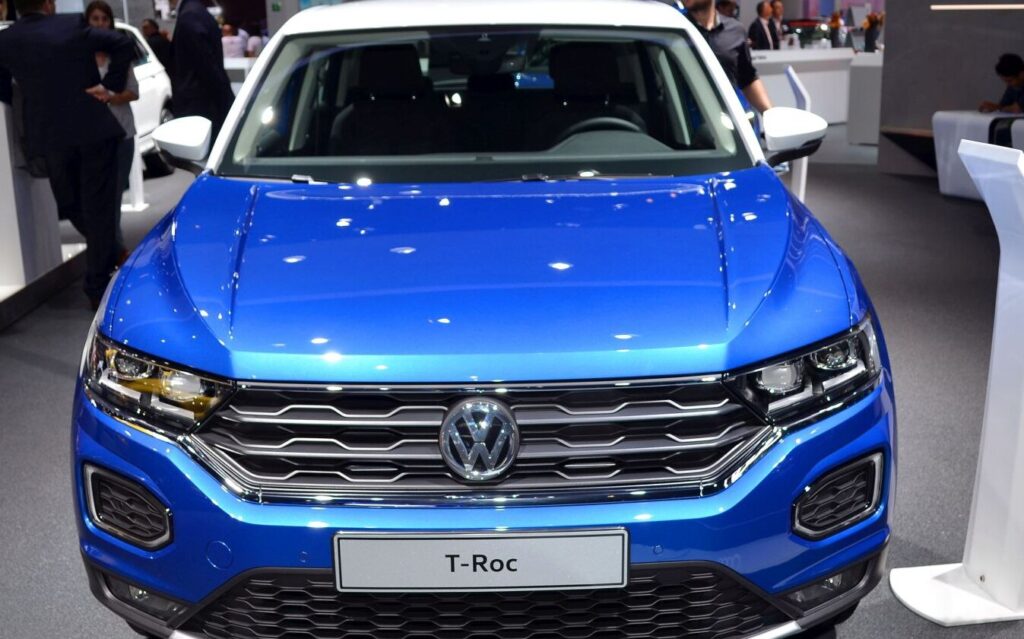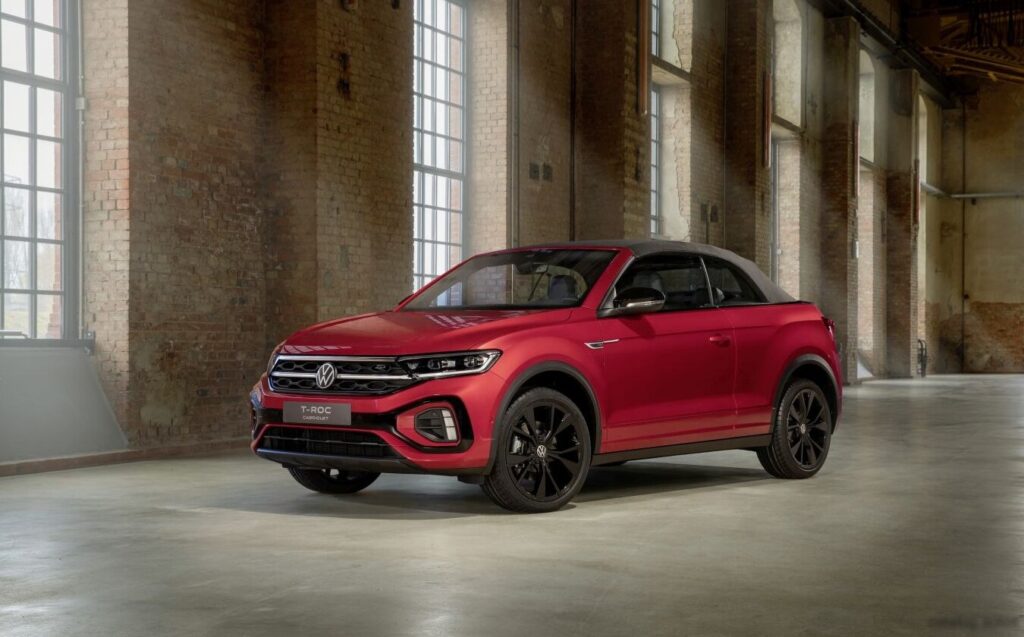
The Volkswagen T-Roc Cabriolet, introduced in 2020, brought open-top motoring to Volkswagen’s popular subcompact SUV range. The facelifted model, launched in March 2022, refined the design and technology of the original. Among the engine options available, the 1.5 TSI producing 150 horsepower became a significant offering, particularly in European markets. This variant aimed to balance performance with fuel efficiency, appealing to buyers seeking a stylish and practical convertible SUV. It sat in the mid-range of the T-Roc Cabriolet lineup, offering more power than the base engine while remaining more accessible than the higher-output versions.
Technical Specifications
| Brand | Volkswagen |
| Model | T-Roc |
| Generation | T-Roc I Cabriolet (facelift 2022) |
| Type (Engine) | 1.5 TSI (150 Hp) |
| Start of production | March, 2022 |
| Powertrain Architecture | Internal Combustion engine |
| Body type | Cabriolet, SUV |
| Seats | 4 |
| Doors | 2 |
| Fuel consumption at Low speed (WLTP) | 8 l/100 km (29.4 US mpg, 35.3 UK mpg, 12.5 km/l) |
| Fuel consumption at Medium speed (WLTP) | 6.1 l/100 km (38.6 US mpg, 46.3 UK mpg, 16.4 km/l) |
| Fuel consumption at high speed (WLTP) | 5.4 l/100 km (43.6 US mpg, 52.3 UK mpg, 18.5 km/l) |
| Fuel consumption at very high speed (WLTP) | 6.4 l/100 km (36.8 US mpg, 44.1 UK mpg, 15.6 km/l) |
| Combined fuel consumption (WLTP) | 6.3 l/100 km (37.3 US mpg, 44.8 UK mpg, 15.9 km/l) |
| CO2 emissions (WLTP) | 141 g/km |
| Fuel consumption (economy) – urban (NEDC) | 7 l/100 km (33.6 US mpg, 40.4 UK mpg, 14.3 km/l) |
| Fuel consumption (economy) – extra urban (NEDC) | 4.7 l/100 km (50 US mpg, 60.1 UK mpg, 21.3 km/l) |
| Fuel consumption (economy) – combined (NEDC) | 5.6 l/100 km (42 US mpg, 50.4 UK mpg, 17.9 km/l) |
| CO2 emissions (NEDC) | 127 g/km |
| Fuel Type | Petrol (Gasoline) |
| Acceleration 0 – 100 km/h | 9.4 sec |
| Acceleration 0 – 62 mph | 9.4 sec |
| Acceleration 0 – 60 mph | 8.9 sec |
| Maximum speed | 205 km/h (127.38 mph) |
| Emission standard | EURO 6d-ISC FCM |
| Weight-to-power ratio | 10.3 kg/Hp, 97.5 Hp/tonne |
| Weight-to-torque ratio | 10.3 kg/Nm, 97.5 Nm/tonne |
| Power | 150 Hp @ 5000-6000 rpm |
| Power per litre | 100.1 Hp/l |
| Torque | 150 Nm @ 1500-3500 rpm (110.63 lb.-ft. @ 1500-3500 rpm) |
| Engine layout | Front, Transverse |
| Engine displacement | 1498 cm3 (91.41 cu. in.) |
| Number of cylinders | 4 |
| Engine configuration | Inline |
| Number of valves per cylinder | 4 |
| Fuel injection system | Direct injection |
| Engine aspiration | Turbocharger, Intercooler |
| Valvetrain | DOHC |
| Engine oil capacity | 4.3 l (4.54 US qt | 3.78 UK qt) |
| Kerb Weight | 1539 kg (3392.91 lbs.) |
| Max. weight | 1910 kg (4210.83 lbs.) |
| Max load | 371 kg (817.91 lbs.) |
| Trunk (boot) space – minimum | 284 l (10.03 cu. ft.) |
| Fuel tank capacity | 50 l (13.21 US gal | 11 UK gal) |
| Permitted trailer load with brakes (8%) | 1700 kg (3747.86 lbs.) |
| Permitted trailer load with brakes (12%) | 1500 kg (3306.93 lbs.) |
| Permitted trailer load without brakes | 750 kg (1653.47 lbs.) |
| Permitted towbar download | 80 kg (176.37 lbs.) |
| Length | 4271-4286 mm (168.15 – 168.74 in.) |
| Width | 1811 mm (71.3 in.) |
| Height | 1527 mm (60.12 in.) |
| Wheelbase | 2630 mm (103.54 in.) |
| Front track | 1538-1548 mm (60.55 – 60.94 in.) |
| Rear (Back) track | 1541-1551 mm (60.67 – 61.06 in.) |
| Minimum turning circle (turning diameter) | 10.9 m (35.76 ft.) |
| Drivetrain Architecture | The Internal combustion engine (ICE) drives the front wheels of the vehicle. |
| Drive wheel | Front wheel drive |
| Number of gears and type of gearbox | 6 gears, manual transmission |
| Front suspension | Independent, type McPherson with coil spring and anti-roll bar |
| Rear suspension | Semi-dependent beam with stabilizer lateral stability |
| Front brakes | Ventilated discs |
| Rear brakes | Disc |
| Assisting systems | ABS (Anti-lock braking system) |
| Steering type | Steering rack and pinion |
| Power steering | Electric Steering |
| Tires size | 215/55 R17; 215/50 R18; 255/40 R19 |
| Wheel rims size | 7J x 17; 7J x 18; 8J x 19 |
INTRODUCTION
The 1.5 TSI 150 hp engine in the facelifted 2022 Volkswagen T-Roc Cabriolet represents a sweet spot in the range. Built on the A1 platform (internally designated as A1 2.0 for the facelift), the T-Roc Cabriolet aimed to capitalize on the growing demand for compact, stylish convertibles. This particular engine and transmission combination was designed to offer a balance between enjoyable performance and reasonable running costs, making it a popular choice for drivers who wanted a fun-to-drive convertible without sacrificing practicality. The facelift brought updated styling, improved technology, and refinements to the engine lineup, enhancing the overall appeal of the T-Roc Cabriolet.
Powertrain & Engine Architecture
The heart of this T-Roc Cabriolet is the EA211 family 1.5-liter turbocharged four-cylinder gasoline engine. Specifically, it’s a version of the engine code DSUA. This engine utilizes direct fuel injection, delivering fuel directly into the combustion chamber for improved efficiency and power. The engine features variable valve timing on both the intake and exhaust sides (DOHC – Dual Overhead Camshaft) to optimize performance across the rev range. A key technology employed is cylinder deactivation; under light load conditions, the engine can shut down two cylinders to reduce fuel consumption. The turbocharger, coupled with an intercooler, provides a boost in power and torque. The 150 horsepower and 150 Nm (110.63 lb.-ft.) of torque are delivered between 1500 and 3500 rpm. The engine is paired with a 6-speed manual transmission, sending power to the front wheels. While a 7-speed DSG dual-clutch automatic transmission was available on other T-Roc variants, the 150 hp engine was primarily offered with the manual gearbox.
Driving Characteristics
The 1.5 TSI 150 hp engine provides adequate performance for the T-Roc Cabriolet. Acceleration from 0-60 mph takes approximately 8.9 seconds, and the top speed is around 127 mph. While not a sports car, the engine offers enough power for comfortable cruising and overtaking maneuvers. The manual transmission allows for greater driver engagement, and the gear ratios are well-suited to everyday driving. The turbocharger provides a noticeable boost in power, but there is some turbo lag at lower engine speeds. Compared to the more powerful 1.6 TSI engine available in some markets, the 1.5 TSI offers slightly less outright performance, but it compensates with improved fuel economy and a more refined driving experience. The manual gearbox, while engaging, may not appeal to all drivers, particularly those accustomed to the convenience of an automatic transmission.
Equipment & Trim Levels
The 1.5 TSI 150 hp T-Roc Cabriolet typically came equipped with a good level of standard features. These included air conditioning, a touchscreen infotainment system with Apple CarPlay and Android Auto compatibility, and a suite of safety features such as ABS, electronic stability control, and multiple airbags. Higher trim levels added features such as automatic climate control, a larger touchscreen display, navigation system, and premium upholstery. Optional extras included LED headlights, a panoramic sunroof, and a premium sound system. Interior upholstery was typically cloth, with leather options available as an upgrade. The dashboard layout was modern and functional, with a focus on ease of use.
Chassis & Braking
The T-Roc Cabriolet utilizes a McPherson strut front suspension and a semi-independent torsion beam rear suspension. This setup provides a good balance between ride comfort and handling. The steering is precise and responsive, making the car enjoyable to drive on winding roads. The front brakes are ventilated discs, while the rear brakes are solid discs. ABS (Anti-lock Braking System) is standard, providing enhanced braking performance in emergency situations. The chassis was reinforced compared to the standard T-Roc to compensate for the lack of a fixed roof, ensuring adequate structural rigidity. Stabilizer bars are fitted to both the front and rear axles to reduce body roll during cornering.
Market Reception & Comparison
The 1.5 TSI 150 hp T-Roc Cabriolet was generally well-received by automotive critics. It was praised for its stylish design, comfortable ride, and enjoyable driving experience. The fuel economy was also considered to be competitive, particularly compared to other convertibles in its class. Compared to the base engine, the 1.5 TSI offered a significant improvement in performance, making it a more appealing option for drivers who wanted a more engaging driving experience. However, some critics noted that the manual transmission might not be to everyone’s taste. In terms of reliability, the EA211 engine family has proven to be generally reliable, although regular maintenance is essential to ensure long-term durability.
Legacy
The Volkswagen T-Roc Cabriolet 1.5 TSI (150 hp) has established itself as a popular choice in the used car market. Its combination of style, practicality, and affordability has made it a desirable option for buyers looking for a compact convertible SUV. The EA211 engine is known for its relatively good reliability, but as with any used car, it’s important to check the service history and have the vehicle inspected by a qualified mechanic before purchasing. The T-Roc Cabriolet represents a unique offering in the Volkswagen lineup, bringing open-top motoring to a wider audience. Its continued popularity in the used car market is a testament to its enduring appeal.