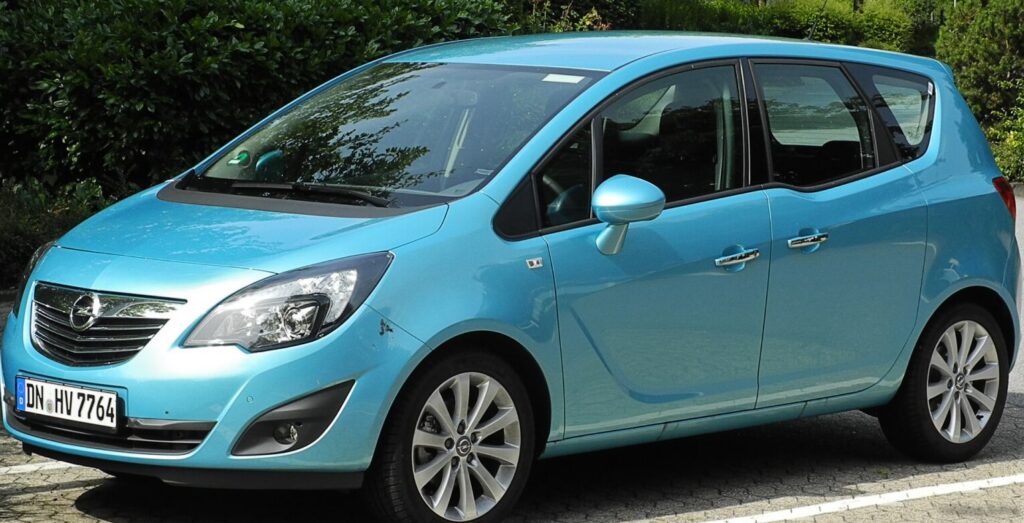
The Opel Meriva B 1.4 Turbo (140 hp) start/stop, produced from December 2011 to October 2013, represented a significant offering within the second generation of the Meriva minivan. Positioned as a mid-range trim, it aimed to balance fuel efficiency with respectable performance in the European market. This variant was built on the General Motors Gamma platform, shared with other Opel/Vauxhall and Chevrolet models, and was designed to appeal to families seeking a practical and versatile vehicle. The introduction of the start/stop system was a key feature, reflecting growing environmental concerns and fuel economy standards. It slotted between the base 1.2L engine and the more powerful 1.6L Turbo options, offering a compromise for drivers who wanted more than basic transportation but didn’t require the highest performance.
Technical Specifications
| Brand | Opel |
| Model | Meriva |
| Generation | Meriva B |
| Type (Engine) | 1.4 Turbo (140 Hp) start/stop |
| Start of production | December, 2011 |
| End of production | October, 2013 |
| Powertrain Architecture | Internal Combustion engine |
| Body type | Minivan |
| Seats | 5 |
| Doors | 5 |
| Fuel consumption (combined) | 6.1 l/100 km (38.6 US mpg, 46.3 UK mpg, 16.4 km/l) |
| Fuel Type | Petrol (Gasoline) |
| Acceleration 0 – 100 km/h | 10.3 sec |
| Acceleration 0 – 62 mph | 10.3 sec |
| Acceleration 0 – 60 mph | 9.8 sec |
| Maximum speed | 196 km/h (121.79 mph) |
| Emission standard | Euro 5 |
| Weight-to-power ratio | 9.2 kg/Hp, 108.9 Hp/tonne |
| Weight-to-torque ratio | 6.4 kg/Nm, 155.5 Nm/tonne |
| Power | 140 Hp @ 4900-6000 rpm |
| Power per litre | 102.6 Hp/l |
| Torque | 200 Nm @ 1850-4900 rpm (147.51 lb.-ft. @ 1850-4900 rpm) |
| Engine layout | Front, Transverse |
| Engine Model/Code | A14NET |
| Engine displacement | 1364 cm3 (83.24 cu. in.) |
| Number of cylinders | 4 |
| Engine configuration | Inline |
| Cylinder Bore | 72.5 mm (2.85 in.) |
| Piston Stroke | 82.6 mm (3.25 in.) |
| Compression ratio | 9.5:1 |
| Number of valves per cylinder | 4 |
| Fuel injection system | Multi-port manifold injection |
| Engine aspiration | Turbocharger, Intercooler |
| Valvetrain | DOHC |
| Engine oil capacity | 4 l (4.23 US qt | 3.52 UK qt) |
| Coolant | 6.2 l (6.55 US qt | 5.46 UK qt) |
| Kerb Weight | 1286 kg (2835.14 lbs.) |
| Max. weight | 1890 kg (4166.74 lbs.) |
| Max load | 604 kg (1331.59 lbs.) |
| Trunk (boot) space – minimum | 400 l (14.13 cu. ft.) |
| Trunk (boot) space – maximum | 1500 l (52.97 cu. ft.) |
| Fuel tank capacity | 54 l (14.27 US gal | 11.88 UK gal) |
| Length | 4288 mm (168.82 in.) |
| Width | 1994 mm (78.5 in.) |
| Height | 1615 mm (63.58 in.) |
| Wheelbase | 2644 mm (104.09 in.) |
| Front track | 1488 mm (58.58 in.) |
| Rear (Back) track | 1509 mm (59.41 in.) |
| Minimum turning circle | 11.48 m (37.66 ft.) |
| Drivetrain Architecture | The Internal combustion engine (ICE) drives the front wheels of the vehicle. |
| Drive wheel | Front wheel drive |
| Number of gears and type of gearbox | 6 gears, manual transmission |
| Assisting systems | ABS (Anti-lock braking system) |
| Steering type | Steering rack and pinion |
| Tires size | 205/55 R16 |
| Wheel rims size | 16 |
Powertrain & Engine Architecture
The heart of the Meriva B 1.4 Turbo was the A14NET engine, a 1.4-liter inline-four cylinder gasoline engine. This engine was part of Opel’s family of small-displacement turbocharged engines, designed to deliver a balance of power and efficiency. It featured multi-point fuel injection and a single turbocharger with an intercooler to enhance performance. The engine utilized a double overhead camshaft (DOHC) valvetrain, contributing to its relatively high power output for its size. The start/stop system, a key feature of this variant, automatically shut off the engine when the vehicle came to a halt, reducing fuel consumption and emissions. The engine was paired with a six-speed manual transmission, providing a good spread of gears for both city driving and highway cruising. The transmission was chosen for its efficiency and responsiveness, complementing the engine’s characteristics.
Driving Characteristics
The 140 hp 1.4 Turbo engine provided adequate performance for the Meriva B, though it wasn’t a particularly sporty vehicle. Acceleration from 0-60 mph took around 9.8 seconds, which was competitive within its class. The turbocharger provided a noticeable boost in power, particularly in the mid-range, making overtaking maneuvers relatively easy. However, the engine did exhibit some turbo lag at lower RPMs. The six-speed manual transmission allowed drivers to keep the engine in its optimal power band. Compared to the base 1.2L engine, the 1.4 Turbo offered a significant improvement in performance, while remaining more fuel-efficient than the 1.6L Turbo. The gear ratios were well-suited to everyday driving, providing a comfortable and manageable experience.
Equipment & Trim Levels
The 1.4 Turbo trim of the Meriva B typically included features such as air conditioning, power windows, power mirrors, and a basic audio system with USB connectivity. Safety features included ABS, front and side airbags, and stability control. Higher trim levels offered options like alloy wheels, a more advanced infotainment system, parking sensors, and climate control. Interior upholstery was typically cloth, with options for upgraded materials. The dashboard layout was functional and user-friendly, with a focus on practicality. The FlexSpace rear seating system, allowing for versatile cargo configurations, was a standard feature across most Meriva B trims.
Chassis & Braking
The Meriva B featured a MacPherson strut front suspension and a torsion beam rear suspension. This setup provided a comfortable ride quality, suitable for family transportation. The torsion beam rear suspension was a cost-effective solution, but it didn’t offer the same level of handling precision as a more sophisticated independent rear suspension. Braking duties were handled by disc brakes on the front wheels and drum brakes on the rear wheels. ABS (Anti-lock Braking System) was standard, enhancing safety during emergency braking situations. The steering was a rack and pinion system, providing reasonably precise steering feel.
Market Reception & Comparison
The Opel Meriva B 1.4 Turbo received generally positive reviews from automotive critics. It was praised for its fuel efficiency, practicality, and comfortable ride. However, some critics noted that the engine could feel strained when fully loaded or driving uphill. Compared to other minivans in its class, the Meriva B offered a good balance of features and price. The 1.4 Turbo variant was seen as a sensible choice for buyers who wanted a bit more performance than the base engine without the added cost of the 1.6L Turbo. Fuel economy was a strong point, with combined figures around 6.1 l/100 km (38.6 US mpg), making it an attractive option for budget-conscious buyers.
Legacy
The Opel Meriva B 1.4 Turbo, while not a particularly groundbreaking vehicle, proved to be a reliable and practical choice for many European families. The A14NET engine, when properly maintained, is known for its durability. On the used car market, these models represent a good value proposition, offering a spacious interior, decent fuel economy, and a reasonable level of equipment. Common issues reported include occasional turbocharger problems and wear on the timing chain, but these are not widespread. The Meriva B, in general, remains a popular choice for those seeking an affordable and versatile family vehicle.