
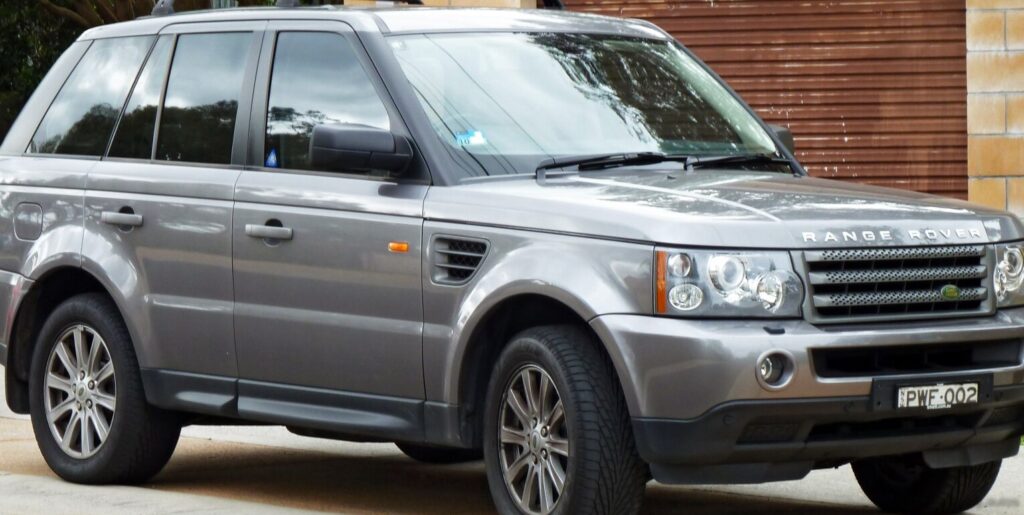
The Land Rover Range Rover Sport I 4.4 V8, produced from 2005 to 2009, represented a significant expansion of the Range Rover lineup. Positioned as a more dynamic and accessible alternative to the full-size Range Rover, the Sport aimed to attract buyers seeking luxury and off-road capability in a slightly more compact package. This particular variant, equipped with the 4.4-liter V8 engine producing 299 horsepower and paired with a six-speed automatic transmission, occupied a premium position within the initial Range Rover Sport range, offering a blend of performance and refinement. It was built on the 4×4 platform, sharing components with the Land Rover Discovery 3, but with a more sophisticated suspension and interior appointments.
Technical Specifications
| Brand | Land Rover |
| Model | Range Rover Sport |
| Generation | Range Rover Sport I |
| Type (Engine) | 4.4 V8 (299 Hp) AWD Automatic |
| Start of production | 2005 |
| End of production | 2009 |
| Powertrain Architecture | Internal Combustion engine |
| Body type | SUV |
| Seats | 5 |
| Doors | 5 |
| Fuel consumption (urban) | 20.9 l/100 km (11.3 US mpg, 13.5 UK mpg, 4.8 km/l) |
| Fuel consumption (extra urban) | 12.1 l/100 km (19.4 US mpg, 23.3 UK mpg, 8.3 km/l) |
| Fuel consumption (combined) | 14.9 l/100 km (15.8 US mpg, 19 UK mpg, 6.7 km/l) |
| CO2 emissions | 352 g/km |
| Fuel Type | Petrol (Gasoline) |
| Acceleration 0 – 100 km/h | 8.9 sec |
| Acceleration 0 – 62 mph | 8.9 sec |
| Acceleration 0 – 60 mph | 8.5 sec |
| Maximum speed | 209 km/h (129.87 mph) |
| Emission standard | Euro 4 |
| Weight-to-power ratio | 8.3 kg/Hp, 120.6 Hp/tonne |
| Weight-to-torque ratio | 5.8 kg/Nm, 171.4 Nm/tonne |
| Power | 299 Hp @ 5500 rpm |
| Power per litre | 68 Hp/l |
| Torque | 425 Nm @ 4000 rpm (313.46 lb.-ft. @ 4000 rpm) |
| Engine layout | Front, Longitudinal |
| Engine Model/Code | AJ41 |
| Engine displacement | 4394 cm3 (268.14 cu. in.) |
| Number of cylinders | 8 |
| Engine configuration | V-engine |
| Cylinder Bore | 88 mm (3.46 in.) |
| Piston Stroke | 90.3 mm (3.56 in.) |
| Compression ratio | 10.75:1 |
| Number of valves per cylinder | 4 |
| Fuel injection system | Multi-port manifold injection |
| Engine aspiration | Naturally aspirated engine |
| Valvetrain | DOHC |
| Engine oil capacity | 8 l (8.45 US qt | 7.04 UK qt) |
| Coolant | 9.5 l (10.04 US qt | 8.36 UK qt) |
| Kerb Weight | 2480 kg (5467.46 lbs.) |
| Max. weight | 3070 kg (6768.19 lbs.) |
| Max load | 590 kg (1300.73 lbs.) |
| Trunk (boot) space – minimum | 958 l (33.83 cu. ft.) |
| Trunk (boot) space – maximum | 2013 l (71.09 cu. ft.) |
| Fuel tank capacity | 88.1 l (23.27 US gal | 19.38 UK gal) |
| Permitted trailer load with brakes (12%) | 3500 kg (7716.18 lbs.) |
| Permitted trailer load without brakes | 750 kg (1653.47 lbs.) |
| Length | 4788 mm (188.5 in.) |
| Width with mirrors folded | 1983 mm (78.07 in.) |
| Width including mirrors | 2170 mm (85.43 in.) |
| Height | 1762-1812 mm (69.37 – 71.34 in.) |
| Wheelbase | 2745 mm (108.07 in.) |
| Front track | 1605 mm (63.19 in.) |
| Rear (Back) track | 1612 mm (63.46 in.) |
| Ride height (ground clearance) | 172-227 mm (6.77 – 8.94 in.) |
| Minimum turning circle (turning diameter) | 11.9 m (39.04 ft.) |
| Approach angle | 30.2-34° |
| Departure angle | 26-29° |
| Ramp-over (brakeover) angle | 20-25° |
| Wading depth | 700 mm (27.56 in.) |
| Drivetrain Architecture | The Internal combustion engine (ICE) drives permanently the four wheels of the vehicle. |
| Drive wheel | All wheel drive (4×4) |
| Number of gears and type of gearbox | 6 gears, automatic transmission |
| Front suspension | Air suspension |
| Rear suspension | Air suspension |
| Front brakes | Ventilated discs, 337 mm |
| Rear brakes | Ventilated discs, 350 mm |
| Assisting systems | ABS (Anti-lock braking system) |
| Steering type | Steering rack and pinion |
| Power steering | Hydraulic Steering |
| Tires size | 255/50 R19 |
| Wheel rims size | 9J x 19 |
INTRODUCTION
The Land Rover Range Rover Sport I 4.4 V8, launched in 2005, was a pivotal model for the British automaker. It aimed to bridge the gap between the luxurious full-size Range Rover and the more utilitarian Land Rover Discovery. This variant, featuring the naturally aspirated 4.4-liter Jaguar-sourced V8 engine and a six-speed automatic transmission, was a key component of the initial lineup. It offered a compelling combination of performance, comfort, and off-road capability, appealing to buyers who desired a sporty SUV without sacrificing the Range Rover brand’s prestige. The vehicle was built on the 4×4 platform, sharing some underpinnings with the Land Rover Discovery 3, but with significant upgrades to the suspension and interior.
Powertrain & Engine Architecture
At the heart of this Range Rover Sport lies the AJ41 engine, a 4.4-liter naturally aspirated V8 developed by Jaguar. This engine, known for its smooth power delivery, produces 299 horsepower at 5500 rpm and 425 Nm (313.46 lb-ft) of torque at 4000 rpm. The engine utilizes multi-port fuel injection and a double overhead camshaft (DOHC) valvetrain. The 6-speed automatic transmission, sourced from ZF, was chosen for its smoothness and responsiveness. This transmission features a torque converter and electronic controls, offering both fully automatic operation and a manual shift mode. The engine is longitudinally mounted in the front of the vehicle, driving all four wheels through a permanent all-wheel-drive system.
Driving Characteristics
The 4.4 V8 automatic combination delivered a respectable driving experience. Acceleration from 0 to 60 mph took approximately 8.5 seconds, and the vehicle had a top speed of 129.87 mph. While not as quick as the supercharged variants, the naturally aspirated V8 provided ample power for everyday driving and overtaking maneuvers. The automatic transmission, while smooth, could sometimes feel hesitant during quick downshifts. The air suspension system, standard on this model, provided a comfortable ride on paved roads and allowed for adjustable ride height for improved off-road capability. The permanent all-wheel-drive system ensured excellent traction in various conditions.
Equipment & Trim Levels
The 4.4 V8 variant of the Range Rover Sport I typically came well-equipped. Standard features included leather upholstery, automatic climate control, a premium audio system, and parking sensors. Optional extras included heated seats, a sunroof, navigation system, and upgraded interior trim materials. The interior design was luxurious, with a focus on comfort and functionality. The dashboard layout was relatively straightforward, with easy-to-use controls. Trim levels varied depending on the market, but generally offered increasing levels of luxury and technology.
Chassis & Braking
The Range Rover Sport I featured an independent air suspension system at both the front and rear, providing a comfortable ride and adjustable ground clearance. The braking system consisted of ventilated discs on all four wheels, with larger discs at the rear (350mm) compared to the front (337mm). Anti-lock braking system (ABS) was standard. The chassis was designed to provide a balance between on-road handling and off-road capability. Stabilizer bars were fitted to both axles to reduce body roll during cornering.
Market Reception & Comparison
The Range Rover Sport I 4.4 V8 was generally well-received by automotive critics. It was praised for its luxurious interior, comfortable ride, and capable off-road performance. However, some critics noted that the fuel economy was relatively poor (around 15.8 US mpg combined) and that the naturally aspirated V8 engine lacked the outright performance of the supercharged variants. Compared to the Range Rover Sport HSE (supercharged), the 4.4 V8 offered a more affordable entry point into the Range Rover Sport lineup, appealing to buyers who prioritized value and fuel efficiency over ultimate performance. Compared to the diesel variants, the 4.4 V8 offered a more refined driving experience but at the cost of higher fuel consumption.
Legacy
The Range Rover Sport I 4.4 V8 has proven to be a relatively reliable vehicle, although maintenance costs can be high due to the complexity of the vehicle and the cost of parts. The AJ41 engine is generally considered to be durable, but regular maintenance is essential. Common issues include air suspension problems and electrical glitches. In the used car market, these vehicles are sought after by enthusiasts who appreciate their blend of luxury, performance, and off-road capability. Values vary depending on condition, mileage, and equipment levels, but well-maintained examples can command a premium price.


