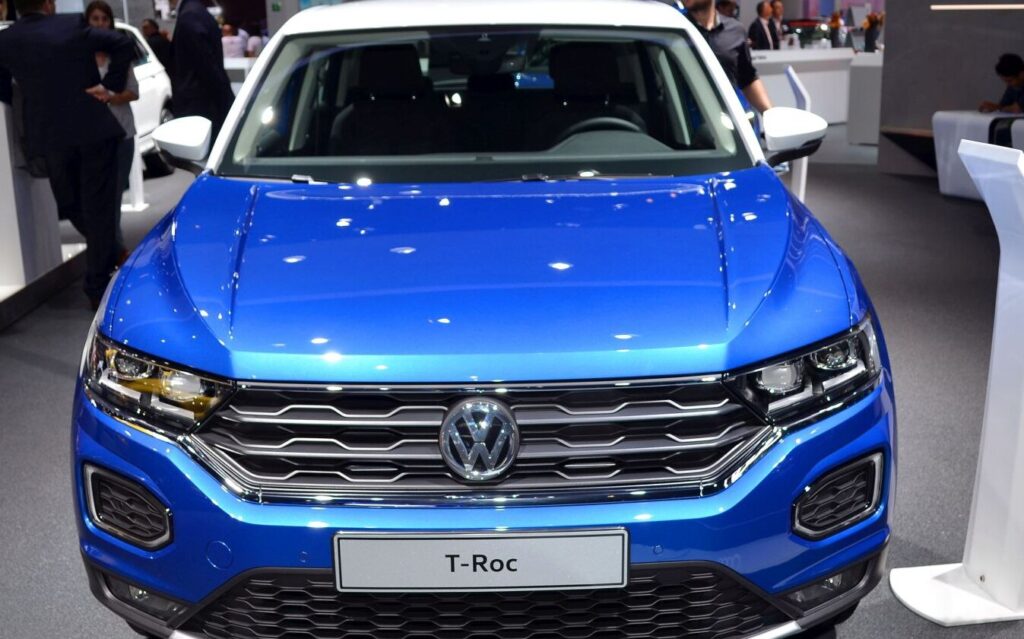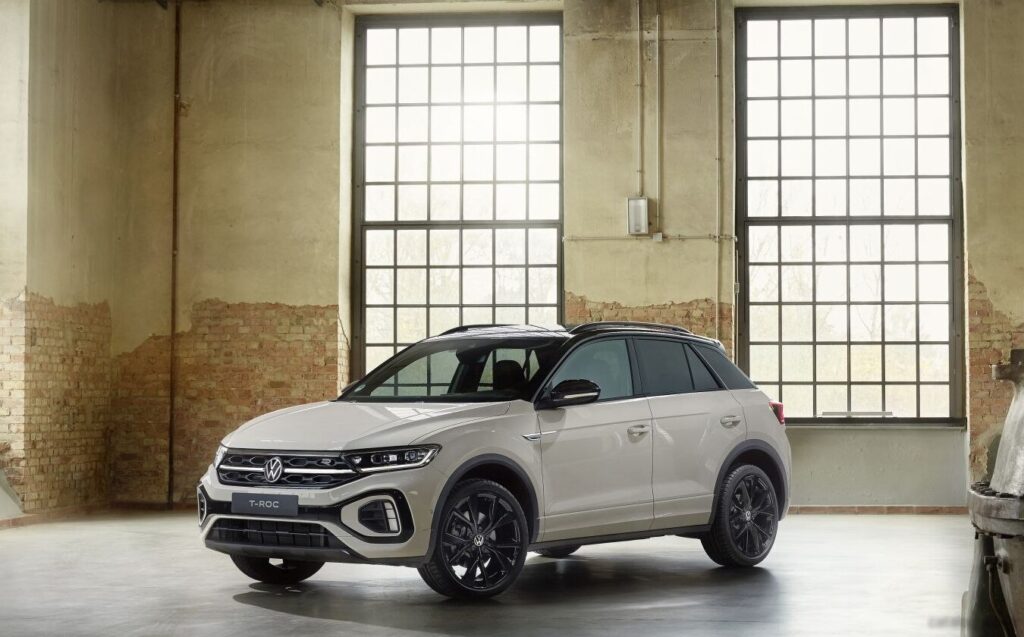
The Volkswagen T-Roc, introduced in 2017, quickly became a popular subcompact SUV, particularly in the European market. The facelifted first generation, launched in 2022, brought updated styling and technology to the range. Among the engine options available was the 1.0 TSI, producing 110 horsepower. This variant, paired with a six-speed manual transmission, represented an entry point into the T-Roc lineup, aimed at buyers prioritizing fuel efficiency and affordability. Production of this specific configuration ran from 2022 through 2024.
Technical Specifications
| Brand | Volkswagen |
| Model | T-Roc |
| Generation | T-Roc I (facelift 2022) |
| Type (Engine) | 1.0 TSI (110 Hp) |
| Start of production | 2022 |
| End of production | 2024 |
| Powertrain Architecture | Internal Combustion engine |
| Body type | SUV |
| Seats | 5 |
| Doors | 5 |
| Fuel consumption at Low speed (WLTP) | 7.3 l/100 km (32.2 US mpg, 38.7 UK mpg, 13.7 km/l) |
| Fuel consumption at Medium speed (WLTP) | 5.6 l/100 km (42 US mpg, 50.4 UK mpg, 17.9 km/l) |
| Fuel consumption at high speed (WLTP) | 5.1 l/100 km (46.1 US mpg, 55.4 UK mpg, 19.6 km/l) |
| Fuel consumption at very high speed (WLTP) | 6.2 l/100 km (37.9 US mpg, 45.6 UK mpg, 16.1 km/l) |
| Combined fuel consumption (WLTP) | 5.9 l/100 km (39.9 US mpg, 47.9 UK mpg, 16.9 km/l) |
| CO2 emissions (WLTP) | 133 g/km |
| Fuel consumption (economy) – urban (NEDC) | 6.2 l/100 km (37.9 US mpg, 45.6 UK mpg, 16.1 km/l) |
| Fuel consumption (economy) – extra urban (NEDC) | 4.6 l/100 km (51.1 US mpg, 61.4 UK mpg, 21.7 km/l) |
| Fuel consumption (economy) – combined (NEDC) | 5.2 l/100 km (45.2 US mpg, 54.3 UK mpg, 19.2 km/l) |
| CO2 emissions (NEDC) | 118 g/km |
| Fuel Type | Petrol (Gasoline) |
| Acceleration 0 – 100 km/h | 10.8 sec |
| Acceleration 0 – 62 mph | 10.8 sec |
| Acceleration 0 – 60 mph | 10.3 sec |
| Maximum speed | 185 km/h (114.95 mph) |
| Emission standard | Euro 6d-ISC-FCM |
| Weight-to-power ratio | 11.1 kg/Hp, 89.7 Hp/tonne |
| Weight-to-torque ratio | 6.1 kg/Nm, 163.1 Nm/tonne |
| Power | 110 Hp @ 5000 rpm |
| Torque | 200 Nm @ 2000-3000 rpm (147.51 lb.-ft. @ 2000-3000 rpm) |
| Engine layout | Front, Transverse |
| Engine Model/Code | DLAA |
| Engine displacement | 999 cm3 (60.96 cu. in.) |
| Number of cylinders | 3 |
| Engine configuration | Inline |
| Cylinder Bore | 74.5 mm (2.93 in.) |
| Piston Stroke | 76.4 mm (3.01 in.) |
| Number of valves per cylinder | 4 |
| Fuel injection system | Direct injection |
| Engine aspiration | Turbocharger, Intercooler |
| Valvetrain | DOHC |
| Engine oil capacity | 4 l (4.23 US qt | 3.52 UK qt) |
| Kerb Weight | 1226 kg (2702.87 lbs.) |
| Max. weight | 1800 kg (3968.32 lbs.) |
| Max load | 574 kg (1265.45 lbs.) |
| Trunk (boot) space – minimum | 445 l (15.72 cu. ft.) |
| Trunk (boot) space – maximum | 1290 l (45.56 cu. ft.) |
| Fuel tank capacity | 50 l (13.21 US gal | 11 UK gal) |
| Max. roof load | 75 kg (165.35 lbs.) |
| Permitted trailer load with brakes (8%) | 1500 kg (3306.93 lbs.) |
| Permitted trailer load with brakes (12%) | 1300 kg (2866.01 lbs.) |
| Permitted trailer load without brakes | 650 kg (1433 lbs.) |
| Permitted towbar download | 80 kg (176.37 lbs.) |
| Length | 4236 mm (166.77 in.) |
| Width | 1819 mm (71.61 in.) |
| Width including mirrors | 2012 mm (79.21 in.) |
| Height | 1584 mm (62.36 in.) |
| Wheelbase | 2590 mm (101.97 in.) |
| Front track | 1538-1549 mm (60.55 – 60.98 in.) |
| Rear (Back) track | 1531-1541 mm (60.28 – 60.67 in.) |
| Ride height (ground clearance) | 161 mm (6.34 in.) |
| Minimum turning circle (turning diameter) | 11.1 m (36.42 ft.) |
| Approach angle | 17.4° |
| Departure angle | 19.4° |
| Ramp-over (brakeover) angle | 13.8° |
| Drivetrain Architecture | The Internal combustion engine (ICE) drives the front wheels of the vehicle. |
| Drive wheel | Front wheel drive |
| Number of gears and type of gearbox | 6 gears, manual transmission |
| Front suspension | Independent type McPherson, Transverse stabilizer |
| Rear suspension | Semi-dependent beam with stabilizer lateral stability |
| Front brakes | Ventilated discs |
| Rear brakes | Disc |
| Assisting systems | ABS (Anti-lock braking system) |
| Steering type | Steering rack and pinion |
| Power steering | Electric Steering |
| Tires size | 205/60 R16; 215/60 R16 |
| Wheel rims size | 6J x 16; 6.5J x 16 |
INTRODUCTION
The 2022-2024 Volkswagen T-Roc 1.0 TSI 110 hp represents a key offering in the subcompact SUV segment. Positioned as an entry-level trim, it provided a more accessible price point for buyers interested in the T-Roc’s stylish design and practical features. Built on the MQB A0 platform (also known as the A05), the T-Roc aimed to attract a younger demographic with its modern aesthetics and available customization options. This variant was primarily sold in Europe and other international markets, where smaller, fuel-efficient SUVs are highly sought after.
Powertrain & Engine Architecture
At the heart of the T-Roc 1.0 TSI is the EA211 family of engines, specifically the DLAA code. This is a 1.0-liter, three-cylinder turbocharged gasoline engine. It utilizes direct fuel injection, a key technology for maximizing efficiency and power output. The engine features a single scroll turbocharger and an intercooler to manage intake air temperature. The DOHC (Double Overhead Camshaft) valvetrain, with four valves per cylinder, contributes to efficient gas exchange. The 110 horsepower is achieved at 5000 rpm, while peak torque of 200 Nm (147.51 lb-ft) is available between 2000 and 3000 rpm. This engine is paired with a six-speed manual transmission, chosen for its affordability and driver engagement. The transmission’s gear ratios are tuned to prioritize fuel economy and acceptable acceleration.
Driving Characteristics
The 1.0 TSI engine, while not exceptionally powerful, provides adequate performance for everyday driving. Acceleration from 0 to 100 km/h (0-62 mph) takes around 10.8 seconds. The turbocharger provides a noticeable boost in power, but it’s not as dramatic as in higher-output versions of the T-Roc. The six-speed manual transmission allows for precise control, but requires more driver involvement than an automatic. Compared to the 1.5 TSI variants, the 1.0 TSI feels less responsive, particularly during overtaking maneuvers. However, it excels in urban environments and on the highway, offering a comfortable and relatively quiet driving experience. The relatively low weight of the engine contributes to balanced handling.
Equipment & Trim Levels
The T-Roc 1.0 TSI 110 hp typically came with a reasonable level of standard equipment. This included air conditioning, a touchscreen infotainment system with Bluetooth connectivity, alloy wheels, and a suite of safety features such as ABS, ESC (Electronic Stability Control), and multiple airbags. Higher trim levels offered options like automatic climate control, a larger touchscreen display, navigation, parking sensors, and adaptive cruise control. Interior upholstery was typically cloth, with options for upgraded materials. The dashboard layout was modern and driver-focused, with a clean and intuitive design.
Chassis & Braking
The T-Roc’s chassis features an independent McPherson strut suspension at the front, providing good ride comfort and handling. The rear suspension utilizes a semi-independent torsion beam setup, which is a cost-effective solution that still delivers acceptable performance. The front brakes are ventilated discs, offering good stopping power, while the rear brakes are solid discs. The electric power steering provides light and precise steering feel. The standard tire size was typically 205/60 R16 or 215/60 R16, depending on the trim level.
Market Reception & Comparison
The T-Roc 1.0 TSI 110 hp was generally well-received by automotive critics as a practical and affordable option. It was praised for its fuel efficiency, comfortable ride, and stylish design. However, some reviewers noted that the engine could feel underpowered, especially when fully loaded or on steep inclines. Compared to the 1.5 TSI variants, the 1.0 TSI offered significantly better fuel economy but at the expense of performance. Against competitors like the Renault Captur and Peugeot 2008, the T-Roc 1.0 TSI held its own, offering a compelling combination of value and features.
Legacy
The 1.0 TSI engine has proven to be a relatively reliable powertrain, although some owners have reported issues with the timing chain. Regular maintenance, including oil changes and timing chain inspections, is crucial for ensuring long-term reliability. On the used car market, the T-Roc 1.0 TSI 110 hp remains a popular choice, particularly for buyers seeking a fuel-efficient and affordable subcompact SUV. Its combination of practicality, style, and reasonable running costs continues to make it an attractive option.