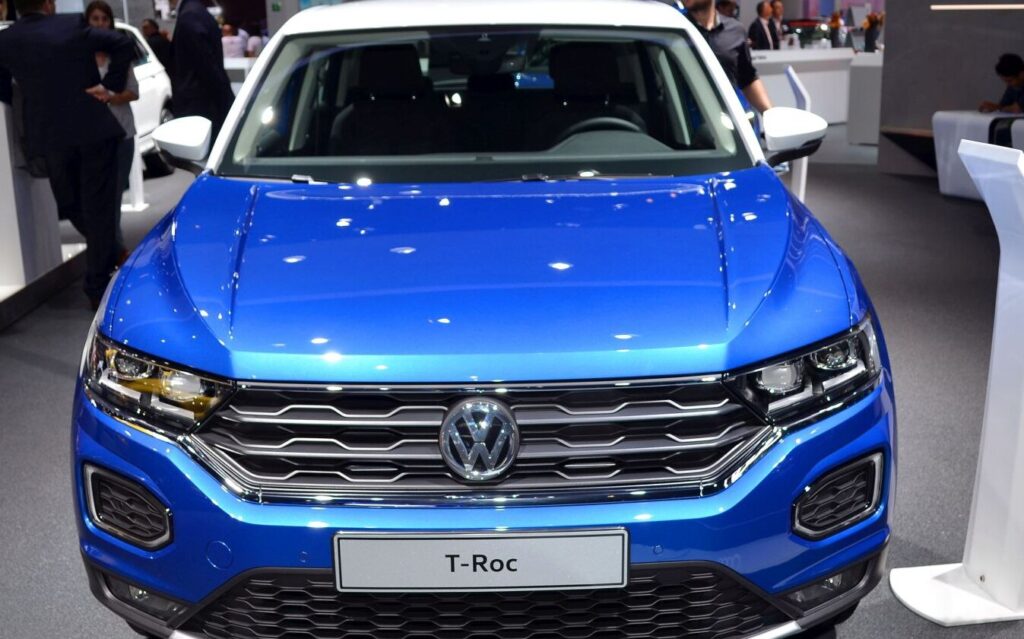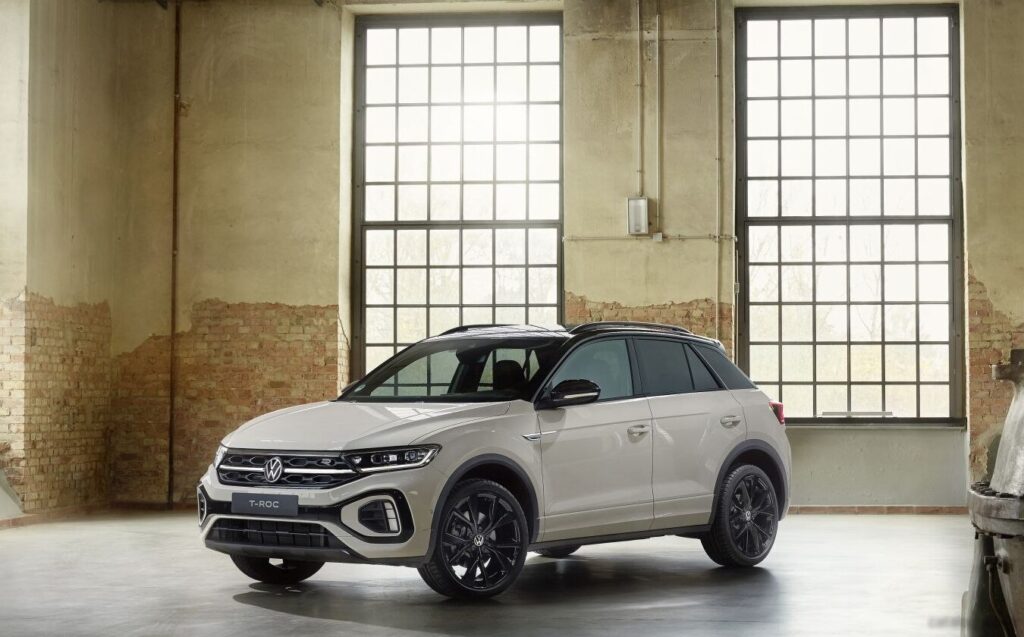
The Volkswagen T-Roc 1.0 TSI (116 hp) represents an entry-level powertrain option within the first generation (T-Roc I) of Volkswagen’s popular subcompact SUV. Introduced with the 2022 facelift and continuing through the 2025 model year, this variant aimed to provide a balance of affordability and efficiency for European and other international markets. It occupied the lower end of the T-Roc lineup, positioned below more powerful engine options like the 1.5 TSI and 2.0 TDI. This model is a key example of Volkswagen’s strategy to offer a diverse range of powertrains to cater to varying customer needs and preferences.
Technical Specifications
| Brand | Volkswagen |
| Model | T-Roc |
| Generation | T-Roc I (facelift 2022) |
| Type (Engine) | 1.0 TSI (116 Hp) |
| Start of production | 2024 |
| End of production | 2025 |
| Powertrain Architecture | Internal Combustion engine |
| Body type | SUV |
| Seats | 5 |
| Doors | 5 |
| Fuel consumption at Low speed (WLTP) | 7.4 l/100 km (31.8 US mpg, 38.2 UK mpg, 13.5 km/l) |
| Fuel consumption at Medium speed (WLTP) | 5.5 l/100 km (42.8 US mpg, 51.4 UK mpg, 18.2 km/l) |
| Fuel consumption at high speed (WLTP) | 4.7-4.8 l/100 km (50 – 49 US mpg, 60.1 – 58.9 UK mpg, 21.3 – 20.8 km/l) |
| Fuel consumption at very high speed (WLTP) | 5.8-5.9 l/100 km (40.6 – 39.9 US mpg, 48.7 – 47.9 UK mpg, 17.2 – 16.9 km/l) |
| Combined fuel consumption (WLTP) | 5.6-5.7 l/100 km (42 – 41.3 US mpg, 50.4 – 49.6 UK mpg, 17.9 – 17.5 km/l) |
| CO2 emissions (WLTP) | 128-129 g/km |
| Fuel Type | Petrol (Gasoline) |
| Maximum speed | 189 km/h (117.44 mph) |
| Emission standard | Euro 6 EA |
| Weight-to-power ratio | 10.6 kg/Hp, 94.4 Hp/tonne |
| Weight-to-torque ratio | 6.1 kg/Nm, 162.7 Nm/tonne |
| Power | 116 Hp |
| Power per litre | 116.1 Hp/l |
| Torque | 200 Nm @ 2000-3500 rpm (147.51 lb.-ft. @ 2000-3500 rpm) |
| Engine layout | Front, Transverse |
| Engine Model/Code | EA211 evo2 |
| Engine displacement | 999 cm3 (60.96 cu. in.) |
| Number of cylinders | 3 |
| Engine configuration | Inline |
| Cylinder Bore | 74.5 mm (2.93 in.) |
| Piston Stroke | 76.4 mm (3.01 in.) |
| Number of valves per cylinder | 4 |
| Fuel injection system | Direct injection |
| Engine aspiration | Turbocharger, Intercooler |
| Valvetrain | DOHC |
| Engine oil capacity | 4 l (4.23 US qt | 3.52 UK qt) |
| Kerb Weight | 1229 kg (2709.48 lbs.) |
| Max. weight | 1790 kg (3946.27 lbs.) |
| Max load | 561 kg (1236.79 lbs.) |
| Trunk (boot) space – minimum | 445 l (15.72 cu. ft.) |
| Trunk (boot) space – maximum | 1290 l (45.56 cu. ft.) |
| Fuel tank capacity | 50 l (13.21 US gal | 11 UK gal) |
| Max. roof load | 75 kg (165.35 lbs.) |
| Permitted trailer load with brakes (8%) | 1500 kg (3306.93 lbs.) |
| Permitted trailer load with brakes (12%) | 1300 kg (2866.01 lbs.) |
| Permitted trailer load without brakes | 650 kg (1433 lbs.) |
| Permitted towbar download | 80 kg (176.37 lbs.) |
| Length | 4236 mm (166.77 in.) |
| Width | 1819 mm (71.61 in.) |
| Width including mirrors | 2012 mm (79.21 in.) |
| Height | 1584 mm (62.36 in.) |
| Wheelbase | 2590 mm (101.97 in.) |
| Front track | 1538-1549 mm (60.55 – 60.98 in.) |
| Rear (Back) track | 1531-1541 mm (60.28 – 60.67 in.) |
| Minimum turning circle (turning diameter) | 11 m (36.09 ft.) |
| Drivetrain Architecture | The Internal combustion engine (ICE) drives the front wheels of the vehicle. |
| Drive wheel | Front wheel drive |
| Number of gears and type of gearbox | 6 gears, manual transmission |
| Front suspension | Independent, type McPherson with coil spring and anti-roll bar |
| Rear suspension | Semi-dependent beam with stabilizer lateral stability |
| Front brakes | Ventilated discs |
| Rear brakes | Disc |
INTRODUCTION
The Volkswagen T-Roc 1.0 TSI (116 hp) is a front-wheel-drive, five-door subcompact SUV that forms part of the first generation T-Roc range (introduced in 2018, facelifted in 2022). This specific variant, utilizing the EA211 evo2 engine, was primarily marketed in Europe and other regions where smaller displacement, turbocharged engines are favored for their fuel efficiency and suitability for urban driving. The 2022 facelift brought styling updates and revised technology, but the core powertrain remained largely unchanged. It’s positioned as an accessible entry point into the T-Roc lineup, appealing to buyers seeking a stylish and practical SUV without the higher costs associated with more powerful engines.
Powertrain & Engine Architecture
At the heart of the T-Roc 1.0 TSI is the EA211 evo2 1.0-liter three-cylinder turbocharged gasoline engine. This engine, designated with various codes depending on the specific market and emissions regulations, is a key component of Volkswagen’s modular engine family. It features direct fuel injection, a single scroll turbocharger, and a double overhead camshaft (DOHC) valvetrain with four valves per cylinder. The engine’s compact size and lightweight construction contribute to the T-Roc’s overall efficiency. The 116 hp version utilizes a relatively conservative turbocharger tune, prioritizing fuel economy over outright performance. The engine is paired with a 6-speed manual transmission as standard, delivering power to the front wheels. The EA211 evo2 incorporates features like a coated cylinder liner to reduce friction and improve efficiency, and an exhaust manifold integrated into the cylinder head for faster warm-up times.
Driving Characteristics
The 1.0 TSI 116 hp engine delivers adequate performance for everyday driving, particularly in urban and suburban environments. Acceleration is not brisk, with a 0-62 mph (0-100 km/h) time of around 10.4 seconds. However, the engine provides sufficient torque (200 Nm / 147.51 lb.-ft.) between 2000-3500 rpm, making it reasonably responsive for overtaking and merging onto highways. Compared to the more powerful 1.5 TSI engine, the 1.0 TSI feels noticeably less energetic, especially when fully loaded or climbing hills. The 6-speed manual transmission is well-matched to the engine’s characteristics, offering precise shifts and a reasonable spread of gear ratios. The front-wheel-drive configuration provides predictable handling, but lacks the all-weather capability of the optional 4MOTION all-wheel-drive system available on other T-Roc variants.
Equipment & Trim Levels
The T-Roc 1.0 TSI (116 hp) typically came equipped with a solid base level of standard features. These generally included air conditioning, a touchscreen infotainment system with Apple CarPlay and Android Auto compatibility, LED headlights, and a suite of safety features such as automatic emergency braking and lane departure warning. Interior upholstery was typically cloth, with plastic trim accents. Optional extras included features like a larger touchscreen display, navigation system, adaptive cruise control, park assist, and upgraded interior trim materials. Trim levels varied by market, but generally offered progressively more features and styling enhancements as you moved up the range. The base trim focused on providing essential features at an affordable price point.
Chassis & Braking
The T-Roc utilizes a MacPherson strut front suspension and a semi-independent torsion beam rear suspension. This setup provides a good balance of ride comfort and handling. The front suspension incorporates a stabilizer bar to reduce body roll during cornering. Braking duties are handled by ventilated discs at the front and solid discs at the rear. Anti-lock Braking System (ABS) and Electronic Stability Control (ESC) are standard features, enhancing safety and control. The T-Roc’s chassis is relatively lightweight, contributing to its agility and fuel efficiency. The steering is electrically assisted, providing a light and responsive feel.
Market Reception & Comparison
The T-Roc 1.0 TSI (116 hp) was generally well-received by automotive critics as a practical and affordable entry point into the subcompact SUV segment. Reviewers praised its fuel efficiency and comfortable ride, but noted its lack of outright performance compared to more powerful variants. Compared to the 1.5 TSI, the 1.0 TSI offered significantly better fuel economy, but at the expense of acceleration and overall driving enjoyment. The 2.0 TDI diesel offered superior torque and fuel economy on longer journeys, but came with a higher purchase price and potential concerns about diesel emissions regulations. The 1.0 TSI appealed to buyers prioritizing affordability and efficiency over performance.
Legacy
The EA211 engine family, including the 1.0 TSI, has proven to be generally reliable, although some early versions experienced issues with timing chain tensioners. Regular maintenance, including oil changes and adherence to Volkswagen’s recommended service intervals, is crucial for ensuring long-term reliability. On the used car market, the T-Roc 1.0 TSI (116 hp) represents a good value proposition for buyers seeking a stylish and economical SUV. Its relatively low running costs and proven powertrain make it an attractive option for those on a budget. The T-Roc’s popularity has established it as a strong contender in the competitive subcompact SUV segment, and the 1.0 TSI variant played a significant role in broadening its appeal to a wider range of customers.