
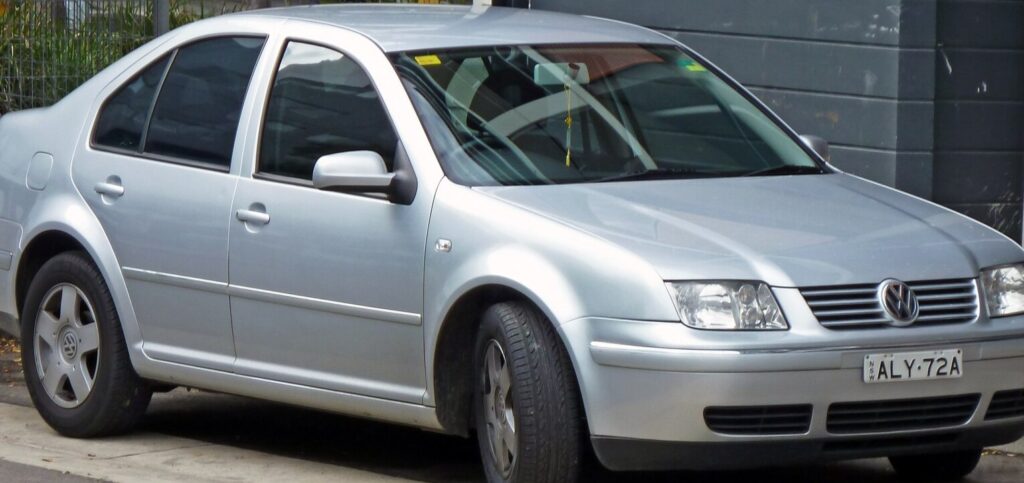
The Volkswagen Bora 2.3 VR5 20V 4MOTION, produced between 2000 and 2005, represents a compelling blend of performance and practicality within the Bora (1J2) lineup. Positioned as a mid-to-upper range offering, it catered to drivers seeking a more engaging experience than the base models, while remaining a more sensible option than the high-performance GTI or R32. This variant combined Volkswagen’s unique VR5 engine with a sophisticated all-wheel-drive system, offering enhanced traction and stability. The Bora itself was Volkswagen’s replacement for the Jetta in Europe, essentially a Golf with a traditional trunk, aiming to appeal to a broader market segment desiring a more conventional sedan body style.
Technical Specifications
| Brand | Volkswagen |
| Model | Bora |
| Generation | Bora (1J2) |
| Type (Engine) | 2.3 VR5 20V (170 Hp) 4MOTION |
| Start of production | 2000 year |
| End of production | 2005 year |
| Powertrain Architecture | Internal Combustion engine |
| Body type | Sedan |
| Seats | 5 |
| Doors | 4 |
| Fuel consumption (economy) – urban | 14.1 l/100 km (16.7 US mpg, 20 UK mpg, 7.1 km/l) |
| Fuel consumption (economy) – extra urban | 7.6 l/100 km (30.9 US mpg, 37.2 UK mpg, 13.2 km/l) |
| Fuel consumption (economy) – combined | 10 l/100 km (23.5 US mpg, 28.2 UK mpg, 10 km/l) |
| CO2 emissions | 240 g/km |
| Fuel Type | Petrol (Gasoline) |
| Acceleration 0 – 100 km/h | 9.1 sec |
| Acceleration 0 – 62 mph | 9.1 sec |
| Acceleration 0 – 60 mph | 8.6 sec |
| Maximum speed | 218 km/h (135.46 mph) |
| Weight-to-power ratio | 8.5 kg/Hp, 117.2 Hp/tonne |
| Weight-to-torque ratio | 6.6 kg/Nm, 151.6 Nm/tonne |
| Power | 170 Hp @ 6200 rpm |
| Power per litre | 73.1 Hp/l |
| Torque | 220 Nm @ 3200 rpm (162.26 lb.-ft. @ 3200 rpm) |
| Engine layout | Front, Transverse |
| Engine Model/Code | AQN |
| Engine displacement | 2324 cm3 (141.82 cu. in.) |
| Number of cylinders | 5 |
| Engine configuration | V-engine |
| Cylinder Bore | 81 mm (3.19 in.) |
| Piston Stroke | 90.2 mm (3.55 in.) |
| Compression ratio | 10.8:1 |
| Number of valves per cylinder | 4 |
| Fuel injection system | Multi-port manifold injection |
| Engine aspiration | Naturally aspirated engine |
| Valvetrain | SOHC |
| Engine oil capacity | 3.9 l (4.12 US qt | 3.43 UK qt) |
| Coolant | 9 l (9.51 US qt | 7.92 UK qt) |
| Kerb Weight | 1451 kg (3198.91 lbs.) |
| Max. weight | 1970 kg (4343.11 lbs.) |
| Max load | 519 kg (1144.2 lbs.) |
| Trunk (boot) space – minimum | 340 l (12.01 cu. ft.) |
| Trunk (boot) space – maximum | 670 l (23.66 cu. ft.) |
| Fuel tank capacity | 63 l (16.64 US gal | 13.86 UK gal) |
| Max. roof load | 75 kg (165.35 lbs.) |
| Permitted trailer load with brakes (12%) | 1600 kg (3527.4 lbs.) |
| Permitted trailer load without brakes | 700 kg (1543.24 lbs.) |
| Permitted towbar download | 75 kg (165.35 lbs.) |
| Length | 4376 mm (172.28 in.) |
| Width | 1735 mm (68.31 in.) |
| Width including mirrors | 2018 mm (79.45 in.) |
| Height | 1446 mm (56.93 in.) |
| Wheelbase | 2519 mm (99.17 in.) |
| Front track | 1513 mm (59.57 in.) |
| Rear (Back) track | 1494 mm (58.82 in.) |
| Minimum turning circle (turning diameter) | 10.9 m (35.76 ft.) |
| Drive wheel | All wheel drive (4×4) |
| Number of gears and type of gearbox | 6 gears, manual transmission |
| Front suspension | Independent, type McPherson with coil spring and anti-roll bar |
| Rear suspension | Semi-independent, coil spring |
| Front brakes | Ventilated discs |
| Rear brakes | Disc |
| Assisting systems | ABS (Anti-lock braking system) |
| Steering type | Steering rack and pinion |
| Power steering | Hydraulic Steering |
| Tires size | 205/55 R16 |
| Wheel rims size | 6.5J x 16 |
Powertrain & Engine Architecture
The heart of the Bora 2.3 VR5 4MOTION is the AQN engine code, a 2.3-liter naturally aspirated V5 engine. This engine is notable for its narrow-angle V configuration – only 10.6 degrees between the cylinder banks – which allows it to be relatively compact while offering a smoother power delivery than an inline-five. The engine utilizes multi-port fuel injection and a single overhead camshaft (SOHC) valvetrain. The 20-valve cylinder head contributes to improved breathing and higher-end power. The 4MOTION all-wheel-drive system employs a viscous coupling, distributing power between the front and rear axles as needed, providing enhanced grip in various conditions. The standard transmission for this variant was a 6-speed manual, although an optional 5-speed automatic transmission was available.
Driving Characteristics
The 170 horsepower and 220 Nm (162 lb-ft) of torque provided by the VR5 engine, coupled with the 4MOTION system, resulted in a capable and confident driving experience. Acceleration from 0-60 mph took approximately 8.6 seconds, and top speed was around 135 mph. While not a sports car, the VR5 offered a noticeable step up in performance compared to the base 1.6 or 1.8-liter models. The all-wheel-drive system significantly improved traction, particularly in wet or slippery conditions. The 6-speed manual transmission allowed for precise control, while the optional automatic, though less engaging, provided convenience for daily driving. The gear ratios were tuned to balance acceleration and fuel economy, with a focus on providing usable power throughout the rev range.
Equipment & Trim Levels
The Bora 2.3 VR5 4MOTION typically came well-equipped, reflecting its position as a mid-range offering. Standard features often included air conditioning, power windows and locks, alloy wheels, and an upgraded audio system. Interior upholstery was typically cloth, with optional leather available. Trim levels varied slightly depending on the market, but generally included features like a multi-function steering wheel, cruise control, and heated front seats. Optional extras could include a sunroof, upgraded audio systems, and parking sensors.
Chassis & Braking
The Bora’s chassis featured an independent McPherson strut suspension in the front and a semi-independent coil spring suspension in the rear. The VR5 4MOTION models often received slightly stiffer suspension components to handle the increased power and weight. Braking systems consisted of ventilated discs at the front and solid discs at the rear, with ABS (Anti-lock Braking System) as standard. The braking performance was adequate for the vehicle’s weight and power, providing confident stopping power in most situations.
Market Reception & Comparison
The Bora 2.3 VR5 4MOTION was generally well-received by automotive critics. It was praised for its unique engine, all-wheel-drive system, and comfortable ride. However, some critics noted that the VR5 engine wasn’t as fuel-efficient as some of its competitors. Compared to the base Bora models, the VR5 4MOTION offered a significant performance upgrade. Compared to the GTI, it provided a more refined and comfortable driving experience, albeit with slightly less outright performance. The 1.9 TDI diesel models offered superior fuel economy, but lacked the VR5’s distinctive character.
Legacy
The Volkswagen Bora 2.3 VR5 4MOTION has developed a loyal following among enthusiasts. The VR5 engine is known for its reliability and unique sound. While not as common as other Bora variants, the 4MOTION models are sought after for their all-weather capability and engaging driving experience. Today, well-maintained examples are becoming increasingly collectible. Common maintenance issues include oil leaks and wear on suspension components. Overall, the Bora 2.3 VR5 4MOTION remains a compelling option for those seeking a practical, yet enjoyable, European sedan.
