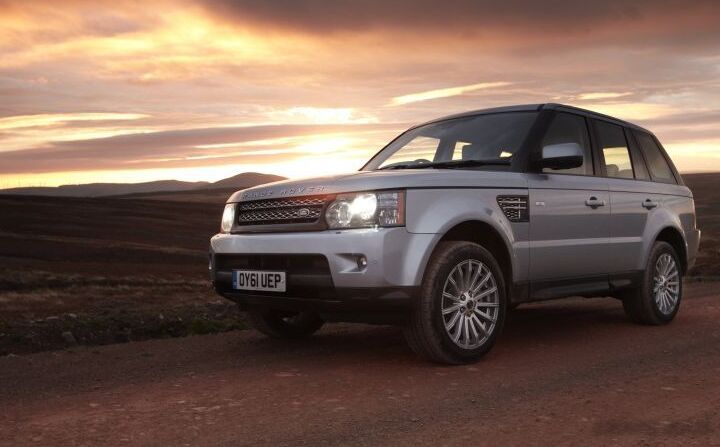
The Land Rover Range Rover Sport I, specifically the facelifted version produced between 2009 and 2011, represented a significant refinement of the original Sport model launched in 2005. This iteration aimed to bridge the gap between the full-size Range Rover and the more accessible Land Rover Discovery, offering a blend of luxury, performance, and off-road capability. Among the engine options available, the 3.0 LR-TD V6 (245 Hp) AWD Automatic variant occupied a crucial middle ground, appealing to buyers seeking a balance of fuel efficiency and respectable power. This model was positioned as a more economical alternative to the supercharged V8 options, while still providing the Range Rover Sport’s signature driving experience.
Technical Specifications
| Brand | Land Rover |
| Model | Range Rover Sport |
| Generation | Range Rover Sport I (facelift 2009) |
| Type (Engine) | 3.0 LR-TD V6 (245 Hp) AWD Automatic |
| Start of production | 2009 |
| End of production | 2011 |
| Powertrain Architecture | Internal Combustion engine |
| Body type | SUV |
| Seats | 5 |
| Doors | 5 |
| Fuel consumption (combined) | 9.2 l/100 km (25.6 US mpg, 30.7 UK mpg, 10.9 km/l) |
| CO2 emissions | 243 g/km |
| Fuel Type | Diesel |
| Acceleration 0 – 100 km/h | 9.3 sec |
| Acceleration 0 – 62 mph | 9.3 sec |
| Acceleration 0 – 60 mph | 8.8 sec |
| Maximum speed | 193 km/h (119.92 mph) |
| Emission standard | Euro 5 |
| Power | 245 Hp @ 4000 rpm |
| Power per litre | 81.9 Hp/l |
| Torque | 600 Nm @ 2000 rpm (442.54 lb.-ft. @ 2000 rpm) |
| Engine layout | Front, Longitudinal |
| Engine Model/Code | 306DT |
| Engine displacement | 2993 cm3 (182.64 cu. in.) |
| Number of cylinders | 6 |
| Engine configuration | V-engine |
| Cylinder Bore | 84 mm (3.31 in.) |
| Piston Stroke | 90 mm (3.54 in.) |
| Compression ratio | 16:1 |
| Number of valves per cylinder | 4 |
| Fuel injection system | Diesel Commonrail |
| Engine aspiration | BiTurbo, Intercooler |
| Engine oil capacity | 5.9 l (6.23 US qt | 5.19 UK qt) |
| Coolant | 11.5 l (12.15 US qt | 10.12 UK qt) |
| Fuel tank capacity | 84.1 l (22.22 US gal | 18.5 UK gal) |
| Length | 4783 mm (188.31 in.) |
| Width with mirrors folded | 2004 mm (78.9 in.) |
| Height | 1784 mm (70.24 in.) |
| Wheelbase | 2745 mm (108.07 in.) |
| Front track | 1605 mm (63.19 in.) |
| Rear track | 1612 mm (63.46 in.) |
| Drive wheel | All wheel drive (4×4) |
| Number of gears and type of gearbox | 6 gears, automatic transmission |
| Front brakes | Ventilated discs |
| Rear brakes | Ventilated discs |
Powertrain & Engine Architecture
The heart of this Range Rover Sport variant is the 3.0-liter LR-TD V6 engine, designated as the 306DT. This engine is a modern diesel powerplant featuring a 60-degree V-configuration. It utilizes a common rail direct injection system, delivering fuel at extremely high pressures for optimized combustion. Crucially, this engine employs a sequential twin-turbocharger setup. A smaller turbocharger provides quick response at low engine speeds, minimizing turbo lag, while a larger turbocharger kicks in at higher RPMs to deliver peak power. An intercooler further enhances performance by cooling the compressed intake air. The engine produces 245 horsepower at 4000 rpm and a substantial 600 Nm (442.54 lb.-ft.) of torque at just 2000 rpm. This torque output is a key characteristic of the engine, providing strong pulling power for towing and off-road driving. The engine is paired with a six-speed automatic transmission, designed to handle the engine’s torque output and provide smooth gear changes. The transmission features a ‘CommandShift’ function, allowing the driver to manually select gears for greater control.
Driving Characteristics
The 3.0 LR-TD V6 Automatic Range Rover Sport offers a distinctly different driving experience compared to its higher-powered siblings. While it doesn’t possess the outright acceleration of the supercharged V8 models, it delivers a more relaxed and refined driving experience. The abundance of low-end torque makes it effortless to drive in everyday situations, providing strong acceleration for overtaking and merging onto highways. The automatic transmission is well-tuned, offering smooth and predictable gear changes. However, it isn’t as sporty or responsive as the transmissions found in performance-oriented SUVs. Compared to the manual transmission versions of the same engine, the automatic sacrifices some driver engagement but gains convenience. The 0-60 mph time of around 8.8 seconds is respectable for a vehicle of this size and weight, but it’s noticeably slower than the V8-powered models. The all-wheel-drive system provides excellent traction in various conditions, making it a capable performer both on and off-road.
Equipment & Trim Levels
The 3.0 LR-TD V6 Automatic typically came equipped with a generous level of standard features. These included leather upholstery, dual-zone climate control, a premium audio system, and parking sensors. Depending on the year and specific package options, features like heated seats, a sunroof, and navigation system were available. The interior design was luxurious and well-appointed, reflecting the Range Rover brand’s commitment to quality. The trim level often sat in the mid-range of the Range Rover Sport lineup, offering a good balance of features and price. Optional extras could significantly increase the vehicle’s price, allowing buyers to customize their vehicle to their specific needs and preferences.
Chassis & Braking
The Range Rover Sport I utilizes a robust chassis designed for both on-road comfort and off-road capability. It features fully independent suspension with air springs, providing a smooth and controlled ride. The suspension system automatically adjusts to varying road conditions, optimizing ride height and damping. The 3.0 LR-TD V6 models were equipped with ventilated disc brakes on all four wheels, providing ample stopping power. An anti-lock braking system (ABS) and electronic stability control (ESC) were standard features, enhancing safety and control. The steering system is a power-assisted rack and pinion setup, offering precise and responsive steering feel.
Market Reception & Comparison
The 3.0 LR-TD V6 Automatic Range Rover Sport was generally well-received by automotive critics. It was praised for its fuel efficiency, comfortable ride, and strong torque output. However, some critics noted that it lacked the outright performance of the V8 models. Compared to the 3.6 TDV8 and supercharged V8 variants, the 3.0 LR-TD V6 offered significantly better fuel economy, making it a more practical choice for everyday driving. Its reliability was generally considered good, although diesel engines can be more complex and potentially more expensive to repair than gasoline engines. In the used car market, this variant represents a good value proposition, offering a luxurious and capable SUV at a more affordable price point.
Legacy
The 3.0 LR-TD V6 engine became a mainstay in the Land Rover lineup for several years, powering various models including the Discovery and Evoque. The powertrain, when properly maintained, has proven to be relatively durable. Common issues include turbocharger wear and potential problems with the diesel particulate filter (DPF), particularly on vehicles that are primarily used for short trips. Today, the 2009-2011 Range Rover Sport 3.0 LR-TD V6 Automatic remains a popular choice in the used car market, appealing to buyers who prioritize fuel efficiency, comfort, and all-weather capability. Its blend of luxury and practicality ensures its continued relevance in the premium SUV segment.