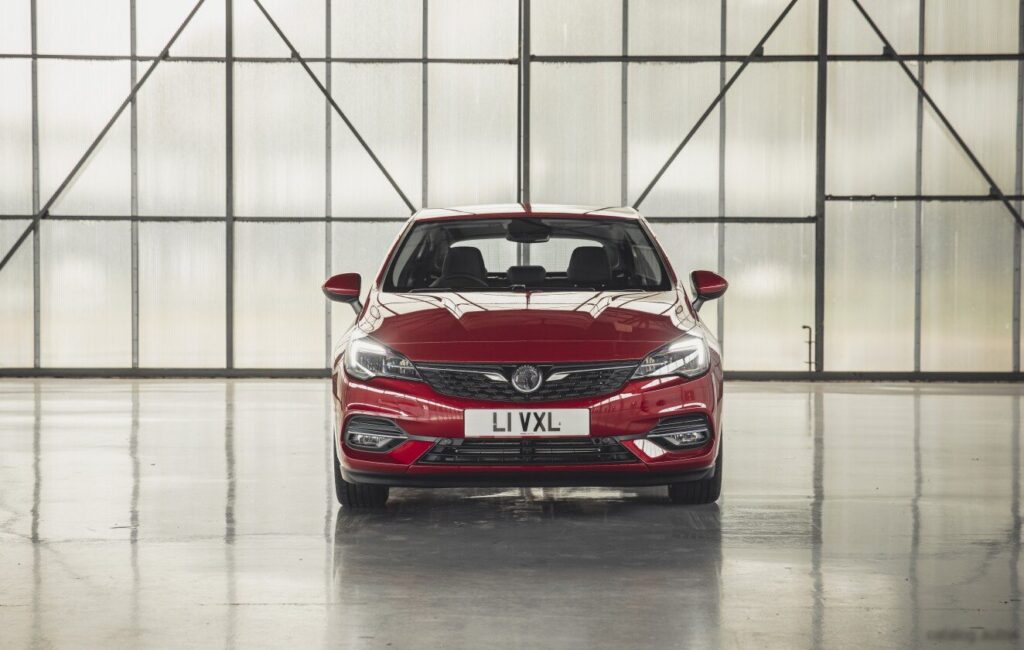
The Vauxhall Astra Mk VII, facelifted in 2019, represented a significant evolution of Opel/Vauxhall’s compact family car. The 1.2 Turbo variant, producing 145 horsepower, was introduced as part of this refresh, aiming to balance fuel efficiency with respectable performance. Production of this specific configuration ran from 2019 until November 2021. Positioned as a mid-range offering within the Mk VII lineup, it slotted between the lower-powered 1.0-liter models and the more performance-oriented versions. The Mk VII Astra, built on the GM Delta platform (also known internally as 1HX0/A3), was a crucial model for Vauxhall in the European market, competing directly with the Ford Focus, Volkswagen Golf, and Peugeot 308.
Technical Specifications
| Brand | Vauxhall |
| Model | Astra |
| Generation | Astra Mk VII (facelift 2019) |
| Type (Engine) | 1.2 Turbo (145 Hp) |
| Start of production | 2019 |
| End of production | November, 2021 |
| Powertrain Architecture | Internal Combustion engine |
| Body type | Hatchback |
| Seats | 5 |
| Doors | 5 |
| Combined fuel consumption (WLTP) | 5.2-5.5 l/100 km (45.2 – 42.8 US mpg, 54.3 – 51.4 UK mpg, 19.2 – 18.2 km/l) |
| CO2 emissions (NEDC, WLTP equivalent) | 99 g/km |
| Fuel Type | Petrol (Gasoline) |
| Maximum speed | 220 km/h (136.7 mph) |
| Emission standard | Euro 6d |
| Power | 145 Hp @ 5500 rpm |
| Power per litre | 120.9 Hp/l |
| Torque | 225 Nm @ 2000-3500 rpm (165.95 lb.-ft. @ 2000-3500 rpm) |
| Engine layout | Front, Transverse |
| Engine Model/Code | F12SHR |
| Engine displacement | 1199 cm3 (73.17 cu. in.) |
| Number of cylinders | 3 |
| Engine configuration | Inline |
| Number of valves per cylinder | 4 |
| Fuel injection system | Direct injection |
| Engine aspiration | Turbocharger, Intercooler |
| Valvetrain | DOHC, VVT |
| Engine oil capacity | 4 l (4.23 US qt | 3.52 UK qt) |
| Coolant | 5.4 l (5.71 US qt | 4.75 UK qt) |
| Max. weight | 1805 kg (3979.34 lbs.) |
| Trunk (boot) space – minimum | 370 l (13.07 cu. ft.) |
| Trunk (boot) space – maximum | 1210 l (42.73 cu. ft.) |
| Fuel tank capacity | 48 l (12.68 US gal | 10.56 UK gal) |
| Permitted trailer load with brakes (12%) | 1350 kg (2976.24 lbs.) |
| Permitted trailer load without brakes | 620 kg (1366.87 lbs.) |
| Length | 4370 mm (172.05 in.) |
| Width | 1809 mm (71.22 in.) |
| Width including mirrors | 2042 mm (80.39 in.) |
| Height | 1485 mm (58.46 in.) |
| Wheelbase | 2662 mm (104.8 in.) |
| Front overhang | 960 mm (37.8 in.) |
| Rear overhang | 748 mm (29.45 in.) |
| Drag coefficient (Cd) | 0.26 |
| Minimum turning circle (turning diameter) | 11.05 m (36.25 ft.) |
| Drivetrain Architecture | The Internal combustion engine (ICE) drives the front wheels of the vehicle. |
| Drive wheel | Front wheel drive |
| Number of gears and type of gearbox | 6 gears, manual transmission |
| Front suspension | Independent type McPherson |
| Rear suspension | Semi-independent, coil spring |
| Front brakes | Ventilated discs, 276 mm |
| Rear brakes | Disc, 264 mm |
| Assisting systems | ABS (Anti-lock braking system) |
| Steering type | Steering rack and pinion |
| Power steering | Electric Steering |
| Tires size | 225/45 R17; 225/40 R18 |
| Wheel rims size | 17; 18 |
Powertrain & Engine Architecture
The heart of this Astra variant is the F12SHR engine, a 1.2-liter turbocharged three-cylinder gasoline engine. This engine belongs to Opel/Vauxhall’s Small Engine Family (SEF), designed for modularity and efficiency. The F12SHR utilizes direct fuel injection, delivering fuel directly into the combustion chamber for improved combustion efficiency and reduced emissions. It also features a double overhead camshaft (DOHC) valvetrain with variable valve timing (VVT) on both intake and exhaust valves, optimizing engine performance across the rev range. The turbocharger, coupled with an intercooler, provides a boost in power and torque, compensating for the relatively small displacement. The engine is transversely mounted at the front of the vehicle. The 1.2 Turbo was typically paired with a six-speed manual transmission, although an automatic option was also available, though less common. The manual transmission offered precise shifts and contributed to the car’s overall responsiveness.
Driving Characteristics
The 145 horsepower and 225 Nm (166 lb-ft) of torque provided by the 1.2 Turbo engine offered a good balance between performance and fuel economy. Acceleration from 0 to 60 mph was typically around 9.5 seconds, making it suitable for everyday driving. While not a sports car, the engine provided sufficient power for overtaking maneuvers and maintaining comfortable cruising speeds on the highway. Compared to the lower-powered 1.0-liter versions, the 1.2 Turbo offered a noticeable improvement in responsiveness, particularly at higher speeds. However, it didn’t match the outright performance of the more powerful Astra models, such as those equipped with larger engines. The six-speed manual transmission allowed drivers to keep the engine in its optimal power band, maximizing efficiency and responsiveness. The gear ratios were well-chosen for both city and highway driving.
Equipment & Trim Levels
The 1.2 Turbo trim typically included features such as air conditioning, a touchscreen infotainment system with Apple CarPlay and Android Auto compatibility, Bluetooth connectivity, and alloy wheels. Higher trim levels, such as ‘Tech Line’ or ‘Elite’, added features like heated seats, a larger touchscreen display, advanced safety systems (automatic emergency braking, lane departure warning), and parking sensors. Interior upholstery was generally cloth, with leather options available on higher trims. Dashboard configuration was consistent across the Mk VII range, featuring a clean and modern design. Optional extras included a panoramic sunroof, navigation system, and premium audio system.
Chassis & Braking
The Astra Mk VII utilized an independent McPherson strut suspension at the front and a semi-independent torsion beam suspension at the rear. This setup provided a good balance between ride comfort and handling. The front brakes were ventilated discs measuring 276mm, while the rear brakes were solid discs measuring 264mm. Anti-lock Braking System (ABS) was standard. Stabilizer bars were fitted to both the front and rear axles to reduce body roll during cornering. The chassis was tuned to provide a comfortable and predictable driving experience, prioritizing stability and ease of use over outright sportiness.
Market Reception & Comparison
The 1.2 Turbo Astra was generally well-received by automotive critics. It was praised for its fuel efficiency, comfortable ride, and well-equipped interior. However, some reviewers noted that the engine could feel strained when pushed hard, and the three-cylinder engine’s inherent vibrations were noticeable at idle. Compared to the 1.0-liter models, the 1.2 Turbo offered a significant improvement in performance, making it a more appealing option for drivers who frequently travel on the highway or carry passengers. In terms of reliability, the 1.2 Turbo engine proved to be generally dependable, although some owners reported issues with the turbocharger and fuel injectors. Fuel economy was a strong point, consistently achieving around 45-50 mpg in real-world driving conditions.
Legacy
The Vauxhall Astra Mk VII 1.2 Turbo (145 Hp) remains a popular choice in the used car market, offering a good balance of affordability, fuel efficiency, and practicality. The engine, while not without its quirks, has proven to be relatively durable with proper maintenance. Parts availability is generally good, and repair costs are reasonable. The Mk VII Astra represents a solid all-around family car, and the 1.2 Turbo variant provides a compelling option for buyers seeking a comfortable and efficient compact hatchback.