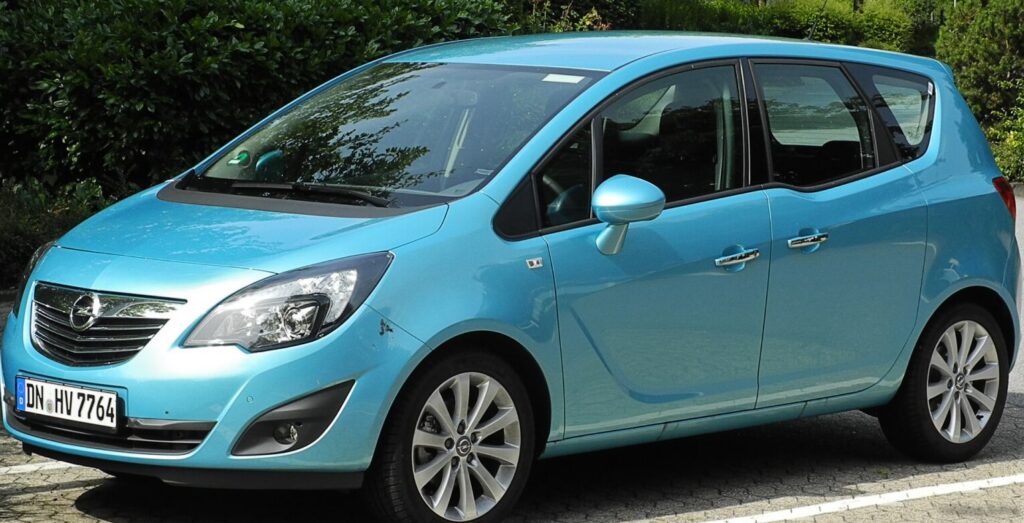
The Opel Meriva B 1.7 CDTI Automatic, produced between July 2010 and October 2013, represented a significant offering in the European compact minivan segment. Positioned as a mid-range trim within the Meriva B lineup, this variant combined a fuel-efficient diesel engine with the convenience of an automatic transmission, appealing to families and drivers prioritizing practicality and ease of use. It was a key component of the second-generation Meriva (A17), known for its innovative FlexSpace interior and focus on versatility. This model aimed to provide a balance between performance, economy, and comfort, making it a popular choice in several European markets.
Technical Specifications
| Brand | Opel |
| Model | Meriva |
| Generation | Meriva B |
| Type (Engine) | 1.7 CDTI (130 Hp) Automatic |
| Start of production | July, 2010 |
| End of production | October, 2013 |
| Powertrain Architecture | Internal Combustion engine |
| Body type | Minivan |
| Seats | 5 |
| Doors | 5 |
| Fuel consumption (combined) | 6.1 l/100 km (38.6 US mpg, 46.3 UK mpg, 16.4 km/l) |
| CO2 emissions | 139 g/km |
| Fuel Type | Diesel |
| Acceleration 0 – 100 km/h | 9.9 sec |
| Acceleration 0 – 62 mph | 9.9 sec |
| Acceleration 0 – 60 mph | 9.4 sec |
| Maximum speed | 196 km/h (121.79 mph) |
| Emission standard | Euro 5 |
| Weight-to-power ratio | 11 kg/Hp, 91 Hp/tonne |
| Weight-to-torque ratio | 4.8 kg/Nm, 210.1 Nm/tonne |
| Power | 130 Hp @ 4000 rpm |
| Power per litre | 77.1 Hp/l |
| Torque | 300 Nm @ 2000-2500 rpm (221.27 lb.-ft. @ 2000-2500 rpm) |
| Engine layout | Front, Transverse |
| Engine Model/Code | A17DTS |
| Engine displacement | 1686 cm3 (102.89 cu. in.) |
| Number of cylinders | 4 |
| Engine configuration | Inline |
| Compression ratio | 16.5:1 |
| Number of valves per cylinder | 4 |
| Fuel injection system | Diesel Commonrail |
| Engine aspiration | Turbocharger, Intercooler |
| Engine oil capacity | 5.4 l (5.71 US qt | 4.75 UK qt) |
| Coolant | 7.1 l (7.5 US qt | 6.25 UK qt) |
| Kerb Weight | 1428 kg (3148.2 lbs.) |
| Max. weight | 2025 kg (4464.36 lbs.) |
| Max load | 597 kg (1316.16 lbs.) |
| Trunk (boot) space – minimum | 400 l (14.13 cu. ft.) |
| Trunk (boot) space – maximum | 1500 l (52.97 cu. ft.) |
| Fuel tank capacity | 54 l (14.27 US gal | 11.88 UK gal) |
| Length | 4288 mm (168.82 in.) |
| Width | 1994 mm (78.5 in.) |
| Height | 1615 mm (63.58 in.) |
| Wheelbase | 2644 mm (104.09 in.) |
| Front track | 1488 mm (58.58 in.) |
| Rear (Back) track | 1509 mm (59.41 in.) |
| Minimum turning circle | 11.06 m (36.29 ft.) |
| Drivetrain Architecture | Front wheel drive |
| Number of gears and type of gearbox | 6 gears, automatic transmission |
| Assisting systems | ABS (Anti-lock braking system) |
| Steering type | Steering rack and pinion |
| Tires size | 205/55 R16 |
| Wheel rims size | 16 |
INTRODUCTION
The Opel Meriva B, launched in 2010, represented a significant departure from its predecessor, focusing on interior space and flexibility. The 1.7 CDTI Automatic variant, powered by the A17DTS engine, was introduced as a practical and efficient option for buyers seeking a comfortable and economical family vehicle. This model sat in the middle of the Meriva B range, offering a step up in performance and refinement compared to the base 1.4-liter petrol engine, while remaining more affordable than the higher-powered diesel options. It was primarily marketed in Europe, where compact MPVs were a popular choice for families.
Powertrain & Engine Architecture
The heart of the Meriva B 1.7 CDTI Automatic is the A17DTS engine, a 1.7-liter inline-four cylinder diesel. This engine utilizes a common rail direct injection system, delivering fuel directly into the combustion chamber at extremely high pressure for improved efficiency and reduced emissions. A turbocharger with an intercooler further enhances performance by forcing more air into the engine. The engine produces 130 horsepower at 4000 rpm and 300 Nm (221 lb-ft) of torque between 2000 and 2500 rpm. This torque output, available across a broad rev range, is particularly well-suited to the demands of everyday driving and provides ample pulling power for a fully loaded vehicle.
The engine is paired with a six-speed automatic transmission. This transmission, while not known for particularly sporty shifts, prioritizes smooth operation and fuel efficiency. It features adaptive shift patterns, adjusting to the driver’s style and road conditions. The automatic transmission contributed to the Meriva’s appeal for drivers who preferred the convenience of not having to manually shift gears, especially in urban traffic.
Driving Characteristics
The 1.7 CDTI Automatic Meriva B offers a comfortable and relaxed driving experience. While not a performance-oriented vehicle, the engine provides sufficient power for everyday driving situations, including highway cruising and overtaking. Acceleration from 0 to 60 mph takes approximately 9.4 seconds, and the top speed is around 122 mph. The automatic transmission contributes to a smooth and effortless driving experience, although it can sometimes feel hesitant when downshifting. Compared to the manual transmission version of the same engine, the automatic offers slightly reduced fuel economy and acceleration, but provides greater convenience. Compared to the more powerful 1.7 CDTI (165 hp) variant, this version offers a more economical driving experience, but with a noticeable reduction in outright performance.
Equipment & Trim Levels
The 1.7 CDTI Automatic trim typically included features such as air conditioning, electric front windows, a CD/radio system, and ABS brakes. Higher trim levels, such as the Cosmo, added features like alloy wheels, climate control, parking sensors, and a more sophisticated infotainment system. The interior upholstery was typically cloth, with options for leather upgrades. The Meriva B was particularly praised for its flexible interior, with the FlexSpace rear seating system allowing for multiple configurations to maximize cargo space. Optional extras included a panoramic sunroof, navigation system, and upgraded audio systems.
Chassis & Braking
The Meriva B utilizes a MacPherson strut front suspension and a torsion beam rear suspension. This setup provides a comfortable ride quality, absorbing bumps and imperfections in the road effectively. The front brakes are ventilated discs, while the rear brakes are typically drums on lower trim levels and discs on higher trims. The steering is a rack and pinion system, providing precise and responsive handling. The 1.7 CDTI Automatic variant, due to its increased weight compared to the petrol models, benefits from a slightly stiffer suspension setup to maintain stability and control.
Market Reception & Comparison
The Opel Meriva B 1.7 CDTI Automatic was generally well-received by automotive critics. It was praised for its spacious interior, flexible seating arrangements, and fuel-efficient engine. However, some critics noted that the automatic transmission could be slow to respond at times. Compared to competitors such as the Ford C-Max and Renault Scenic, the Meriva B offered a compelling combination of practicality, affordability, and fuel economy. The 1.7 CDTI Automatic offered better fuel economy than the petrol-powered versions, but the higher-powered diesel variants provided more spirited performance.
Legacy
The Opel Meriva B 1.7 CDTI Automatic has proven to be a relatively reliable vehicle, with the A17DTS engine generally considered durable. Common issues include diesel particulate filter (DPF) problems, particularly on vehicles that are primarily used for short journeys. Regular maintenance, including oil changes and DPF regeneration, is crucial for ensuring long-term reliability. In the used car market, the Meriva B 1.7 CDTI Automatic remains a popular choice for budget-conscious buyers seeking a practical and economical family vehicle. Its spacious interior, fuel efficiency, and comfortable ride continue to make it a viable option for those needing a versatile and affordable MPV.