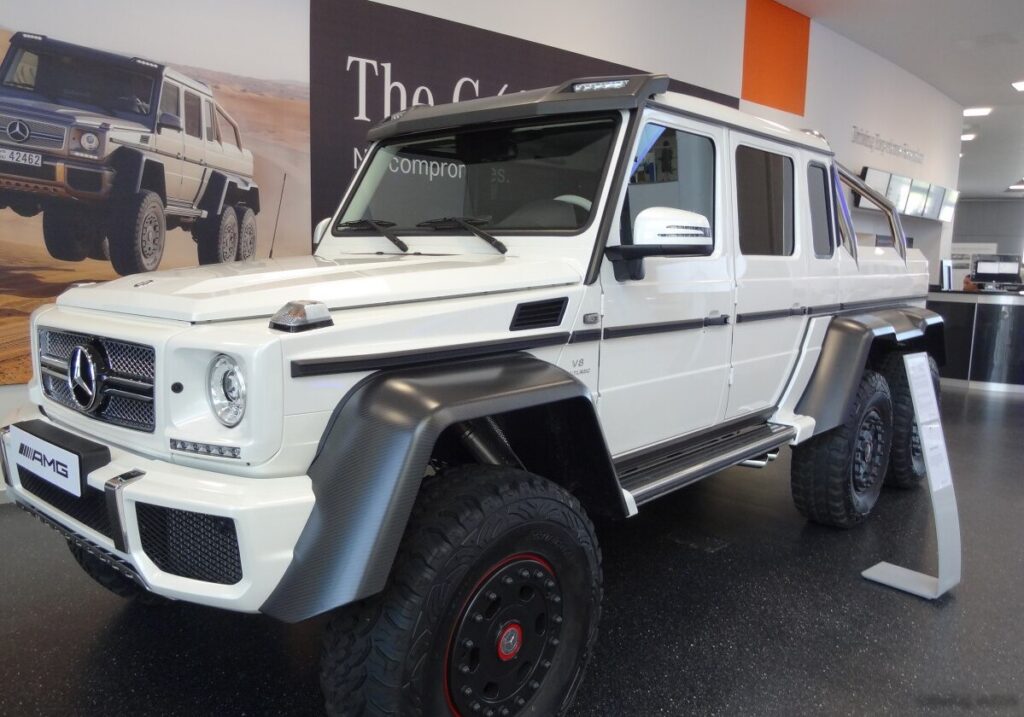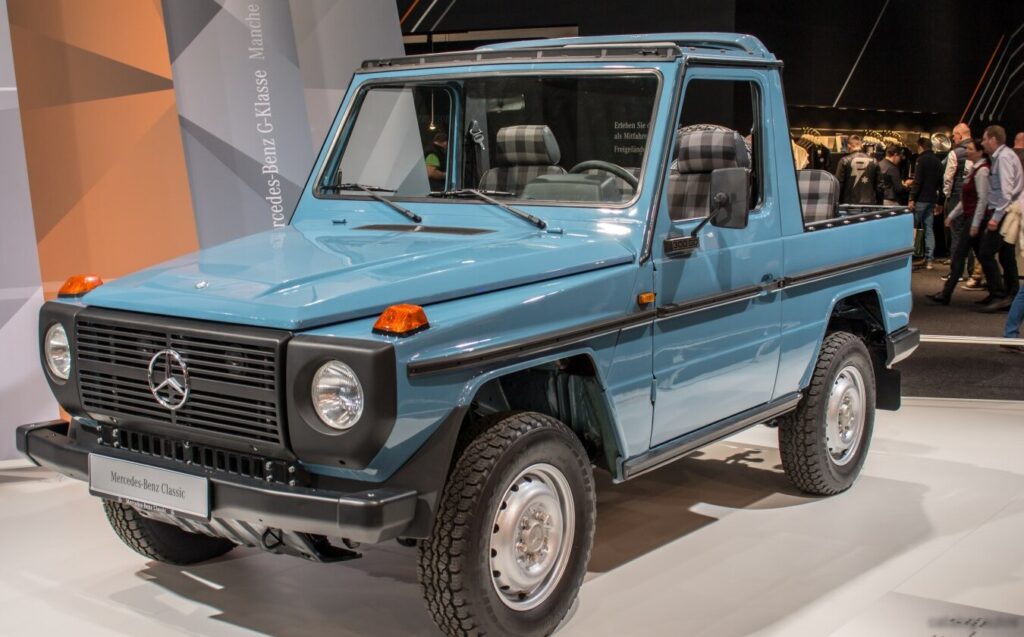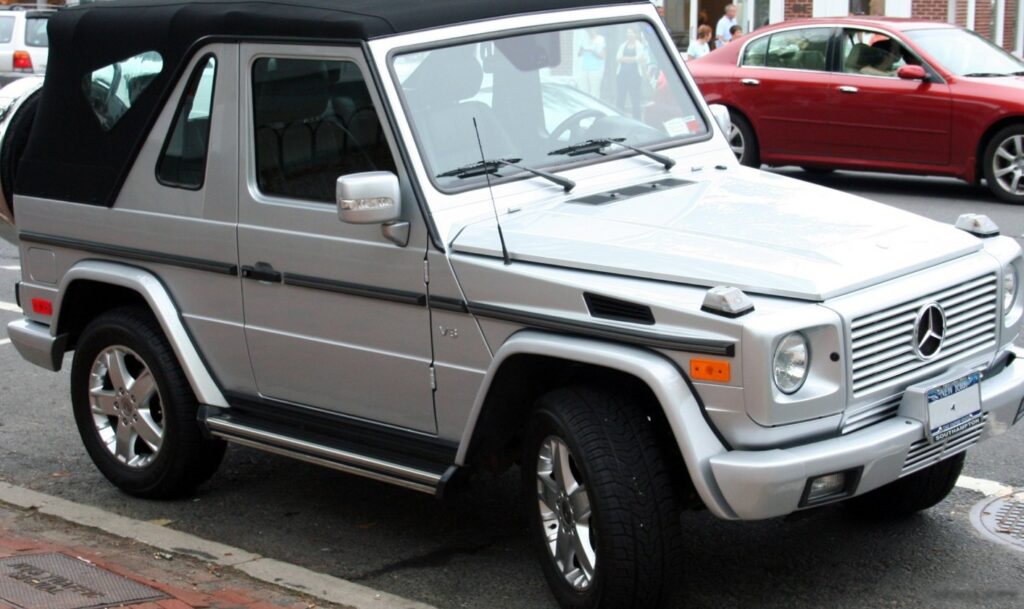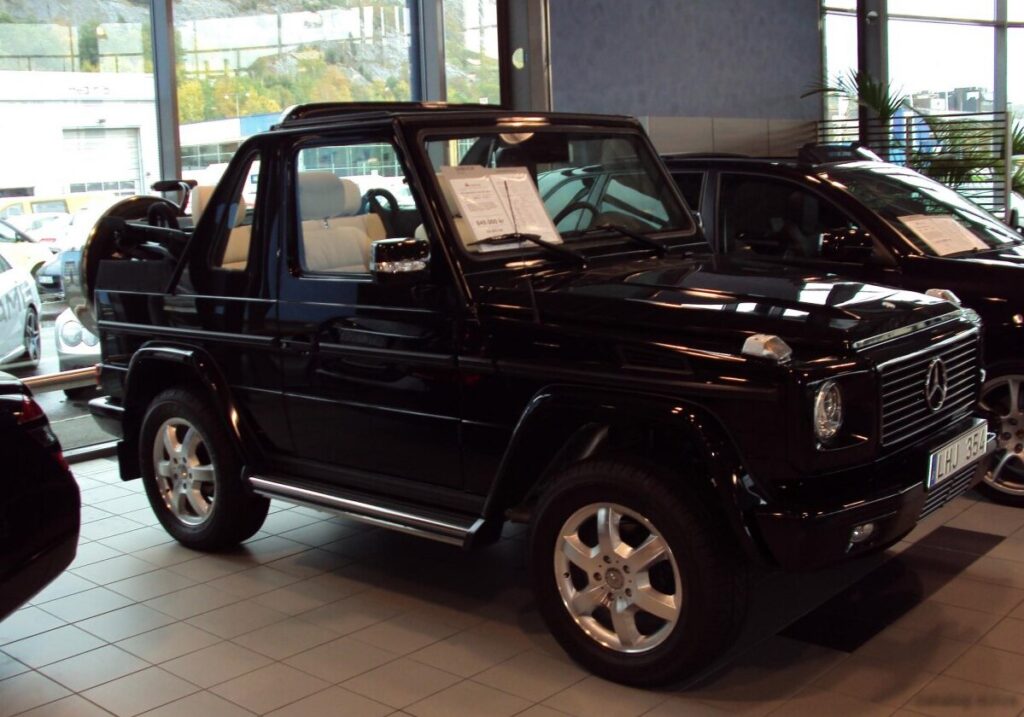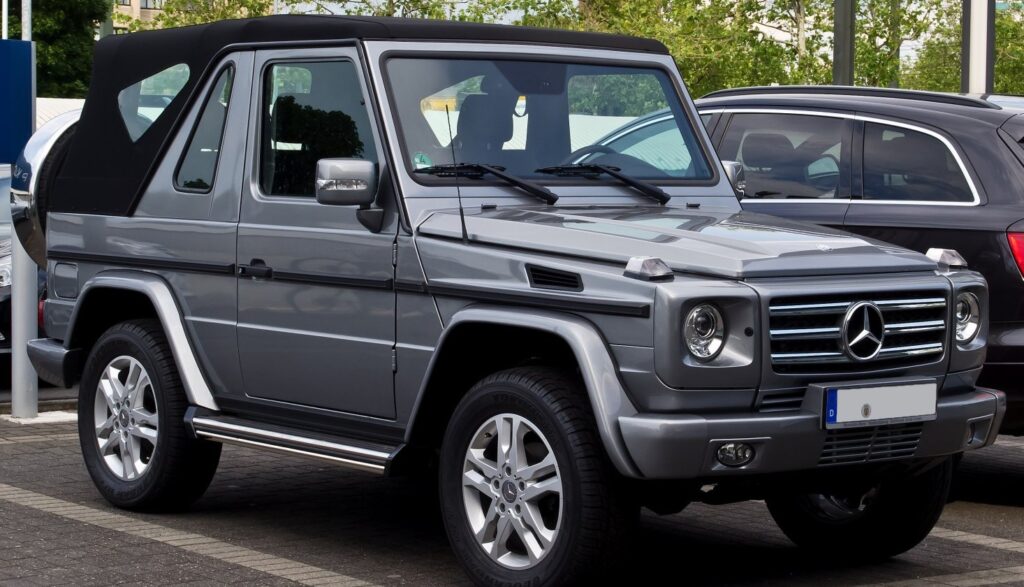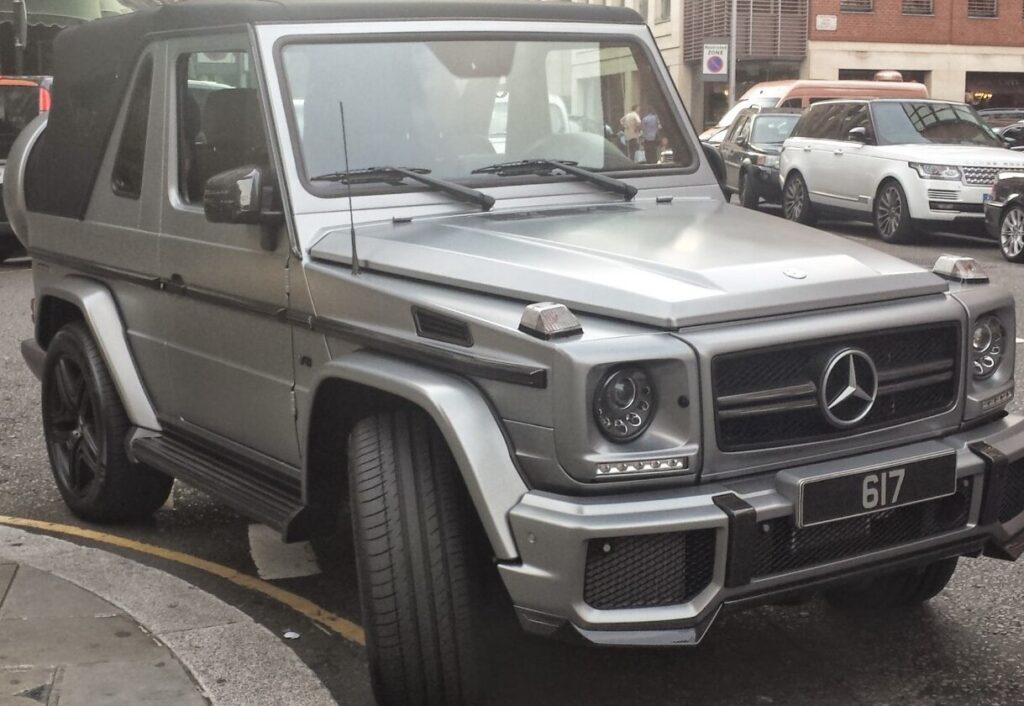
The Mercedes-Benz G-Class Cabriolet G 500 V8 (388 Hp) 4MATIC, produced from 2012 to 2013, represents a unique iteration of the iconic G-Wagen. This variant, part of the W463 facelift series, combined the rugged off-road capability synonymous with the G-Class with the open-air experience of a convertible. Positioned as a premium offering within the G-Class lineup, it catered to buyers seeking both luxury and adventurous versatility. The 2012-2013 G 500 Cabriolet was primarily sold in Europe and select international markets, offering a distinctive alternative to the more common hardtop G-Class models.
Technical Specifications
| Brand | Mercedes-Benz |
| Model | G-class |
| Generation | G-class Cabriolet (W463, facelift 2012) |
| Type (Engine) | G 500 V8 (388 Hp) 4MATIC 7G-TRONIC PLUS |
| Start of production | 2012 |
| End of production | 2013 |
| Powertrain Architecture | Internal Combustion engine |
| Body type | Off-road vehicle, Cabriolet |
| Seats | 4 |
| Doors | 2 |
| Fuel consumption (economy) – urban (NEDC) | 20 l/100 km (11.8 US mpg, 14.1 UK mpg, 5 km/l) |
| Fuel consumption (economy) – extra urban (NEDC) | 11.9 l/100 km (19.8 US mpg, 23.7 UK mpg, 8.4 km/l) |
| Fuel consumption (economy) – combined (NEDC) | 14.9 l/100 km (15.8 US mpg, 19 UK mpg, 6.7 km/l) |
| CO2 emissions (NEDC) | 348 g/km |
| Fuel Type | Petrol (Gasoline) |
| Acceleration 0 – 100 km/h | 5.9 sec |
| Acceleration 0 – 62 mph | 5.9 sec |
| Acceleration 0 – 60 mph | 5.6 sec |
| Maximum speed | 210 km/h (130.49 mph) – Electronically limited |
| Emission standard | Euro 5 |
| Weight-to-power ratio | 5.9 kg/Hp, 168.3 Hp/tonne |
| Weight-to-torque ratio | 4.3 kg/Nm, 229.9 Nm/tonne |
| Power | 388 Hp @ 6000 rpm |
| Power per litre | 71 Hp/l |
| Torque | 530 Nm @ 2800-4800 rpm (390.91 lb.-ft. @ 2800-4800 rpm) |
| Engine layout | Front, Longitudinal |
| Engine Model/Code | M 273.963 |
| Engine displacement | 5461 cm3 (333.25 cu. in.) |
| Number of cylinders | 8 |
| Engine configuration | V-engine |
| Cylinder Bore | 98 mm (3.86 in.) |
| Piston Stroke | 90.5 mm (3.56 in.) |
| Compression ratio | 10.7:1 |
| Number of valves per cylinder | 4 |
| Fuel injection system | Multi-port manifold injection |
| Engine aspiration | Naturally aspirated engine |
| Valvetrain | DOHC |
| Engine oil capacity | 9 l (9.51 US qt | 7.92 UK qt) |
| Kerb Weight | 2305 kg (5081.66 lbs.) |
| Max. weight | 2850 kg (6283.17 lbs.) |
| Max load | 545 kg (1201.52 lbs.) |
| Trunk (boot) space – minimum | 238 l (8.4 cu. ft.) |
| Trunk (boot) space – maximum | 1580 l (55.8 cu. ft.) |
| Fuel tank capacity | 96 l (25.36 US gal | 21.12 UK gal) |
| Permitted trailer load with brakes (12%) | 2850 kg (6283.17 lbs.) |
| Permitted trailer load without brakes | 750 kg (1653.47 lbs.) |
| Length | 4257 mm (167.6 in.) |
| Width | 1760 mm (69.29 in.) |
| Width including mirrors | 2055 mm (80.91 in.) |
| Height | 1951 mm (76.81 in.) |
| Wheelbase | 2400 mm (94.49 in.) |
| Front track | 1475 mm (58.07 in.) |
| Rear (Back) track | 1475 mm (58.07 in.) |
| Front overhang | 783 mm (30.83 in.) |
| Rear overhang | 820 mm (32.28 in.) |
| Ride height (ground clearance) | 205 mm (8.07 in.) |
| Drag coefficient (Cd) | 0.54 |
| Minimum turning circle (turning diameter) | 11.3 m (37.07 ft.) |
| Approach angle | 36° |
| Departure angle | 27° |
| Ramp-over (brakeover) angle | 23° |
| Climb angle | 38.7° |
| Wading depth | 600 mm (23.62 in.) |
| Drivetrain Architecture | The Internal combustion engine (ICE) drives permanently the four wheels of the vehicle. |
| Drive wheel | All wheel drive (4×4) |
| Number of gears and type of gearbox | 7 gears, automatic transmission G-TRONIC PLUS |
| Front suspension | Coil spring, Rigid axle suspension, Trailing arm |
| Rear suspension | Rigid axle suspension, Trailing arm, Coil spring |
| Front brakes | Ventilated discs |
| Rear brakes | Disc |
| Assisting systems | ABS (Anti-lock braking system) |
| Steering type | Cone worm with recirculation balls |
| Power steering | Hydraulic Steering |
| Tires size | 265/60 R18 |
| Wheel rims size | 7.5J x 18 |
INTRODUCTION
The G 500 V8 Cabriolet, produced between 2012 and 2013, was a facelifted version of the W463 G-Class, benefiting from updates to the interior, exterior, and powertrain. It continued the G-Class tradition of combining luxurious appointments with exceptional off-road capability, but with the added appeal of open-top motoring. This model occupied the upper echelon of the G-Class range, offering a more exclusive and powerful alternative to the G 350 d or G 55 AMG variants. The Cabriolet body style, while less common than the standard wagon, added a unique dimension to the G-Class’s already distinctive character.
Powertrain & Engine Architecture
At the heart of the G 500 V8 Cabriolet lies the M 273.963 5.5-liter naturally aspirated V8 engine. This engine, a mainstay of many Mercedes-Benz models during this period, produced 388 horsepower at 6000 rpm and 530 Nm (390.91 lb-ft) of torque between 2800 and 4800 rpm. The engine featured a three-valve per cylinder design (two intake, one exhaust) and multi-port fuel injection. The M 273 engine was known for its smooth power delivery and robust construction. Power was transmitted to all four wheels via a 7G-TRONIC PLUS seven-speed automatic transmission. This transmission offered smooth and responsive shifts, contributing to both on-road refinement and off-road control. The 4MATIC all-wheel-drive system employed a permanent all-wheel drive setup with a center differential, providing excellent traction in various conditions.
Driving Characteristics
The G 500 V8 Cabriolet offered a unique driving experience. While the V8 engine provided ample power for swift acceleration – 0-60 mph in approximately 5.6 seconds – the vehicle’s substantial weight (2305 kg / 5081.66 lbs) and boxy shape meant it wasn’t a sports car. The 7G-TRONIC transmission was well-matched to the engine, providing smooth gear changes and helping to keep the engine in its optimal power band. Off-road, the G 500 excelled, thanks to its robust 4MATIC system, three locking differentials, and high ground clearance. The Cabriolet configuration did introduce some body flex compared to the hardtop models, but the overall structural rigidity was still impressive for an open-top vehicle of this type. The steering, while hydraulic, felt somewhat heavy and lacked the precision of more modern systems.
Equipment & Trim Levels
The G 500 V8 Cabriolet came standard with a high level of equipment, befitting its premium positioning. Standard features included leather upholstery, heated front seats, automatic climate control, a premium audio system, and parking sensors. The interior trim was typically finished with wood or aluminum accents. Optional extras included a sunroof (in addition to the convertible top), upgraded leather, a navigation system, and various driver assistance features. The Cabriolet also featured a power-operated soft top, which could be opened or closed at the touch of a button.
Chassis & Braking
The G-Class chassis remained largely unchanged from its original 1979 design, retaining a ladder-frame construction. This provided exceptional durability and off-road capability. The suspension consisted of coil springs and rigid axles front and rear, offering a comfortable ride despite the vehicle’s rugged nature. Braking duties were handled by ventilated discs at the front and solid discs at the rear, assisted by ABS. While adequate for the vehicle’s weight and performance, the braking system wasn’t particularly sporty.
Market Reception & Comparison
The G 500 V8 Cabriolet was generally well-received by critics, who praised its unique combination of luxury, performance, and off-road capability. However, its high price tag and relatively poor fuel economy (14.9 l/100 km combined) were often cited as drawbacks. Compared to the G 350 d, the G 500 offered significantly more power and a more refined driving experience, but at a considerable cost. The G 55 AMG provided even greater performance, but with a more aggressive character and a higher price point. The G 500 Cabriolet appealed to buyers who wanted a luxurious and capable off-roader with the added enjoyment of open-top motoring.
Legacy
The M 273 V8 engine, while superseded by more modern designs, proved to be a reliable and durable powerplant. The 7G-TRONIC transmission also enjoyed a good reputation for longevity. Today, the 2012-2013 G 500 V8 Cabriolet is a sought-after vehicle among collectors and enthusiasts. Its rarity, combined with the enduring appeal of the G-Class, ensures that it remains a desirable and valuable classic. Maintenance costs can be high, due to the vehicle’s complexity and the cost of parts, but well-maintained examples continue to provide years of reliable service.