Technical Specifications
| Brand | Opel |
| Model | Meriva |
| Generation | Meriva B (facelift 2014) |
| Type (Engine) | 1.7 CDTI (110 Hp) Ecotec Automatic |
| Start of production | January, 2014 |
| End of production | June, 2015 |
| Powertrain Architecture | Internal Combustion engine |
| Body type | MPV |
| Seats | 5 |
| Doors | 5 |
| Fuel consumption (urban) | 7.9 l/100 km (29.8 US mpg, 35.8 UK mpg, 12.7 km/l) |
| Fuel consumption (extra urban) | 5 l/100 km (47 US mpg, 56.5 UK mpg, 20 km/l) |
| Fuel consumption (combined) | 6.1 l/100 km (38.6 US mpg, 46.3 UK mpg, 16.4 km/l) |
| CO2 emissions | 160 g/km |
| Fuel Type | Diesel |
| Acceleration 0 – 100 km/h | 12.9 sec |
| Acceleration 0 – 62 mph | 12.9 sec |
| Acceleration 0 – 60 mph | 12.3 sec |
| Maximum speed | 178 km/h (110.6 mph) |
| Emission standard | Euro 5 |
| Power | 110 Hp @ 4000 rpm |
| Power per litre | 65.2 Hp/l |
| Torque | 280 Nm @ 1750-2500 rpm (206.52 lb.-ft. @ 1750-2500 rpm) |
| Engine layout | Front, Transverse |
| Engine Model/Code | A17DTI |
| Engine displacement | 1686 cm3 (102.89 cu. in.) |
| Number of cylinders | 4 |
| Engine configuration | Inline |
| Cylinder Bore | 79 mm (3.11 in.) |
| Piston Stroke | 86 mm (3.39 in.) |
| Fuel injection system | Diesel Commonrail |
| Engine aspiration | Turbocharger, Intercooler |
| Valvetrain | DOHC |
| Engine oil capacity | 5.4 l (5.71 US qt | 4.75 UK qt) |
| Coolant | 7.1 l (7.5 US qt | 6.25 UK qt) |
| Trunk (boot) space – minimum | 400 l (14.13 cu. ft.) |
| Trunk (boot) space – maximum | 1500 l (52.97 cu. ft.) |
| Fuel tank capacity | 54 l (14.27 US gal | 11.88 UK gal) |
| Length | 4300 mm (169.29 in.) |
| Width | 1912 mm (75.28 in.) |
| Height | 1615 mm (63.58 in.) |
| Wheelbase | 2644 mm (104.09 in.) |
| Front track | 1488 mm (58.58 in.) |
| Rear (Back) track | 1509 mm (59.41 in.) |
| Minimum turning circle | 11.06 m (36.29 ft.) |
| Drivetrain Architecture | Front wheel drive |
| Number of gears | 6 |
| Gearbox type | Automatic transmission |
| Front suspension | Independent type McPherson |
| Rear suspension | Elastic beam |
| Front brakes | Ventilated discs |
| Rear brakes | Disc |
| Assisting systems | ABS (Anti-lock braking system) |
| Steering type | Steering rack and pinion |
| Power steering | Electric Steering |
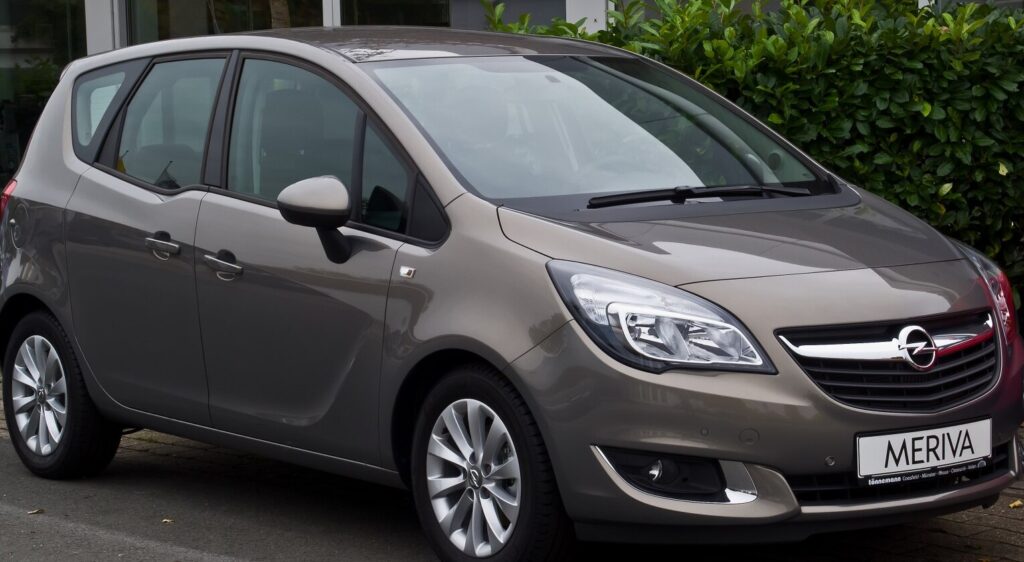
The Opel Meriva B, particularly the facelifted version introduced in 2014, represented a significant evolution of Opel’s compact MPV offering. The 1.7 CDTI (110 hp) Ecotec Automatic variant, produced from January 2014 to June 2015, occupied a middle ground within the Meriva B lineup, aiming to balance fuel efficiency with reasonable performance and the convenience of an automatic transmission. This model was primarily targeted at European markets, where compact MPVs were – and continue to be – a popular choice for families seeking practicality and versatility. It built upon the foundation of the original Meriva B (introduced in 2010), which itself was based on the GM Delta platform, also known as the 1HX0/A3 platform.
Powertrain & Engine Architecture
The heart of this Meriva variant is the A17DTI engine, a 1.7-liter inline-four cylinder diesel. This engine is a member of Opel/Fiat’s family of small-displacement diesel engines, known for its relatively compact size and fuel efficiency. The A17DTI utilizes a common rail direct injection system, delivering fuel directly into the combustion chamber at extremely high pressure. This, combined with a turbocharger and intercooler, allows for a good balance of power and economy. The engine features a double overhead camshaft (DOHC) valvetrain, optimizing airflow for improved performance. The six-speed automatic transmission, sourced from Aisin, was chosen for its smoothness and reliability. It’s a conventional torque converter automatic, offering a comfortable driving experience, though not as sporty or efficient as some newer dual-clutch transmissions.
Driving Characteristics
The 110 hp output and automatic transmission configuration resulted in a driving experience geared towards comfort and ease of use rather than outright performance. Acceleration from 0-60 mph took around 12.3 seconds, which was noticeably slower than the manual transmission versions or those equipped with more powerful engines. The automatic transmission, while smooth, did contribute to a slight reduction in fuel economy compared to the manual. Gear ratios were tuned for everyday drivability, prioritizing smooth transitions and adequate power for merging and overtaking. The engine delivered its peak torque of 280 Nm (206.52 lb-ft) between 1750 and 2500 rpm, providing sufficient pulling power for typical driving situations, but it wasn’t an engine that encouraged high-revving driving.
Equipment & Trim Levels
The 1.7 CDTI Automatic trim typically fell into the mid-range of the Meriva B lineup. Standard equipment generally included air conditioning, power windows, central locking, a basic audio system with USB connectivity, and ABS brakes. Higher trim levels, such as the Cosmo, added features like alloy wheels, a more advanced infotainment system with touchscreen display, parking sensors, and climate control. Interior upholstery was typically cloth, with options for upgraded materials on higher trims. The Meriva B was known for its flexible interior, with the FlexSpace rear seating system allowing for various configurations to maximize cargo space.
Chassis & Braking
The Meriva B utilized a McPherson strut front suspension and an elastic beam rear suspension. This setup provided a comfortable ride quality, well-suited for everyday driving. The front brakes were ventilated discs, offering good stopping power, while the rear brakes were solid discs. The steering was electrically assisted, providing light and easy steering feel. Stabilizer bars were fitted to both the front and rear axles to reduce body roll during cornering, though the Meriva B was not designed to be a particularly sporty vehicle.
Market Reception & Comparison
The 1.7 CDTI Automatic Meriva B received generally positive reviews, particularly for its practicality, fuel efficiency, and comfortable ride. Critics noted that the engine, while adequate, wasn’t particularly powerful, and the automatic transmission could feel a bit sluggish at times. Compared to the 1.4-liter turbocharged petrol engine, the 1.7 CDTI offered significantly better fuel economy, but less outright performance. The 1.7 CDTI was also a more economical choice than the more powerful 1.6-liter petrol engine, making it a popular option for drivers prioritizing running costs. Reliability was generally good, with the A17DTI engine proving to be a durable unit.
Legacy
The Opel Meriva B 1.7 CDTI Automatic has established itself as a reliable and affordable used car option. The A17DTI engine, while not known for being exceptionally high-performance, has proven to be relatively robust and long-lasting with proper maintenance. Common issues are typically related to diesel particulate filter (DPF) clogging, particularly on vehicles used primarily for short journeys. The automatic transmission, if serviced regularly, is also generally reliable. Today, these Merivas represent a practical and economical choice for families seeking a versatile and affordable MPV.