
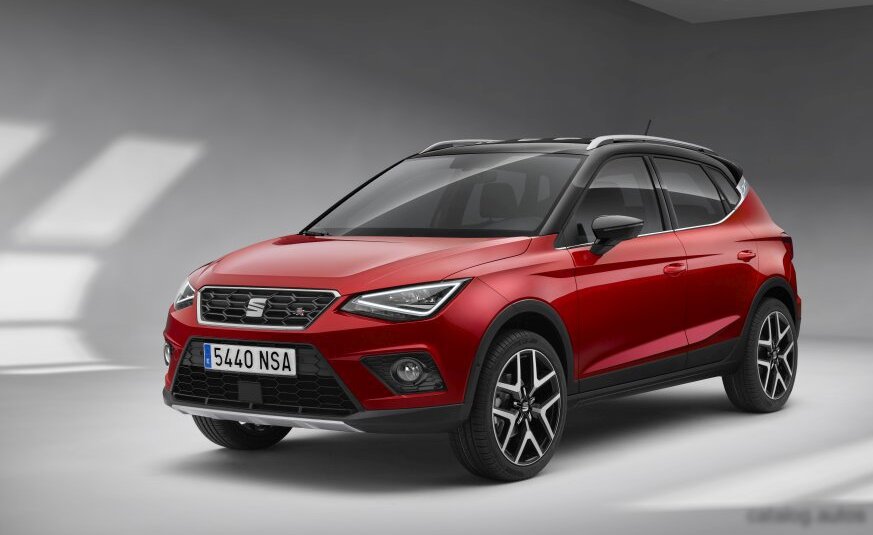
The Seat Arona 1.0 TSI 95 hp, produced from 2019 to 2020, represents an entry-level offering within the first generation (2017-2025) of Seat’s popular subcompact crossover SUV. Positioned as a more affordable and fuel-efficient option, it played a key role in attracting budget-conscious buyers to the Arona lineup, particularly in European markets. This variant aimed to provide a practical and economical urban vehicle, appealing to first-time car buyers and those seeking a smaller, manageable SUV. It was built on the Volkswagen Group’s MQB A0 platform, shared with models like the Volkswagen Polo and Audi A1.
Technical Specifications
| Brand | Seat |
| Model | Arona |
| Generation | Arona |
| Type (Engine) | 1.0 TSI (95 Hp) |
| Start of production | 2019 |
| End of production | 2020 |
| Powertrain Architecture | Internal Combustion engine |
| Body type | SUV |
| Seats | 5 |
| Doors | 5 |
| Combined fuel consumption (WLTP) | 5.7-5.9 l/100 km (41.3 – 39.9 US mpg, 49.6 – 47.9 UK mpg, 17.5 – 16.9 km/l) |
| CO2 emissions (WLTP) | 129-134 g/km |
| Fuel consumption (economy) – urban (NEDC) | 5.9-6.0 l/100 km (39.9 – 39.2 US mpg, 47.9 – 47.1 UK mpg, 16.9 – 16.7 km/l) |
| Fuel consumption (economy) – extra urban (NEDC) | 4.3-4.4 l/100 km (54.7 – 53.5 US mpg, 65.7 – 64.2 UK mpg, 23.3 – 22.7 km/l) |
| Fuel consumption (economy) – combined (NEDC) | 4.9-5.0 l/100 km (48 – 47 US mpg, 57.6 – 56.5 UK mpg, 20.4 – 20 km/l) |
| CO2 emissions (NEDC) | 112-113 g/km |
| Fuel Type | Petrol (Gasoline) |
| Acceleration 0 – 100 km/h | 11.4 sec |
| Acceleration 0 – 62 mph | 11.4 sec |
| Acceleration 0 – 60 mph | 10.8 sec |
| Maximum speed | 175 km/h (108.74 mph) |
| Emission standard | Euro 6 DG |
| Weight-to-power ratio | 11.6 kg/Hp, 86 Hp/tonne |
| Weight-to-torque ratio | 6.3 kg/Nm, 158.4 Nm/tonne |
| Power | 95 Hp @ 5000-5500 rpm |
| Torque | 175 Nm @ 2000-3500 rpm (129.07 lb.-ft. @ 2000-3500 rpm) |
| Engine layout | Front, Transverse |
| Engine Model/Code | CHZL |
| Engine displacement | 999 cm3 (60.96 cu. in.) |
| Number of cylinders | 3 |
| Engine configuration | Inline |
| Cylinder Bore | 74.5 mm (2.93 in.) |
| Piston Stroke | 76.4 mm (3.01 in.) |
| Compression ratio | 10.5:1 |
| Number of valves per cylinder | 4 |
| Fuel injection system | Direct injection |
| Engine aspiration | Turbocharger, Intercooler |
| Engine oil capacity | 4 l (4.23 US qt | 3.52 UK qt) |
| Coolant | 10 l (10.57 US qt | 8.8 UK qt) |
| Kerb Weight | 1105 kg (2436.11 lbs.) |
| Max. weight | 1700 kg (3747.86 lbs.) |
| Max load | 595 kg (1311.75 lbs.) |
| Trunk (boot) space – minimum | 400 l (14.13 cu. ft.) |
| Trunk (boot) space – maximum | 1280 l (45.2 cu. ft.) |
| Fuel tank capacity | 40 l (10.57 US gal | 8.8 UK gal) |
| Max. roof load | 75 kg (165.35 lbs.) |
| Permitted trailer load with brakes (12%) | 1000 kg (2204.62 lbs.) |
| Permitted trailer load without brakes | 590 kg (1300.73 lbs.) |
| Permitted towbar download | 55 kg (121.25 lbs.) |
| Length | 4138 mm (162.91 in.) |
| Width | 1780 mm (70.08 in.) |
| Height | 1552 mm (61.1 in.) |
| Wheelbase | 2566 mm (101.02 in.) |
| Front track | 1503 mm (59.17 in.) |
| Rear (Back) track | 1486 mm (58.5 in.) |
| Front overhang | 803 mm (31.61 in.) |
| Rear overhang | 769 mm (30.28 in.) |
| Ride height (ground clearance) | 190 mm (7.48 in.) |
| Minimum turning circle (turning diameter) | 11 m (36.09 ft.) |
| Approach angle | 20.1° |
| Departure angle | 29.5° |
| Drivetrain Architecture | The Internal combustion engine (ICE) drives the front wheels of the vehicle. |
| Drive wheel | Front wheel drive |
| Number of gears and type of gearbox | 5 gears, manual transmission |
| Front suspension | Independent type McPherson |
| Rear suspension | Elastic beam |
| Front brakes | Ventilated discs, 276×24 mm |
| Rear brakes | Disc, 228×42 mm |
| Assisting systems | ABS (Anti-lock braking system) |
| Tires size | 205/60 R16; 205/55 R17; 215/45 R18 |
| Wheel rims size | 6J x 16; 6.5J x 17; 7J x 18 |
Powertrain & Engine Architecture
The Seat Arona 1.0 TSI 95 hp utilizes the Volkswagen Group’s CHZL engine code, a three-cylinder, 1.0-liter turbocharged gasoline engine. This engine is part of the EA288 family and features direct fuel injection and an intercooled turbocharger. The direct injection system, operating at pressures up to 250 bar, ensures precise fuel delivery for optimal combustion. The engine’s valvetrain employs four valves per cylinder, contributing to efficient gas exchange. The 95 hp variant is tuned for fuel economy rather than outright performance. The engine is transversely mounted at the front of the vehicle, driving the front wheels. The transmission is a five-speed manual gearbox, chosen for its simplicity and cost-effectiveness in this entry-level trim. The engine incorporates Start & Stop technology to further reduce fuel consumption and emissions.
Driving Characteristics
The 1.0 TSI 95 hp Arona delivers adequate performance for urban driving and occasional highway use. With 95 horsepower and 175 Nm (129 lb-ft) of torque, acceleration from 0-60 mph takes around 10.8 seconds. The turbocharger provides a noticeable boost in power, but the engine can feel strained when pushed hard, particularly when fully loaded. The five-speed manual transmission is well-matched to the engine’s characteristics, offering smooth gear changes. The gear ratios are optimized for fuel efficiency, resulting in a relatively high fifth gear for comfortable cruising. Compared to higher-output versions of the Arona, such as the 1.5 TSI, this variant feels significantly less powerful, especially during overtaking maneuvers. However, its lighter weight and efficient engine contribute to better fuel economy.
Equipment & Trim Levels
The 1.0 TSI 95 hp Arona typically came with a base level of equipment, focusing on essential features. Standard equipment generally included air conditioning, a touchscreen infotainment system with Bluetooth connectivity, electric front windows, and basic safety features like ABS, ESP, and multiple airbags. Interior upholstery was typically cloth, and the dashboard featured a functional, if somewhat basic, design. Optional extras included alloy wheels, parking sensors, a rear-view camera, and upgraded infotainment systems with navigation. The trim level often sat as the entry point to the Arona range, making it an attractive option for buyers prioritizing affordability.
Chassis & Braking
The Arona 1.0 TSI 95 hp utilizes a McPherson strut front suspension and an elastic beam rear suspension. This setup provides a comfortable ride quality, well-suited for everyday driving. The front brakes are ventilated discs, while the rear brakes are solid discs. The braking system is assisted by ABS (Anti-lock Braking System) and ESP (Electronic Stability Program). The suspension is tuned for comfort rather than sporty handling, resulting in a slight degree of body roll during cornering. The relatively lightweight engine and overall vehicle weight contribute to manageable braking distances.
Market Reception & Comparison
The Seat Arona 1.0 TSI 95 hp was generally well-received by critics as a practical and economical choice within the subcompact SUV segment. Reviewers praised its fuel efficiency and affordability, but noted its lack of outright performance compared to more powerful variants. Compared to the 1.5 TSI Arona, the 1.0 TSI offered significantly lower running costs but sacrificed acceleration and overall driving enjoyment. Against competitors like the Renault Captur and Peugeot 2008, the Arona 1.0 TSI held its own in terms of value for money and fuel economy.
Legacy
The 1.0 TSI engine has proven to be a relatively reliable powertrain, although some owners have reported issues with the timing chain. Regular maintenance, including oil changes and timing chain inspections, is crucial for ensuring long-term reliability. In the used car market, the Arona 1.0 TSI 95 hp remains a popular choice for budget-conscious buyers seeking a small, economical SUV. Its low running costs and practical interior make it a sensible option for urban commuting and everyday use. While not the most exciting vehicle to drive, it offers a compelling combination of affordability, fuel efficiency, and practicality.
