
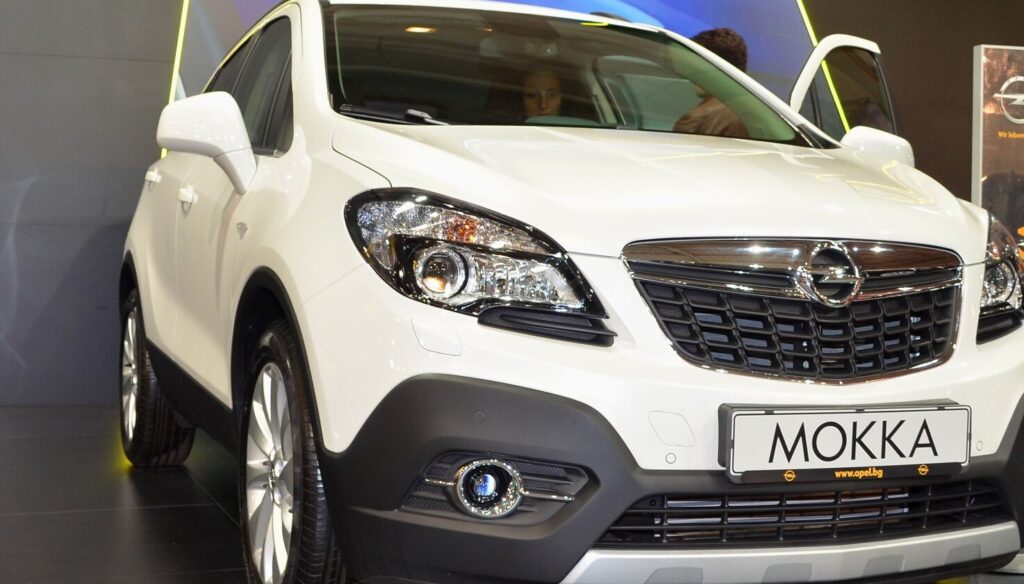
The Opel Mokka 1.4 Turbo Ecotec Automatic, produced between April 2013 and May 2016, represented a key offering in Opel’s burgeoning SUV lineup. Positioned as a mid-range trim within the first generation Mokka (J13) series, it aimed to provide a balance between fuel efficiency, reasonable performance, and the convenience of an automatic transmission. The Mokka itself was Opel’s first foray into the subcompact SUV segment, designed to appeal to a broader customer base seeking a more versatile and modern vehicle. This variant was primarily marketed in Europe, where compact SUVs were gaining significant popularity.
Technical Specifications
| Brand | Opel |
| Model | Mokka |
| Generation | Mokka |
| Type (Engine) | 1.4 Turbo (140 Hp) Ecotec Automatic |
| Start of production | April, 2013 |
| End of production | May, 2016 |
| Powertrain Architecture | Internal Combustion engine |
| Body type | SUV |
| Seats | 5 |
| Doors | 5 |
| Fuel consumption (urban) | 8.7 l/100 km (27 US mpg, 32.5 UK mpg, 11.5 km/l) |
| Fuel consumption (extra urban) | 5.7 l/100 km (41.3 US mpg, 49.6 UK mpg, 17.5 km/l) |
| Fuel consumption (combined) | 6.8 l/100 km (34.6 US mpg, 41.5 UK mpg, 14.7 km/l) |
| CO2 emissions | 158 g/km |
| Fuel Type | Petrol (Gasoline) |
| Acceleration 0 – 100 km/h | 10.7 sec |
| Acceleration 0 – 62 mph | 10.7 sec |
| Acceleration 0 – 60 mph | 10.2 sec |
| Maximum speed | 191 km/h (118.68 mph) |
| Emission standard | Euro 5 |
| Weight-to-power ratio | 10.6 kg/Hp, 94 Hp/tonne |
| Weight-to-torque ratio | 7.5 kg/Nm, 134.2 Nm/tonne |
| Power | 140 Hp @ 4900-6000 rpm |
| Power per litre | 102.6 Hp/l |
| Torque | 200 Nm @ 1850-4900 rpm (147.51 lb.-ft. @ 1850-4900 rpm) |
| Engine layout | Front, Transverse |
| Engine Model/Code | A14NET, B14NET |
| Engine displacement | 1364 cm3 (83.24 cu. in.) |
| Number of cylinders | 4 |
| Engine configuration | Inline |
| Cylinder Bore | 72.5 mm (2.85 in.) |
| Piston Stroke | 82.6 mm (3.25 in.) |
| Fuel injection system | Multi-port manifold injection |
| Engine aspiration | Turbocharger, Intercooler |
| Engine oil capacity | 4 l (4.23 US qt | 3.52 UK qt) |
| Coolant | 6 l (6.34 US qt | 5.28 UK qt) |
| Kerb Weight | 1490 kg (3284.89 lbs.) |
| Max. weight | 1959 kg (4318.86 lbs.) |
| Max load | 469 kg (1033.97 lbs.) |
| Trunk (boot) space – minimum | 356 l (12.57 cu. ft.) |
| Trunk (boot) space – maximum | 1372 l (48.45 cu. ft.) |
| Fuel tank capacity | 54 l (14.27 US gal | 11.88 UK gal) |
| Length | 4278 mm (168.43 in.) |
| Width | 1658 mm (65.28 in.) |
| Height | 1777 mm (69.96 in.) |
| Wheelbase | 2555 mm (100.59 in.) |
| Front track | 1540 mm (60.63 in.) |
| Rear (Back) track | 1540 mm (60.63 in.) |
| Minimum turning circle | 10.8 m (35.43 ft.) |
| Drivetrain Architecture | Front wheel drive |
| Number of gears | 6 |
| Gearbox type | automatic transmission |
| Front suspension | Independent type McPherson |
| Rear suspension | Semi-independent, coil spring |
| Front brakes | Ventilated discs |
| Rear brakes | Disc |
| Assisting systems | ABS (Anti-lock braking system) |
| Steering type | Steering rack and pinion |
| Tires size | 215/55 R18 |
| Wheel rims size | 18 |
Powertrain & Engine Architecture
At the heart of the Mokka 1.4 Turbo Automatic lies the A14NET or B14NET engine, a 1.4-liter inline-four cylinder gasoline engine. This engine is part of Opel/Vauxhall’s ‘Family 0’ engine family, known for its compact size and use of technologies like turbocharging and direct injection to improve efficiency and power output. The engine utilizes multi-port fuel injection, delivering fuel directly into the intake ports. The turbocharger, coupled with an intercooler, provides a boost in power and torque, mitigating the typical power deficit associated with smaller displacement engines. The engine produces 140 horsepower at 4900-6000 rpm and 200 Nm (147.51 lb-ft) of torque between 1850 and 4900 rpm. This power is then transferred to the front wheels via a six-speed automatic transmission. This transmission, while providing convenience, wasn’t known for particularly rapid shifts or sporting performance.
Driving Characteristics
The 1.4 Turbo Automatic Mokka offered a comfortable, if not particularly exhilarating, driving experience. Acceleration from 0-60 mph took around 10.2 seconds, which was adequate for everyday driving but noticeably slower than the 1.7 diesel or the more powerful 1.4 Turbo with a manual transmission. The automatic transmission, while smooth in normal driving conditions, could feel somewhat hesitant during quick overtaking maneuvers. The gear ratios were tuned for fuel economy rather than outright performance. The engine’s torque delivery was relatively linear, providing sufficient power for cruising on the highway, but lacked the punch of larger displacement engines. The Mokka’s relatively high weight (1490 kg / 3284.89 lbs) further contributed to the less-than-sporty feel.
Equipment & Trim Levels
The 1.4 Turbo Automatic trim typically included standard features such as air conditioning, power windows, central locking, a CD/MP3 stereo system, and alloy wheels. Safety features included ABS, ESP (Electronic Stability Program), and multiple airbags. Optional extras included a touchscreen infotainment system with navigation, parking sensors, heated seats, and a panoramic sunroof. Interior upholstery was typically cloth, with the option of leather upgrades. The dashboard layout was functional and straightforward, prioritizing ease of use over stylistic flair.
Chassis & Braking
The Mokka utilized a McPherson strut front suspension and a semi-independent coil spring rear suspension. This setup provided a reasonable balance between ride comfort and handling. The front brakes were ventilated discs, while the rear brakes were solid discs. ABS (Anti-lock Braking System) was standard, providing enhanced braking performance in emergency situations. The steering was a rack and pinion system, offering decent precision and feedback. Stabilizer bars were fitted to both the front and rear axles to reduce body roll during cornering.
Market Reception & Comparison
The Opel Mokka 1.4 Turbo Automatic received mixed reviews. Critics praised its comfortable ride, spacious interior, and relatively fuel-efficient engine. However, the automatic transmission was often criticized for its sluggishness and lack of responsiveness. Compared to the 1.7-liter diesel Mokka, the 1.4 Turbo offered less fuel economy but more power. The manual transmission version of the 1.4 Turbo provided a more engaging driving experience, albeit at the expense of convenience. The Mokka competed with other subcompact SUVs such as the Nissan Juke, Renault Captur, and Peugeot 2008.
Legacy
The Opel Mokka 1.4 Turbo Automatic, while not a performance standout, proved to be a reliable and practical vehicle. The A14NET engine, when properly maintained, is generally considered to be durable. Common issues reported by owners include occasional turbocharger problems and minor electrical glitches. On the used car market, these Mokkas represent a relatively affordable entry point into the subcompact SUV segment. Their fuel efficiency and practicality continue to appeal to buyers seeking a versatile and economical vehicle. The Mokka played a significant role in establishing Opel as a competitor in the rapidly growing SUV market, paving the way for future models like the Mokka X and the current Mokka-e.
