
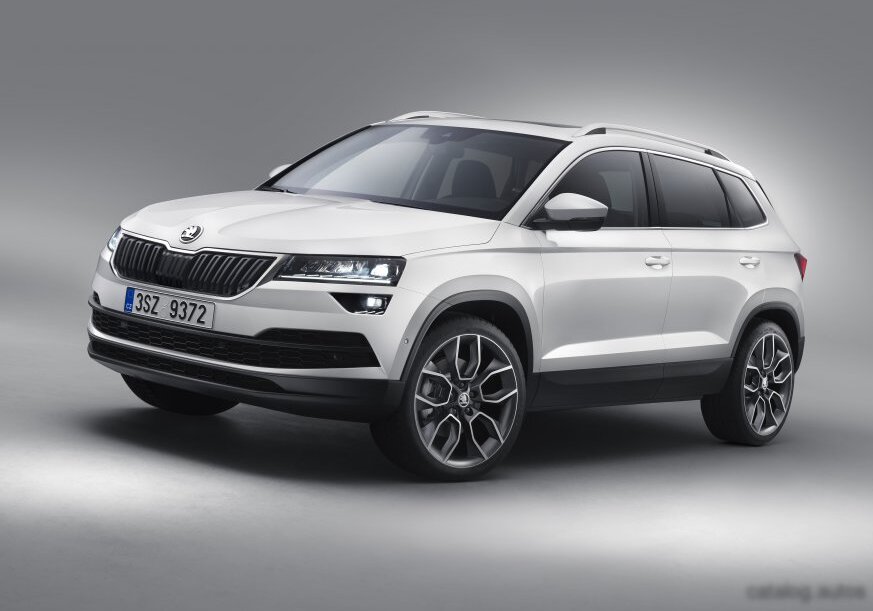
The Skoda Karoq 1.0 TSI Automatic, produced from July 2017 to October 2020, represented an entry point into the Karoq SUV range. Positioned as a fuel-efficient and accessible option, it catered to buyers prioritizing practicality and lower running costs over outright performance. This variant utilized a downsized turbocharged engine paired with a seven-speed automatic transmission, making it a popular choice in European markets where smaller displacement engines are favored. It falls within the first generation of the Karoq, which is based on the Volkswagen Group’s MQB platform (A1).
Technical Specifications
| Brand | Skoda |
| Model | Karoq |
| Type (Engine) | 1.0 TSI (116 Hp) Automatic |
| Start of production | July, 2017 |
| End of production | October, 2020 |
| Powertrain Architecture | Internal Combustion engine |
| Body type | SUV |
| Seats | 5 |
| Doors | 5 |
| Fuel consumption (urban) | 5.8 l/100 km (40.6 US mpg, 48.7 UK mpg, 17.2 km/l) |
| Fuel consumption (extra urban) | 4.8 l/100 km (49 US mpg, 58.9 UK mpg, 20.8 km/l) |
| Fuel consumption (combined) | 5.2 l/100 km (45.2 US mpg, 54.3 UK mpg, 19.2 km/l) |
| CO2 emissions | 118 g/km |
| Fuel Type | Petrol (Gasoline) |
| Acceleration 0 – 100 km/h | 10.7 sec |
| Acceleration 0 – 62 mph | 10.7 sec |
| Acceleration 0 – 60 mph | 10.2 sec |
| Maximum speed | 186 km/h (115.58 mph) |
| Emission standard | Euro 6 |
| Weight-to-power ratio | 11.1 kg/Hp, 90.2 Hp/tonne |
| Weight-to-torque ratio | 6.4 kg/Nm, 155.5 Nm/tonne |
| Power | 116 Hp @ 5000-5500 rpm |
| Power per litre | 116.1 Hp/l |
| Torque | 200 Nm @ 2000-3500 rpm (147.51 lb.-ft. @ 2000-3500 rpm) |
| Engine layout | Front, Transverse |
| Engine Model/Code | EA211 / CHZJ |
| Engine displacement | 999 cm3 (60.96 cu. in.) |
| Number of cylinders | 3 |
| Engine configuration | Inline |
| Cylinder Bore | 74.5 mm (2.93 in.) |
| Piston Stroke | 76.4 mm (3.01 in.) |
| Compression ratio | 10.3:1 |
| Number of valves per cylinder | 4 |
| Fuel injection system | Direct injection |
| Engine aspiration | Turbocharger, Intercooler |
| Engine oil capacity | 4 l (4.23 US qt | 3.52 UK qt) |
| Kerb Weight | 1286 kg (2835.14 lbs.) |
| Max. weight | 1900 kg (4188.78 lbs.) |
| Max load | 614 kg (1353.64 lbs.) |
| Trunk (boot) space – minimum | 521 l (18.4 cu. ft.) |
| Trunk (boot) space – maximum | 1630 l (57.56 cu. ft.) |
| Fuel tank capacity | 50 l (13.21 US gal | 11 UK gal) |
| Max. roof load | 75 kg (165.35 lbs.) |
| Permitted trailer load with brakes (12%) | 1200 kg (2645.55 lbs.) |
| Permitted trailer load without brakes | 680 kg (1499.14 lbs.) |
| Length | 4382 mm (172.52 in.) |
| Width | 1841 mm (72.48 in.) |
| Height | 1603 mm (63.11 in.) |
| Wheelbase | 2638 mm (103.86 in.) |
| Front track | 1576 mm (62.05 in.) |
| Rear (Back) track | 1541 mm (60.67 in.) |
| Minimum turning circle | 10.9 m (35.76 ft.) |
| Drivetrain Architecture | Front wheel drive |
| Number of gears and type of gearbox | 7 gears, automatic transmission |
| Front brakes | Ventilated discs |
| Rear brakes | Disc |
Powertrain & Engine Architecture
The Karoq 1.0 TSI Automatic is powered by the EA211 family of engines, specifically the CHZJ code. This is a 1.0-liter, three-cylinder turbocharged gasoline engine. The EA211 is a modular engine family designed for fuel efficiency and reduced emissions. It features direct fuel injection, a single turbocharger with an intercooler, and four valves per cylinder. The engine’s aluminum block contributes to weight savings. The seven-speed dual-clutch transmission (DSG) is a key component, offering quick and smooth gear changes. This transmission is known for its efficiency and responsiveness, although some early units experienced reliability concerns. The engine’s turbocharger provides a boost in power and torque, compensating for the small displacement.
Driving Characteristics
The 1.0 TSI Automatic Karoq delivers adequate performance for everyday driving. With 116 horsepower and 200 Nm (147.51 lb-ft) of torque, acceleration from 0-60 mph takes around 10.2 seconds. While not particularly sporty, the engine provides sufficient power for highway cruising and overtaking. The seven-speed DSG transmission helps to keep the engine in its optimal power band. Compared to the 1.4 TSI or 2.0 TDI variants, the 1.0 TSI feels less powerful, especially when fully loaded or tackling steep inclines. The automatic transmission prioritizes fuel economy, sometimes resulting in slightly hesitant responses. The gear ratios are tuned for efficiency rather than outright acceleration.
Equipment & Trim Levels
The Karoq 1.0 TSI Automatic typically came with a reasonable level of standard equipment. This included air conditioning, a touchscreen infotainment system with Apple CarPlay and Android Auto compatibility, alloy wheels, and a suite of safety features such as ABS, ESC, and multiple airbags. Higher trim levels, such as SE L or Style, added features like automatic climate control, parking sensors, a rear-view camera, and upgraded interior trim. Optional extras included a panoramic sunroof, adaptive cruise control, and a premium sound system. Interior upholstery was typically cloth, with leather options available on higher trims.
Chassis & Braking
The Karoq’s chassis is based on the MQB platform, providing a comfortable and stable ride. The front suspension utilizes MacPherson struts, while the rear suspension employs a multi-link setup. This configuration balances ride comfort with handling precision. The 1.0 TSI variant typically featured ventilated front disc brakes and solid rear disc brakes. The braking system is assisted by ABS and ESC, providing good stopping power and stability. The steering is electric power-assisted, offering a light and responsive feel. Stabilizer bars are fitted to both the front and rear axles to reduce body roll during cornering.
Market Reception & Comparison
The Skoda Karoq 1.0 TSI Automatic was generally well-received by automotive critics. It was praised for its fuel efficiency, comfortable ride, and spacious interior. However, some reviewers noted the engine’s lack of outright power, particularly when compared to larger-displacement alternatives. Fuel economy figures of around 45.2 US mpg (combined) were considered competitive for its class. In terms of reliability, the EA211 engine has proven to be generally robust, although some owners have reported issues with the DSG transmission. Compared to the 1.4 TSI, the 1.0 TSI offered lower running costs but less performance. The 2.0 TDI provided superior torque and fuel economy but came with a higher purchase price.
Legacy
The Karoq 1.0 TSI Automatic remains a popular choice in the used car market, particularly for buyers seeking a practical and fuel-efficient SUV. The EA211 engine has a good reputation for reliability, and the DSG transmission, while potentially requiring maintenance, is generally durable. The Karoq’s spacious interior and comfortable ride continue to appeal to families and individuals alike. As a downsized engine option, it represents a shift towards greater fuel efficiency and reduced emissions in the automotive industry. The Karoq 1.0 TSI Automatic offers a good balance of practicality, affordability, and fuel economy, making it a sensible choice for those prioritizing these attributes.
