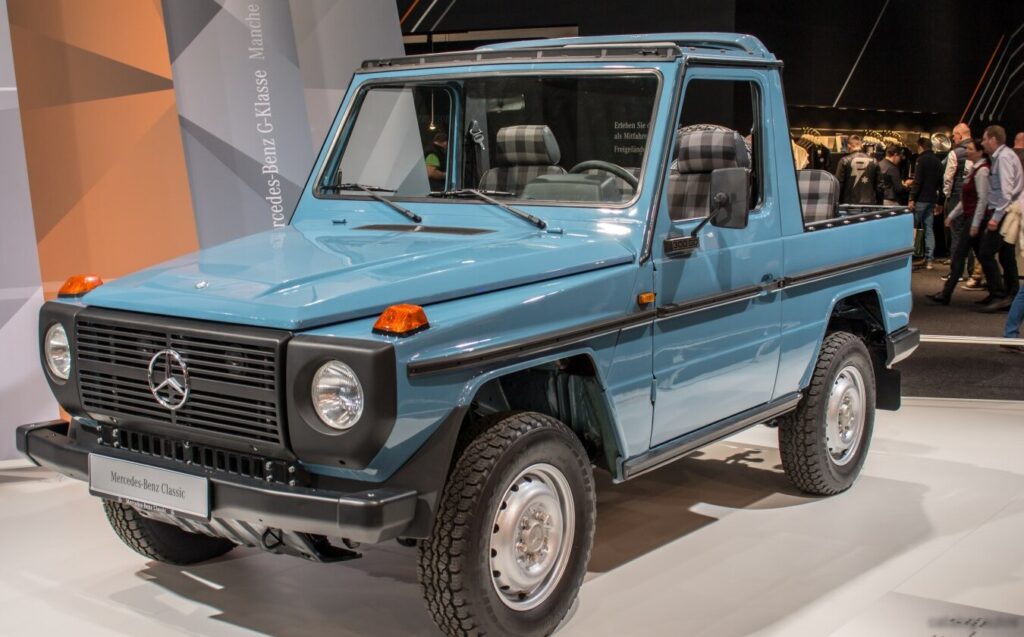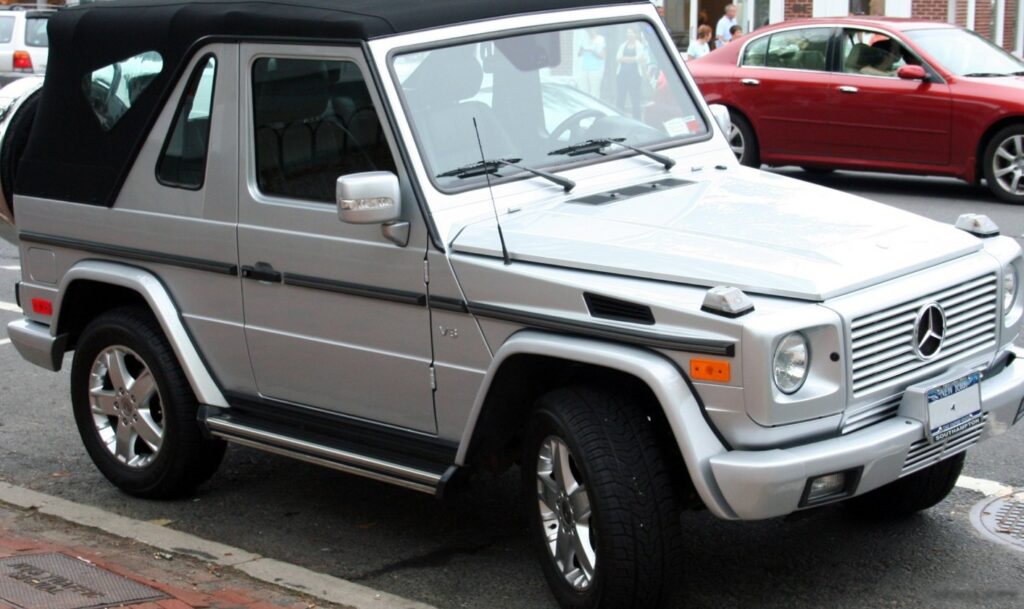
The Mercedes-Benz G 400 CDI, produced from 2001 to 2006, represents a significant iteration of the long-wheelbase (W463) G-Class following the 2000 facelift. This variant, equipped with a 4.0-liter V8 turbodiesel engine and a five-speed automatic transmission, was positioned as a premium offering within the G-Class range, blending robust off-road capability with a degree of luxury and refinement. It catered to buyers seeking a powerful and capable vehicle for both on- and off-road adventures, particularly in European markets where diesel engines were highly favored. The G 400 CDI aimed to bridge the gap between the more utilitarian base models and the high-performance G 55 AMG.
Technical Specifications
| Brand | Mercedes-Benz |
| Model | G-class |
| Generation | G-class Long (W463, facelift 2000) |
| Type (Engine) | G 400 CDI V8 (250 Hp) 4MATIC Automatic |
| Start of production | January, 2001 |
| End of production | September, 2006 |
| Powertrain Architecture | Internal Combustion engine |
| Body type | Off-road vehicle |
| Seats | 5 |
| Doors | 5 |
| Fuel consumption (economy) – urban (NEDC) | 16.1 l/100 km (14.6 US mpg, 17.5 UK mpg, 6.2 km/l) |
| Fuel consumption (economy) – extra urban (NEDC) | 11 l/100 km (21.4 US mpg, 25.7 UK mpg, 9.1 km/l) |
| Fuel consumption (economy) – combined (NEDC) | 12.8 l/100 km (18.4 US mpg, 22.1 UK mpg, 7.8 km/l) |
| CO2 emissions (NEDC) | 343 g/km |
| Fuel Type | Diesel |
| Acceleration 0 – 100 km/h | 9.9 sec |
| Acceleration 0 – 62 mph | 9.9 sec |
| Acceleration 0 – 60 mph | 9.4 sec |
| Maximum speed | 182 km/h (113.09 mph) |
| Emission standard | Euro 3 |
| Weight-to-power ratio | 10.3 kg/Hp, 96.7 Hp/tonne |
| Weight-to-torque ratio | 4.6 kg/Nm, 216.6 Nm/tonne |
| Power | 250 Hp @ 4400 rpm |
| Power per litre | 62.6 Hp/l |
| Torque | 560 Nm @ 1700-2600 rpm (413.03 lb.-ft. @ 1700-2600 rpm) |
| Engine layout | Front, Longitudinal |
| Engine Model/Code | OM 628.962 |
| Engine displacement | 3996 cm3 (243.85 cu. in.) |
| Number of cylinders | 8 |
| Engine configuration | V-engine |
| Cylinder Bore | 86 mm (3.39 in.) |
| Piston Stroke | 86 mm (3.39 in.) |
| Compression ratio | 18.5:1 |
| Number of valves per cylinder | 4 |
| Fuel injection system | Diesel Commonrail |
| Engine aspiration | Turbocharger, Intercooler |
| Valvetrain | DOHC |
| Engine oil capacity | 9 l (9.51 US qt | 7.92 UK qt) |
| Coolant | 10.8 l (11.41 US qt | 9.5 UK qt) |
| Kerb Weight | 2585 kg (5698.95 lbs.) |
| Max. weight | 3200 kg (7054.79 lbs.) |
| Max load | 615 kg (1355.84 lbs.) |
| Trunk (boot) space – minimum | 480 l (16.95 cu. ft.) |
| Trunk (boot) space – maximum | 2250 l (79.46 cu. ft.) |
| Fuel tank capacity | 96 l (25.36 US gal | 21.12 UK gal) |
| Max. roof load | 200 kg (440.92 lbs.) |
| Permitted trailer load with brakes (12%) | 3500 kg (7716.18 lbs.) |
| Permitted trailer load without brakes | 750 kg (1653.47 lbs.) |
| Length | 4680 mm (184.25 in.) |
| Width | 1760 mm (69.29 in.) |
| Width including mirrors | 2007 mm (79.02 in.) |
| Height | 1936 mm (76.22 in.) |
| Wheelbase | 2850 mm (112.2 in.) |
| Front track | 1475 mm (58.07 in.) |
| Rear (Back) track | 1475 mm (58.07 in.) |
| Ride height (ground clearance) | 205 mm (8.07 in.) |
| Minimum turning circle (turning diameter) | 13.3 m (43.64 ft.) |
| Approach angle | 37° |
| Departure angle | 31° |
| Ramp-over (brakeover) angle | 23° |
| Climb angle | 38.7° |
| Wading depth | 500 mm (19.69 in.) |
| Drivetrain Architecture | The Internal combustion engine (ICE) drives permanently the four wheels of the vehicle. |
| Drive wheel | All wheel drive (4×4) |
| Number of gears and type of gearbox | 5 gears, automatic transmission |
| Front suspension | Coil spring, Rigid axle suspension, Trailing arm |
| Rear suspension | Rigid axle suspension, Trailing arm, Coil spring |
| Front brakes | Ventilated discs |
| Rear brakes | Disc |
| Assisting systems | ABS (Anti-lock braking system) |
| Steering type | Cone worm with recirculation balls |
| Power steering | Hydraulic Steering |
| Tires size | 265/60 R 18 |
| Wheel rims size | 7.5 J x 18 |
INTRODUCTION
The G 400 CDI, introduced in January 2001, was a key component of the W463 G-Class lineup following the 2000 facelift. Built upon the robust ladder-frame chassis that defined the G-Wagen, this variant offered a compelling combination of off-road prowess and on-road comfort. The “Long” designation indicates the extended wheelbase version, providing increased interior space and improved ride quality. The 400 CDI model was primarily aimed at the European market, where diesel engines were preferred for their fuel efficiency and torque characteristics. It served as a middle ground, offering more performance than the base G 270 CDI but at a lower price point than the flagship G 55 AMG.
Powertrain & Engine Architecture
The heart of the G 400 CDI is the OM 628.962, a 4.0-liter V8 turbodiesel engine. This engine utilizes a common rail direct injection system, delivering fuel directly into the cylinders at extremely high pressure for improved combustion efficiency and reduced emissions. The engine produces 250 horsepower at 4400 rpm and a substantial 560 Nm (413 lb-ft) of torque between 1700 and 2600 rpm. This broad torque curve provides excellent pulling power, both on and off-road. The engine features a double overhead camshaft (DOHC) valvetrain and an intercooled turbocharger to maximize power output. Paired with the engine is a five-speed automatic transmission, providing smooth and convenient gear changes. This transmission was chosen for its durability and ability to handle the engine’s significant torque. While not the most modern transmission by today’s standards, it was well-suited to the G-Class’s intended use.
Driving Characteristics
The G 400 CDI delivers a unique driving experience. The high torque output of the diesel engine provides effortless acceleration, particularly in the lower and mid-range. While not as quick as the gasoline-powered G 55 AMG, the 400 CDI offers ample power for overtaking and maintaining highway speeds. The automatic transmission shifts smoothly, although it can feel somewhat deliberate compared to more modern transmissions. Off-road, the G 400 CDI truly shines. The permanent all-wheel-drive system, combined with the engine’s low-end torque and the vehicle’s robust construction, allows it to tackle challenging terrain with ease. The long wheelbase contributes to stability, while the relatively high ground clearance and impressive approach, departure, and breakover angles enable it to navigate obstacles effectively. The steering, while hydraulic, can feel somewhat vague, requiring deliberate inputs.
Equipment & Trim Levels
The G 400 CDI typically came well-equipped, reflecting its premium positioning within the G-Class range. Standard features included leather upholstery, automatic climate control, power windows and locks, and an upgraded audio system. Optional extras included a sunroof, heated seats, and various exterior enhancements. The interior design was functional and durable, with a focus on practicality rather than outright luxury. The long wheelbase provided ample space for passengers in both the front and rear seats. Trim levels were relatively limited, with most customization options available through individual selections rather than pre-defined packages.
Chassis & Braking
The G 400 CDI retains the traditional G-Class chassis – a robust ladder frame construction that provides exceptional strength and durability. The suspension consists of coil springs and rigid axles with trailing arms, offering a comfortable ride both on and off-road. Braking duties are handled by ventilated discs at the front and solid discs at the rear, assisted by an anti-lock braking system (ABS). While adequate for the vehicle’s weight and intended use, the braking system is not particularly sporty. The steering system utilizes a cone worm and recirculation ball mechanism, providing a direct but somewhat heavy feel.
Market Reception & Comparison
The G 400 CDI was generally well-received by automotive critics, who praised its powerful engine, off-road capability, and comfortable ride. However, some criticized its relatively high fuel consumption and somewhat dated interior. Compared to the G 270 CDI, the 400 CDI offered significantly more power and performance. Compared to the G 55 AMG, it provided a more economical option, albeit with less outright speed. The G 400 CDI appealed to buyers who wanted a capable and luxurious off-road vehicle without the high price tag of the AMG model.
Legacy
The G 400 CDI has proven to be a relatively reliable vehicle, with the OM 628 engine known for its durability. However, like all older vehicles, it requires regular maintenance to prevent issues. Common maintenance items include oil changes, filter replacements, and inspection of the cooling system. Today, the G 400 CDI is a sought-after vehicle among G-Class enthusiasts, particularly those who appreciate its unique combination of power, capability, and classic styling. Well-maintained examples command a premium in the used car market, reflecting the enduring appeal of the G-Wagen.