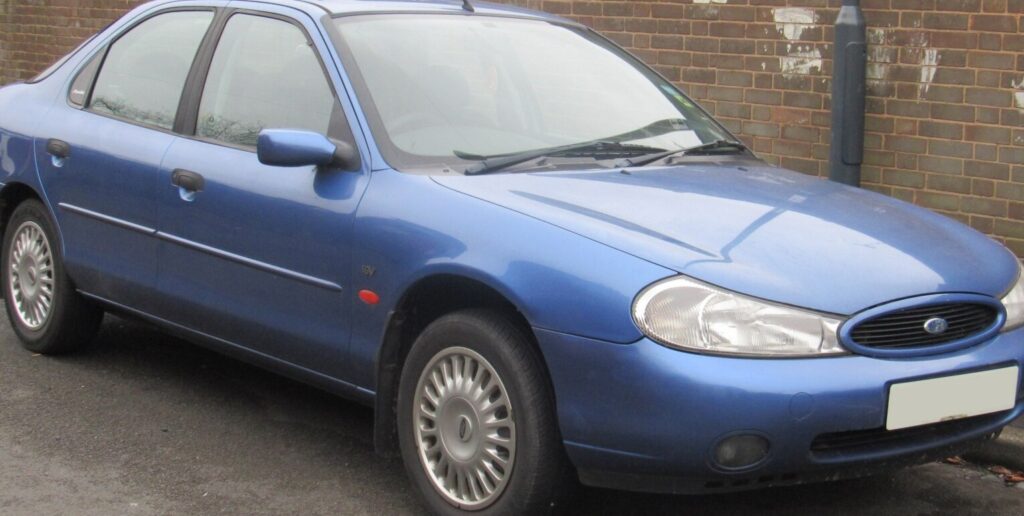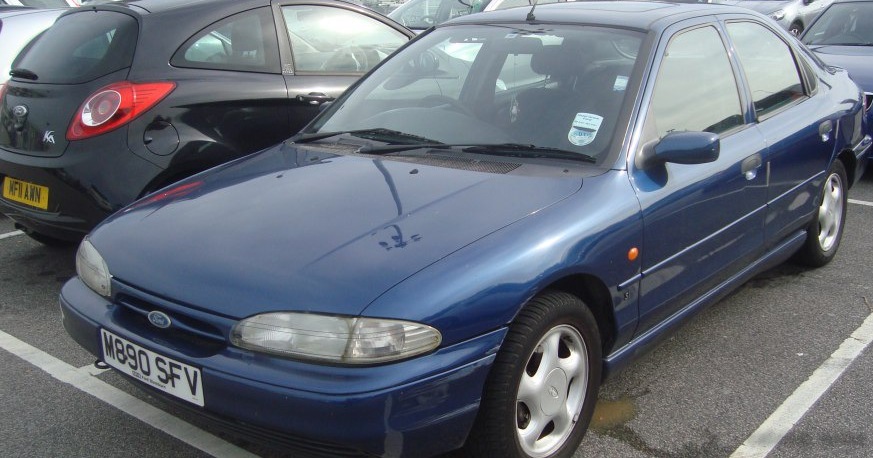
The Ford Mondeo I, launched in 1993, represented a significant step forward for Ford of Europe, replacing the aging Sierra and Escort ranges with a single, modern family car. The Mondeo was designed to compete directly with established rivals like the Volkswagen Passat and Opel Vectra, offering a blend of practicality, comfort, and driving dynamics. The 1.6 liter 16V variant, produced from 1994 to 1996, served as the entry point to the Mondeo lineup, appealing to buyers seeking affordable and economical transportation. This particular hatchback configuration, with its five doors and five seats, was a popular choice in European markets.
Technical Specifications
| Brand | Ford |
| Model | Mondeo |
| Generation | Mondeo I Hatchback |
| Type (Engine) | 1.6 i 16V (88 Hp) |
| Start of production | 1994 |
| End of production | 1996 |
| Powertrain Architecture | Internal Combustion engine |
| Body type | Hatchback |
| Seats | 5 |
| Doors | 5 |
| Fuel consumption (combined) | 7.6 l/100 km (30.9 US mpg, 37.2 UK mpg, 13.2 km/l) |
| Fuel Type | Petrol (Gasoline) |
| Acceleration 0 – 100 km/h | 13.7 sec |
| Acceleration 0 – 62 mph | 13.7 sec |
| Acceleration 0 – 60 mph | 13 sec |
| Maximum speed | 180 km/h (111.85 mph) |
| Weight-to-power ratio | 14.3 kg/Hp (69.8 Hp/tonne) |
| Weight-to-torque ratio | 9.3 kg/Nm (107.1 Nm/tonne) |
| Power | 88 Hp @ 5250 rpm |
| Power per litre | 55.1 Hp/l |
| Torque | 135 Nm @ 3500 rpm (99.57 lb.-ft. @ 3500 rpm) |
| Engine layout | Front, Transverse |
| Engine Model/Code | L1J |
| Engine displacement | 1597 cm3 (97.45 cu. in.) |
| Number of cylinders | 4 |
| Engine configuration | Inline |
| Cylinder Bore | 76 mm (2.99 in.) |
| Piston Stroke | 88 mm (3.46 in.) |
| Compression ratio | 10.3:1 |
| Number of valves per cylinder | 4 |
| Fuel injection system | Multi-port manifold injection |
| Engine aspiration | Naturally aspirated engine |
| Valvetrain | DOHC |
| Engine oil capacity | 4.25 l (4.49 US qt | 3.74 UK qt) |
| Coolant | 6.6 l (6.97 US qt | 5.81 UK qt) |
| Kerb Weight | 1260 kg (2777.82 lbs.) |
| Max. weight | 1800 kg (3968.32 lbs.) |
| Max load | 540 kg (1190.5 lbs.) |
| Trunk (boot) space – minimum | 470 l (16.6 cu. ft.) |
| Trunk (boot) space – maximum | 965 l (34.08 cu. ft.) |
| Fuel tank capacity | 61 l (16.11 US gal | 13.42 UK gal) |
| Length | 4487 mm (176.65 in.) |
| Width | 1749 mm (68.86 in.) |
| Height | 1424 mm (56.06 in.) |
| Wheelbase | 2704 mm (106.46 in.) |
| Front track | 1503 mm (59.17 in.) |
| Rear (Back) track | 1487 mm (58.54 in.) |
| Drivetrain Architecture | Front wheel drive |
| Number of gears and type of gearbox | 5 gears, manual transmission |
| Front suspension | Wishbone |
| Rear suspension | Coil spring |
| Front brakes | Ventilated discs |
| Rear brakes | Disc |
| Assisting systems | ABS (Anti-lock braking system) |
| Steering type | Steering rack and pinion |
| Power steering | Hydraulic Steering |
| Tires size | 185/65 R14 |
| Wheel rims size | 6J x 14 |
Powertrain & Engine Architecture
The 1.6 liter engine, designated L1J, was a naturally aspirated, inline-four cylinder unit. It featured a dual overhead camshaft (DOHC) valvetrain operating four valves per cylinder, enhancing breathing and contributing to its modest power output. Fuel delivery was handled by a multi-port fuel injection system, a common feature for the time, providing precise fuel metering for improved efficiency and reduced emissions. The engine produced 88 horsepower at 5250 rpm and 135 Nm (99.57 lb-ft) of torque at 3500 rpm. This engine was paired with a five-speed manual transmission, the standard offering for this trim level. While an automatic transmission was available on some Mondeo models, it wasn’t commonly paired with the 1.6L engine due to the performance limitations.
Driving Characteristics
The 1.6L Mondeo offered a comfortable, if not particularly exhilarating, driving experience. Acceleration from 0-60 mph took around 13 seconds, and top speed was limited to 111.85 mph. The engine felt somewhat strained when pushed hard, requiring frequent downshifts to maintain momentum. Compared to the more powerful 2.0L or V6 Mondeo variants, the 1.6L lacked the punch for quick overtaking maneuvers. However, the five-speed manual transmission allowed drivers to keep the engine in its optimal power band. The suspension provided a good balance between comfort and handling, making it suitable for everyday driving. The steering was light and precise, contributing to a relatively easy driving experience.
Equipment & Trim Levels
The 1.6L Mondeo typically came with a reasonable level of standard equipment, positioning it as a practical and well-equipped family car. Features included central locking, power steering, and an adjustable steering column. Interior upholstery was typically cloth, and the dashboard featured a functional, if somewhat utilitarian, design. Optional extras included air conditioning, electric windows, and an upgraded audio system. The trim level often dictated the availability of these options, with higher trims offering more standard features.
Chassis & Braking
The Mondeo I utilized a front-wheel-drive layout with independent wishbone suspension at the front and a coil spring rear suspension. This setup provided a comfortable ride and decent handling characteristics. Braking duties were handled by ventilated discs at the front and solid discs at the rear. Anti-lock Braking System (ABS) was available, enhancing safety by preventing wheel lockup during hard braking. The chassis was designed to provide a stable and predictable driving experience, prioritizing comfort and practicality over outright sportiness.
Market Reception & Comparison
The 1.6L Mondeo was generally well-received as an affordable and practical family car. Critics praised its spacious interior, comfortable ride, and good fuel economy. However, the engine’s lack of power was a common criticism, particularly when compared to its rivals. The 2.0L Mondeo offered a significant performance upgrade, while the V6 models provided even more power. The 1.6L variant appealed to buyers who prioritized fuel efficiency and affordability over outright performance. Its fuel consumption of 7.6 l/100 km (30.9 US mpg) was competitive for its time.
Legacy
The L1J 1.6L engine, while not known for its exceptional performance, proved to be a relatively reliable unit. Properly maintained examples can still be found on the road today. The Mondeo I, as a whole, established the Mondeo nameplate as a strong contender in the family car segment. The 1.6L variant, while often overlooked in favor of its more powerful siblings, provided an accessible entry point to the Mondeo range, making it a popular choice for budget-conscious buyers. In the used car market, these models are typically affordable and represent a good value for those seeking a practical and reliable family car.