
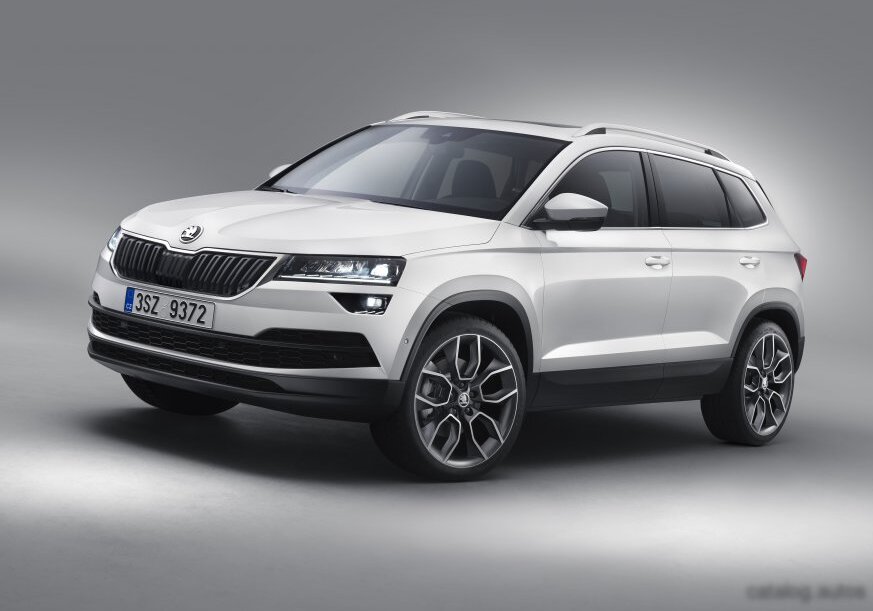
The Skoda Karoq 1.5 TSI Automatic, produced from July 2017 to November 2021, represents a significant offering in the compact SUV segment. Positioned as a mid-range trim within the broader Karoq lineup, it aimed to balance fuel efficiency, practicality, and a reasonable level of performance for family buyers. This variant utilized Skoda’s modern 1.5-liter turbocharged gasoline engine paired with a seven-speed dual-clutch transmission (DCT), offering a more refined driving experience than lower-spec models while remaining more accessible than the higher-output petrol or diesel options. The Karoq itself is built on the Volkswagen Group’s MQB platform (A1), shared with models like the Volkswagen Tiguan and SEAT Ateca.
Technical Specifications
| Brand | Skoda |
| Model | Karoq |
| Type (Engine) | 1.5 TSI (150 Hp) Automatic |
| Start of production | July, 2017 |
| End of production | November, 2021 |
| Powertrain Architecture | Internal Combustion engine |
| Body type | SUV |
| Seats | 5 |
| Doors | 5 |
| Fuel consumption (urban) | 6.6 l/100 km (35.6 US mpg, 42.8 UK mpg, 15.2 km/l) |
| Fuel consumption (extra urban) | 4.9 l/100 km (48 US mpg, 57.6 UK mpg, 20.4 km/l) |
| Fuel consumption (combined) | 5.5 l/100 km (42.8 US mpg, 51.4 UK mpg, 18.2 km/l) |
| CO2 emissions | 125 g/km |
| Fuel Type | Petrol (Gasoline) |
| Acceleration 0 – 100 km/h | 8.6 sec |
| Acceleration 0 – 62 mph | 8.6 sec |
| Acceleration 0 – 60 mph | 8.2 sec |
| Maximum speed | 203 km/h (126.14 mph) |
| Emission standard | Euro 6 |
| Weight-to-power ratio | 8.8 kg/Hp, 113.8 Hp/tonne |
| Weight-to-torque ratio | 5.3 kg/Nm, 189.7 Nm/tonne |
| Power | 150 Hp @ 5000-6000 rpm |
| Power per litre | 100.1 Hp/l |
| Torque | 250 Nm @ 1500-3500 rpm (184.39 lb.-ft. @ 1500-3500 rpm) |
| Engine layout | Front, Transverse |
| Engine Model/Code | EA211 evo / DADA |
| Engine displacement | 1498 cm3 (91.41 cu. in.) |
| Number of cylinders | 4 |
| Engine configuration | Inline |
| Cylinder Bore | 74.5 mm (2.93 in.) |
| Piston Stroke | 85.9 mm (3.38 in.) |
| Compression ratio | 10.5:1 |
| Number of valves per cylinder | 4 |
| Fuel injection system | Direct injection |
| Engine aspiration | Turbocharger, Intercooler |
| Engine oil capacity | 4.3 l (4.54 US qt | 3.78 UK qt) |
| Kerb Weight | 1318 kg (2905.69 lbs.) |
| Max. weight | 1929 kg (4252.72 lbs.) |
| Max load | 611 kg (1347.02 lbs.) |
| Trunk (boot) space – minimum | 521 l (18.4 cu. ft.) |
| Trunk (boot) space – maximum | 1630 l (57.56 cu. ft.) |
| Fuel tank capacity | 50 l (13.21 US gal | 11 UK gal) |
| Max. roof load | 75 kg (165.35 lbs.) |
| Permitted trailer load with brakes (12%) | 1500 kg (3306.93 lbs.) |
| Permitted trailer load without brakes | 690 kg (1521.19 lbs.) |
| Length | 4382 mm (172.52 in.) |
| Width | 1841 mm (72.48 in.) |
| Height | 1603 mm (63.11 in.) |
| Wheelbase | 2638 mm (103.86 in.) |
| Front track | 1576 mm (62.05 in.) |
| Rear (Back) track | 1541 mm (60.67 in.) |
| Minimum turning circle | 10.9 m (35.76 ft.) |
| Drivetrain | Front wheel drive |
| Number of gears | 7 |
| Gearbox type | automatic transmission |
| Front brakes | Ventilated discs |
| Rear brakes | Disc |
Powertrain & Engine Architecture
The heart of the Karoq 1.5 TSI is the EA211 evo series engine, a 1.5-liter inline-four cylinder gasoline engine. This engine is a key component of the Volkswagen Group’s strategy to offer downsized, turbocharged engines for improved fuel economy. The ‘evo’ designation signifies the latest iteration of the EA211, incorporating features like a coated cylinder bore for reduced friction and improved efficiency. It utilizes direct fuel injection, delivering fuel directly into the combustion chamber for precise control and optimized combustion. The engine also features an exhaust gas recirculation (EGR) system to reduce NOx emissions. The turbocharger, coupled with an intercooler, provides a boost in power and torque. The engine code ‘DADA’ is commonly associated with this specific output level. The seven-speed dual-clutch transmission (DCT) – often referred to as DSG (Direct-Shift Gearbox) by Volkswagen – provides quick and smooth gear changes, contributing to a more engaging driving experience compared to a traditional automatic transmission. The DCT operates by utilizing two separate clutches, pre-selecting the next gear for seamless transitions.
Driving Characteristics
The 150 hp output and 250 Nm (184 lb-ft) of torque, combined with the seven-speed DCT, provide adequate performance for everyday driving. Acceleration from 0-60 mph takes around 8.2 seconds, which is competitive within the segment. However, it’s noticeably slower than Karoq models equipped with the 2.0-liter TSI engine or the 2.0-liter TDI diesel. The DCT transmission is programmed for efficiency, meaning it upshifts quickly to maintain low engine speeds. This contributes to good fuel economy but can sometimes feel slightly hesitant during more aggressive acceleration. The gear ratios are well-chosen for cruising on the highway, providing a comfortable and relaxed driving experience. Compared to the manual transmission versions of the 1.5 TSI, the automatic offers greater convenience, particularly in urban traffic, but sacrifices some driver engagement.
Equipment & Trim Levels
The Karoq 1.5 TSI Automatic typically came equipped with a respectable level of standard features. These included air conditioning, a touchscreen infotainment system with Apple CarPlay and Android Auto compatibility, alloy wheels, and a suite of safety features such as ABS, electronic stability control, and multiple airbags. Higher trim levels offered upgrades like automatic climate control, a larger touchscreen display, navigation system, parking sensors, and leather upholstery. Optional extras included a panoramic sunroof, adaptive cruise control, and a premium sound system. Interior upholstery was generally cloth on the base trims, with leather options available on higher-spec models. The dashboard layout was functional and well-designed, with a focus on ergonomics.
Chassis & Braking
The Karoq’s chassis is tuned for comfort and stability. It utilizes independent suspension at the front (MacPherson strut) and a multi-link suspension at the rear, providing a good balance between ride quality and handling. The front brakes are ventilated discs, offering good stopping power, while the rear brakes are solid discs. The steering is electrically assisted, providing a light and precise feel. Stabilizer bars are fitted to both the front and rear axles to reduce body roll during cornering. The weight distribution is relatively balanced, contributing to predictable handling characteristics.
Market Reception & Comparison
The Skoda Karoq 1.5 TSI Automatic was generally well-received by automotive critics. It was praised for its spacious interior, comfortable ride, and fuel efficiency. However, some reviewers noted that the engine could feel a little underpowered when fully loaded or tackling steep hills. Compared to the 2.0-liter TSI, the 1.5 TSI offered a more affordable entry point into the Karoq range, but at the expense of performance. The 2.0-liter TDI diesel provided superior fuel economy and torque, but came with a higher purchase price and potential concerns about diesel emissions. The 1.5 TSI Automatic appealed to buyers who prioritized comfort, practicality, and fuel efficiency over outright performance.
Legacy
The EA211 evo engine, including the 1.5 TSI variant, has proven to be a relatively reliable powertrain. Common issues are generally minor and often related to the timing chain or the direct injection system. The seven-speed DCT transmission is also generally reliable, but requires regular servicing (fluid changes) to ensure optimal performance and longevity. On the used car market, the Karoq 1.5 TSI Automatic represents a good value proposition, offering a well-equipped and practical SUV at a competitive price. Its fuel efficiency and relatively low running costs make it an attractive option for families and commuters. The Karoq’s reputation for build quality and reliability further enhances its appeal in the used car market.
