
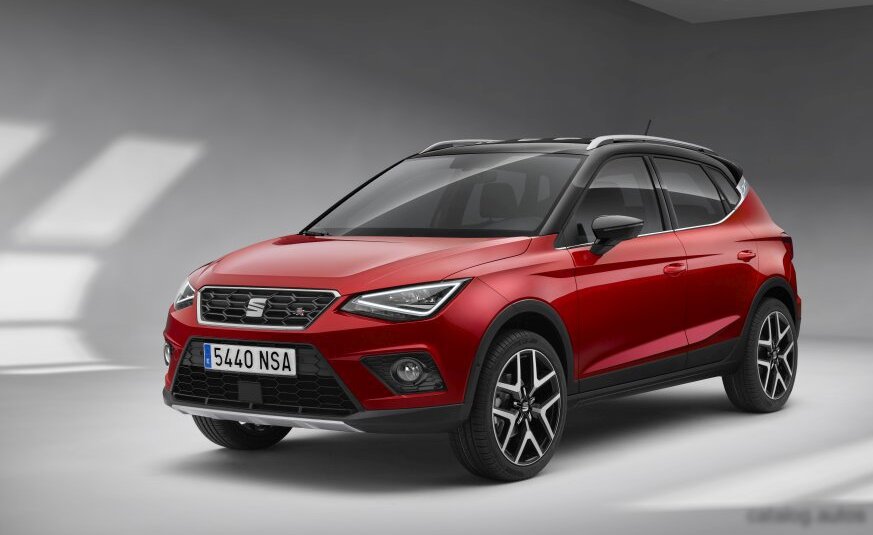
The Seat Arona 1.6 TDI (115 hp) was a front-wheel-drive subcompact SUV produced by the Spanish automaker Seat from 2018 to June 2021. Positioned as a mid-range offering within the Arona lineup, it aimed to provide a balance between fuel efficiency and acceptable performance for everyday driving. The Arona, launched in 2017, represented Seat’s entry into the rapidly growing crossover market, and the 1.6 TDI variant was a key component of its initial sales success, particularly in European markets where diesel engines remained popular. It was built on the Volkswagen Group’s MQB A0 platform, shared with models like the Volkswagen Polo and Audi A1.
Technical Specifications
| Brand | Seat |
| Model | Arona |
| Generation | Arona |
| Type (Engine) | 1.6 TDI (115 Hp) |
| Start of production | 2018 |
| End of production | June, 2021 |
| Powertrain Architecture | Internal Combustion engine |
| Body type | SUV |
| Seats | 5 |
| Doors | 5 |
| Fuel consumption (urban) | 4.7-4.8 l/100 km (50 – 49 US mpg, 60.1 – 58.9 UK mpg, 21.3 – 20.8 km/l) |
| Fuel consumption (extra urban) | 3.7 l/100 km (63.6 US mpg, 76.3 UK mpg, 27 km/l) |
| Fuel consumption (combined) | 4.1 l/100 km (57.4 US mpg, 68.9 UK mpg, 24.4 km/l) |
| CO2 emissions | 106-107 g/km |
| Fuel Type | Diesel |
| Acceleration 0 – 100 km/h | 10.5 sec |
| Acceleration 0 – 62 mph | 10.5 sec |
| Acceleration 0 – 60 mph | 10 sec |
| Maximum speed | 185 km/h (114.95 mph) |
| Emission standard | Euro 6 |
| Weight-to-power ratio | 10.7 kg/Hp, 93.6 Hp/tonne |
| Weight-to-torque ratio | 4.9 kg/Nm, 203.6 Nm/tonne |
| Power | 115 Hp @ 3250-4000 rpm |
| Power per litre | 72 Hp/l |
| Torque | 250 Nm @ 1500-3200 rpm (184.39 lb.-ft. @ 1500-3200 rpm) |
| Engine layout | Front, Transverse |
| Engine Model/Code | DGTA |
| Engine displacement | 1598 cm3 (97.52 cu. in.) |
| Number of cylinders | 4 |
| Engine configuration | Inline |
| Cylinder Bore | 79.5 mm (3.13 in.) |
| Piston Stroke | 80.5 mm (3.17 in.) |
| Compression ratio | 16.2:1 |
| Number of valves per cylinder | 4 |
| Fuel injection system | Diesel Commonrail |
| Engine aspiration | Turbocharger, Intercooler |
| Engine oil capacity | 4.7 l (4.97 US qt | 4.14 UK qt) |
| Coolant | 8 l (8.45 US qt | 7.04 UK qt) |
| Kerb Weight | 1228 kg (2707.28 lbs.) |
| Max. weight | 1810 kg (3990.37 lbs.) |
| Max load | 582 kg (1283.09 lbs.) |
| Trunk (boot) space – minimum | 400 l (14.13 cu. ft.) |
| Trunk (boot) space – maximum | 1280 l (45.2 cu. ft.) |
| Fuel tank capacity | 40 l (10.57 US gal | 8.8 UK gal) |
| Permitted trailer load with brakes (12%) | 1200 kg (2645.55 lbs.) |
| Permitted trailer load without brakes | 650 kg (1433 lbs.) |
| Permitted towbar download | 55 kg (121.25 lbs.) |
| Length | 4138 mm (162.91 in.) |
| Width | 1780 mm (70.08 in.) |
| Width including mirrors | 1942 mm (76.46 in.) |
| Height | 1552 mm (61.1 in.) |
| Wheelbase | 2566 mm (101.02 in.) |
| Front track | 1503 mm (59.17 in.) |
| Rear (Back) track | 1486 mm (58.5 in.) |
| Front overhang | 803 mm (31.61 in.) |
| Rear overhang | 769 mm (30.28 in.) |
| Minimum turning circle (turning diameter) | 10.6 m (34.78 ft.) |
| Drivetrain Architecture | The Internal combustion engine (ICE) drives the front wheels of the vehicle. |
| Drive wheel | Front wheel drive |
| Number of gears and type of gearbox | 6 gears, manual transmission |
| Front suspension | Independent type McPherson |
| Rear suspension | Coil spring, Elastic beam |
| Front brakes | Ventilated discs |
| Rear brakes | Disc |
| Assisting systems | ABS (Anti-lock braking system) |
| Steering type | Steering rack and pinion |
| Power steering | Electric Steering |
| Tires size | 205/60 R16; 205/55 R17; 215/45 R18 |
| Wheel rims size | 6J x 16; 6.5J x 17; 7J x 18 |
INTRODUCTION
The Seat Arona 1.6 TDI (115 hp) represented a pragmatic choice for buyers seeking a fuel-efficient and reasonably equipped subcompact SUV. Introduced in 2018 as part of the first-generation Arona range (internally designated as the 6H series), it slotted into the lineup below the more powerful petrol variants and above the entry-level engine options. The Arona aimed to attract a younger demographic with its modern styling and available customization options, while the 1.6 TDI engine provided a balance between running costs and usability for everyday commutes and longer journeys. This model was primarily sold in Europe, where diesel engines still held a significant market share due to favorable taxation and fuel economy.
Powertrain & Engine Architecture
The heart of the Arona 1.6 TDI was the Volkswagen Group’s DGTA engine, a 1.6-liter inline-four cylinder diesel engine. This engine was a common sight in various VW Group vehicles of the period. It featured a common rail direct injection system, delivering fuel directly into the combustion chamber at extremely high pressure for improved efficiency and reduced emissions. The engine utilized a turbocharger with an intercooler to boost power output and improve throttle response. The 115 hp version of the DGTA engine produced 250 Nm (184 lb-ft) of torque between 1500 and 3200 rpm, providing decent low-end grunt for urban driving and overtaking. The engine also incorporated a diesel particulate filter (DPF) to meet stringent Euro 6 emission standards. The Arona 1.6 TDI was typically paired with a six-speed manual transmission, although a seven-speed dual-clutch transmission (DSG) was available as an option.
Driving Characteristics
The Arona 1.6 TDI, with its 115 horsepower and manual transmission, offered a respectable, if not exhilarating, driving experience. Acceleration from 0 to 100 km/h (0-62 mph) took around 10.5 seconds, making it competitive within its class. The engine’s torque delivery meant that it felt more responsive in everyday driving situations than its horsepower figure might suggest. The six-speed gearbox was well-matched to the engine’s characteristics, allowing for comfortable cruising on the highway. Compared to the more powerful petrol versions of the Arona, the 1.6 TDI felt less eager to rev, but it compensated with superior fuel economy. The manual transmission provided a more engaging driving experience than the optional DSG, but required more driver involvement.
Equipment & Trim Levels
The Arona 1.6 TDI was available in various trim levels, including Style, Xcellence, and FR. The base Style trim included features such as air conditioning, a touchscreen infotainment system with Apple CarPlay and Android Auto compatibility, and a suite of safety features including ABS, ESC, and multiple airbags. Higher trims, like the Xcellence and FR, added features such as automatic climate control, parking sensors, a rear-view camera, alloy wheels, and sportier styling cues. Optional extras included a panoramic sunroof, navigation system, and advanced driver assistance systems like adaptive cruise control and lane assist. Interior upholstery typically consisted of cloth seats, with leather options available on higher trims.
Chassis & Braking
The Arona 1.6 TDI utilized a McPherson strut front suspension and a torsion beam rear suspension. This setup provided a good balance between ride comfort and handling. The steering was electrically assisted, offering a light and precise feel. The braking system consisted of ventilated discs on the front wheels and solid discs on the rear. ABS (Anti-lock Braking System) and ESC (Electronic Stability Control) were standard features, enhancing safety and stability. The suspension was tuned to prioritize comfort over outright sportiness, making it well-suited for everyday driving conditions.
Market Reception & Comparison
The Seat Arona 1.6 TDI was generally well-received by automotive critics. It was praised for its fuel efficiency, comfortable ride, and practical interior. However, some reviewers noted that the engine could feel underpowered when fully loaded or tackling steep hills. Compared to the petrol-powered Aronas, the 1.6 TDI offered significantly better fuel economy, but at the expense of performance. It also provided a more refined driving experience than some of its competitors in the subcompact SUV segment. The 1.6 TDI was a popular choice for buyers who prioritized running costs and practicality over outright performance.
Legacy
The Seat Arona 1.6 TDI, while no longer in production, remains a relatively common sight on used car markets. The DGTA engine, while generally reliable, is known to require regular maintenance, particularly regarding the DPF system. Proper servicing and the use of high-quality diesel fuel are crucial to prevent issues. The Arona’s MQB A0 platform has proven to be robust and well-supported, ensuring that spare parts are readily available. The 1.6 TDI variant continues to appeal to buyers seeking an affordable and fuel-efficient subcompact SUV, offering a practical and economical transportation solution.
