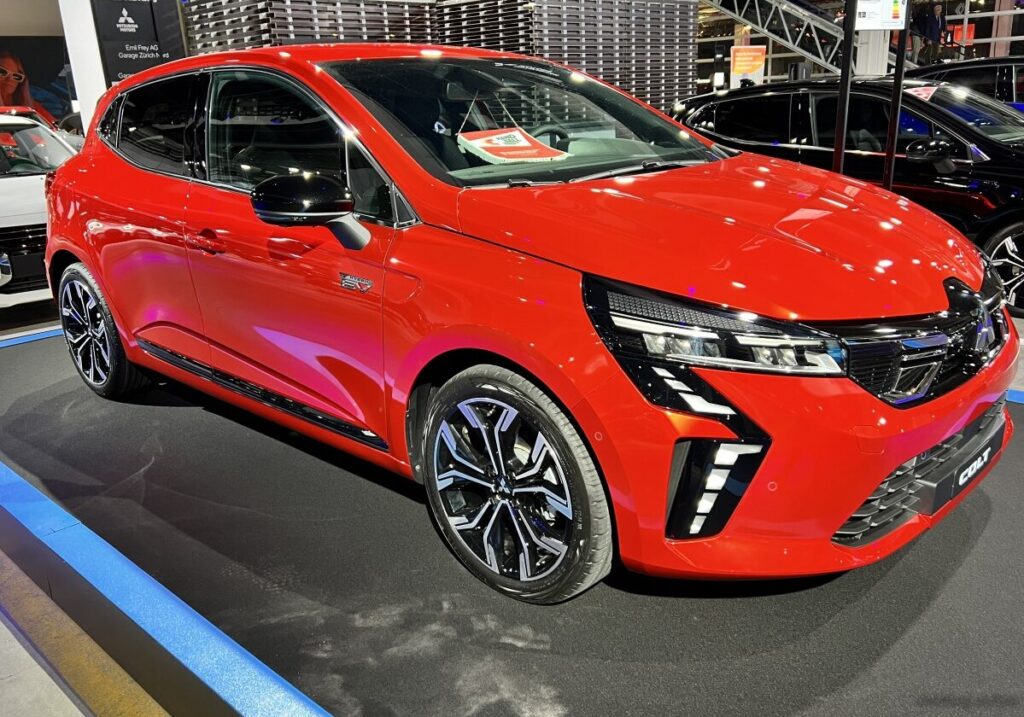
The Mitsubishi Colt VII 1.6 (143 Hp) Hybrid Multi-Mode, launched in October 2023, represents the latest iteration of Mitsubishi’s long-running Colt supermini. This variant is a key component of the seventh generation (introduced as a rebadged Renault Clio V), marking a significant shift for the Colt, particularly in European markets where it aims to compete with established players like the Peugeot 208 and Volkswagen Polo. The 1.6 Hybrid Multi-Mode trim occupies a mid-range position within the Colt VII lineup, offering a balance between fuel efficiency, performance, and technology. It’s designed to appeal to buyers seeking a practical and economical city car with the added benefit of hybrid power.
Technical Specifications
| Brand | Mitsubishi |
| Model | Colt |
| Generation | Colt VII |
| Type (Engine) | 1.6 (143 Hp) Hybrid Multi-Mode |
| Start of production | October, 2023 |
| Powertrain Architecture | FHEV (Full Hybrid Electric Vehicle) |
| Body type | Hatchback |
| Seats | 5 |
| Doors | 5 |
| Fuel consumption at Low speed (WLTP) | 3.6 l/100 km (65.3 US mpg, 78.5 UK mpg, 27.8 km/l) |
| Fuel consumption at Medium speed (WLTP) | 3.8 l/100 km (61.9 US mpg, 74.3 UK mpg, 26.3 km/l) |
| Fuel consumption at high speed (WLTP) | 3.7 l/100 km (63.6 US mpg, 76.3 UK mpg, 27 km/l) |
| Fuel consumption at very high speed (WLTP) | 4.8 l/100 km (49 US mpg, 58.9 UK mpg, 20.8 km/l) |
| Combined fuel consumption (WLTP) | 4.1 l/100 km (57.4 US mpg, 68.9 UK mpg, 24.4 km/l) |
| CO2 emissions (WLTP) | 92 g/km |
| Fuel Type | Petrol (Gasoline) |
| Acceleration 0 – 100 km/h | 9.3 sec |
| Acceleration 0 – 62 mph | 9.3 sec |
| Acceleration 0 – 60 mph | 8.8 sec |
| Maximum speed | 180 km/h (111.85 mph) |
| Emission standard | Euro 6d |
| Weight-to-power ratio | 8.8 kg/Hp, 113.9 Hp/tonne |
| Weight-to-torque ratio | 8.5 kg/Nm, 117.8 Nm/tonne |
| Gross battery capacity | 1.2 kWh |
| Battery voltage | 230 V |
| Battery technology | Lithium-ion (Li-Ion) |
| Battery location | Under the trunk |
| Electric motor power | 49 Hp |
| Electric motor location | Integrated into the transmission |
| Electric motor type | Synchronous |
| System power | 143 Hp |
| Power | 94 Hp @ 5600 rpm |
| Power per litre | 58.8 Hp/l |
| Torque | 148 Nm @ 3200-3600 rpm (109.16 lb.-ft. @ 3200-3600 rpm) |
| Engine layout | Front, Transverse |
| Engine displacement | 1598 cm3 (97.52 cu. in.) |
| Number of cylinders | 4 |
| Engine configuration | Inline |
| Cylinder Bore | 78 mm (3.07 in.) |
| Piston Stroke | 83.6 mm (3.29 in.) |
| Compression ratio | 10.8:1 |
| Number of valves per cylinder | 4 |
| Fuel injection system | Multi-port manifold injection |
| Engine aspiration | Naturally aspirated engine |
| Valvetrain | DOHC |
| Engine systems | Start & Stop System, Particulate filter |
| Kerb Weight | 1256-1285 kg (2769.01 – 2832.94 lbs.) |
| Max. weight | 1730-1765 kg (3814 – 3891.16 lbs.) |
| Max load | 474-480 kg (1044.99 – 1058.22 lbs.) |
| Trunk (boot) space – minimum | 301 l (10.63 cu. ft.) |
| Trunk (boot) space – maximum | 979 l (34.57 cu. ft.) |
| Fuel tank capacity | 39 l (10.3 US gal | 8.58 UK gal) |
| Max. roof load | 80 kg (176.37 lbs.) |
| Permitted trailer load with brakes (12%) | 900 kg (1984.16 lbs.) |
| Permitted trailer load without brakes | 655 kg (1444.03 lbs.) |
| Permitted towbar download | 63 kg (138.89 lbs.) |
| Length | 4053 mm (159.57 in.) |
| Width | 1798 mm (70.79 in.) |
| Width including mirrors | 1988 mm (78.27 in.) |
| Height | 1439 mm (56.65 in.) |
| Wheelbase | 2583 mm (101.69 in.) |
| Front track | 1518 mm (59.76 in.) |
| Rear (Back) track | 1506 mm (59.29 in.) |
| Front overhang | 833 mm (32.8 in.) |
| Rear overhang | 637 mm (25.08 in.) |
| Ride height (ground clearance) | 142 mm (5.59 in.) |
| Minimum turning circle (turning diameter) | 10.4 m (34.12 ft.) |
| Drivetrain Architecture | The Internal combustion engine (ICE) and electric motor drive the front wheels of the car with the ability to work in full electric or mixed mode. |
| Drive wheel | Front wheel drive |
| Number of gears and type of gearbox | automatic transmission Multi-Mode |
| Front suspension | Independent type McPherson |
| Rear suspension | Torsion |
| Front brakes | Ventilated discs |
| Rear brakes | Disc |
| Assisting systems | ABS (Anti-lock braking system) |
| Steering type | Steering rack and pinion |
| Power steering | Electric Steering |
| Tires size | 195/55 R16; 205/45 R17 |
| Wheel rims size | 6.5J x 16; 7J x 17 |
Powertrain & Engine Architecture
The Colt VII 1.6 Hybrid Multi-Mode utilizes a full hybrid (FHEV) powertrain. The core of the system is a 1.6-liter, naturally aspirated inline-four cylinder gasoline engine (internal designation likely derived from the Renault engine family). This engine produces 94 horsepower at 5600 rpm and 148 Nm (109.16 lb.-ft.) of torque between 3200 and 3600 rpm. The engine features multi-point fuel injection and a double overhead camshaft (DOHC) valvetrain. Crucially, it’s paired with a 49 horsepower electric motor integrated into the transmission. The combined system output is 143 horsepower. The transmission is a unique “Multi-Mode” automatic, which isn’t a traditional continuously variable transmission (CVT) but rather a sophisticated automated manual transmission designed to mimic the feel of a conventional automatic while maximizing efficiency. The battery pack, utilizing Lithium-ion technology with a capacity of 1.2 kWh, is located under the trunk floor.
Driving Characteristics
The 1.6 Hybrid Multi-Mode offers a comfortable and refined driving experience, particularly in urban environments. The electric motor provides instant torque, aiding in quick acceleration from a standstill and contributing to smooth, quiet operation at lower speeds. The Multi-Mode transmission generally shifts smoothly, although it can occasionally exhibit some hesitation during rapid acceleration. Compared to a standard gasoline-powered Colt VII, the hybrid variant offers improved fuel economy, especially in city driving. However, the 0-60 mph time of around 8.8 seconds is modest, placing it behind some of its more performance-oriented rivals. The hybrid system prioritizes efficiency over outright speed, and the engine can sometimes feel strained when pushed hard. The steering is light and precise, making it easy to maneuver in tight spaces.
Equipment & Trim Levels
The 1.6 Hybrid Multi-Mode trim typically includes standard features such as air conditioning, a touchscreen infotainment system with Apple CarPlay and Android Auto compatibility, a rearview camera, and various safety systems like automatic emergency braking and lane departure warning. Higher trim levels add features like keyless entry, a larger touchscreen display, upgraded upholstery, and parking sensors. Interior materials are generally of good quality for the segment, with a focus on practicality and durability. The dashboard layout is modern and user-friendly, with logically placed controls.
Chassis & Braking
The Colt VII utilizes a front-wheel-drive chassis with an independent McPherson strut suspension at the front and a torsion beam suspension at the rear. This setup provides a good balance between ride comfort and handling. The front brakes are ventilated discs, while the rear brakes are solid discs. ABS (Anti-lock Braking System) is standard. The suspension is tuned for comfort, absorbing bumps and imperfections in the road surface effectively. Stabilizer bars are fitted to both the front and rear axles to reduce body roll during cornering.
Market Reception & Comparison
The Mitsubishi Colt VII 1.6 Hybrid Multi-Mode has been generally well-received by automotive critics, who praise its fuel efficiency, comfortable ride, and well-equipped interior. However, some reviewers have noted its modest performance and the occasionally hesitant behavior of the Multi-Mode transmission. Compared to other hybrid options in the same segment, such as the Renault Clio E-Tech, the Colt offers a competitive fuel economy and a similar level of refinement. The Colt’s pricing is also competitive, making it an attractive option for budget-conscious buyers.
Legacy
As a relatively new model, the long-term reliability of the Colt VII 1.6 Hybrid Multi-Mode remains to be fully established. However, Mitsubishi has a generally good reputation for building reliable vehicles. The hybrid powertrain, while complex, is expected to offer good durability with proper maintenance. On the used car market, the Colt VII Hybrid is likely to hold its value reasonably well, particularly as demand for fuel-efficient vehicles continues to grow. The integration of Renault technology may also influence parts availability and repair costs in the future.