
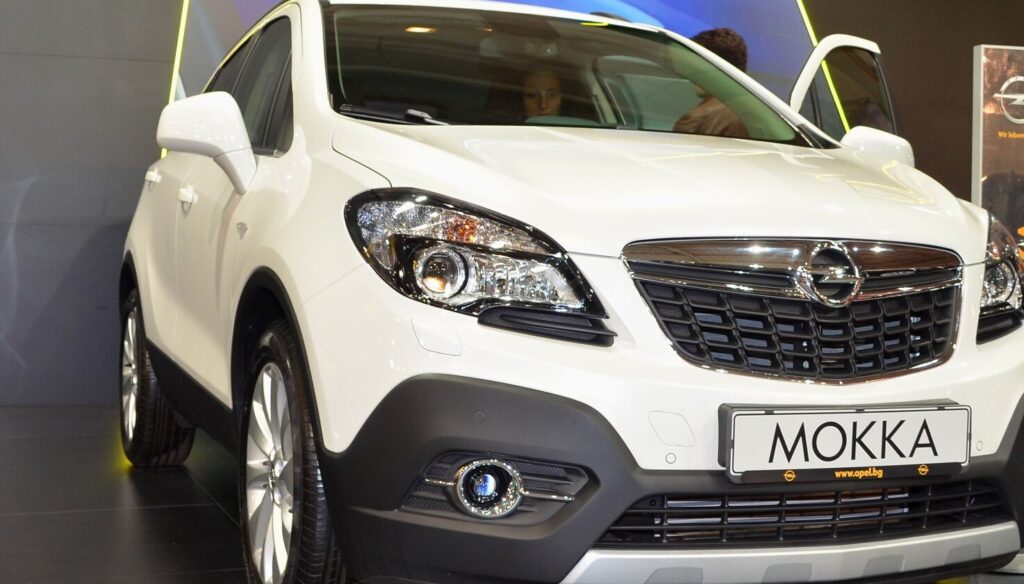
The Opel Mokka 1.6 CDTI (110 hp) ecoFLEX, produced from July 2015 to May 2016, represented a fuel-efficient diesel option within the first generation of the Mokka subcompact SUV (J13/A13 platform). Positioned as a mid-range trim, it aimed to balance affordability with reasonable performance and economy. This variant was primarily marketed in Europe, where diesel engines held a significant market share, offering a compelling alternative to gasoline-powered models and more powerful diesel options within the Mokka lineup. The “ecoFLEX” designation signified Opel’s efforts to optimize fuel consumption through aerodynamic improvements and revised engine mapping.
Technical Specifications
| Brand | Opel |
| Model | Mokka |
| Generation | Mokka |
| Type (Engine) | 1.6 CDTI (110 Hp) ecoFLEX |
| Start of production | July, 2015 |
| End of production | May, 2016 |
| Powertrain Architecture | Internal Combustion engine |
| Body type | SUV |
| Seats | 5 |
| Doors | 5 |
| Fuel consumption (urban) | 4.8-4.7 l/100 km (49 – 50 US mpg, 58.9 – 60.1 UK mpg, 20.8 – 21.3 km/l) |
| Fuel consumption (extra urban) | 4.0-3.8 l/100 km (58.8 – 61.9 US mpg, 70.6 – 74.3 UK mpg, 25 – 26.3 km/l) |
| Fuel consumption (combined) | 4.3-4.1 l/100 km (54.7 – 57.4 US mpg, 65.7 – 68.9 UK mpg, 23.3 – 24.4 km/l) |
| CO2 emissions | 114-106 g/km |
| Fuel Type | Diesel |
| Acceleration 0 – 100 km/h | 12.5 sec |
| Acceleration 0 – 62 mph | 12.5 sec |
| Acceleration 0 – 60 mph | 11.9 sec |
| Maximum speed | 178 km/h (110.6 mph) |
| Emission standard | Euro 6 |
| Weight-to-power ratio | 12.5 kg/Hp, 80.1 Hp/tonne |
| Weight-to-torque ratio | 4.6 kg/Nm, 218.3 Nm/tonne |
| Power | 110 Hp @ 4000 rpm |
| Torque | 300 Nm @ 2000-2250 rpm (221.27 lb.-ft. @ 2000-2250 rpm) |
| Engine layout | Front, Transverse |
| Engine Model/Code | B16DTN |
| Engine displacement | 1598 cm3 (97.52 cu. in.) |
| Number of cylinders | 4 |
| Engine configuration | Inline |
| Cylinder Bore | 79.7 mm (3.14 in.) |
| Piston Stroke | 80.1 mm (3.15 in.) |
| Compression ratio | 16:1 |
| Fuel injection system | Diesel Commonrail |
| Engine aspiration | Turbocharger, Intercooler |
| Engine oil capacity | 5 l (5.28 US qt | 4.4 UK qt) |
| Coolant capacity | 6.2 l (6.55 US qt | 5.46 UK qt) |
| Kerb Weight | 1374 kg (3029.15 lbs.) |
| Max. weight | 1883 kg (4151.3 lbs.) |
| Max load | 509 kg (1122.15 lbs.) |
| Fuel tank capacity | 52 l (13.74 US gal | 11.44 UK gal) |
| Max. roof load | 75 kg (165.35 lbs.) |
| Permitted trailer load with brakes (12%) | 1500 kg (3306.93 lbs.) |
| Permitted trailer load without brakes | 500 kg (1102.31 lbs.) |
| Permitted towbar download | 75 kg (165.35 lbs.) |
| Length | 4278 mm (168.43 in.) |
| Width | 1777 mm (69.96 in.) |
| Width including mirrors | 2038 mm (80.24 in.) |
| Height | 1658 mm (65.28 in.) |
| Wheelbase | 2555 mm (100.59 in.) |
| Front track | 1540 mm (60.63 in.) |
| Rear track | 1540 mm (60.63 in.) |
| Front overhang | 943 mm (37.13 in.) |
| Rear overhang | 780 mm (30.71 in.) |
| Ride height (ground clearance) | 158 mm (6.22 in.) |
| Drivetrain Architecture | Front wheel drive |
| Number of gears and type of gearbox | 6 gears, manual transmission |
| Front brakes | Ventilated discs |
| Rear brakes | Disc |
Powertrain & Engine Architecture
The Mokka 1.6 CDTI ecoFLEX utilized the Opel/Fiat-sourced B16DTN engine, a 1.6-liter inline-four cylinder diesel. This engine belonged to the family of small-capacity diesel engines developed jointly by Opel and Fiat, known for their efficiency and relatively low emissions. The B16DTN featured a turbocharger with an intercooler to boost power output, and employed a common-rail direct fuel injection system for precise fuel delivery. This system, operating at high pressure, contributed to improved combustion efficiency and reduced particulate matter. The engine’s valvetrain consisted of two overhead camshafts (DOHC) operating four valves per cylinder. The 6-speed manual transmission was standard, chosen for its fuel efficiency and driver engagement, although an automatic transmission was available as an option in some markets. The engine was transversely mounted in the front of the vehicle, driving the front wheels.
Driving Characteristics
The 110 hp output of the 1.6 CDTI, coupled with the 300 Nm (221 lb-ft) of torque, provided adequate, though not exhilarating, performance for everyday driving. Acceleration from 0-60 mph took around 11.9 seconds, and top speed was approximately 110.6 mph. The engine’s peak torque was available from 2000-2250 rpm, offering good responsiveness in typical driving situations. Compared to the more powerful 1.4 Turbo gasoline engine or the 130 hp version of the 1.6 CDTI, the 110 hp variant felt less eager to accelerate, particularly when fully loaded or on inclines. However, the manual transmission allowed drivers to maintain optimal engine speed for efficient cruising. The gear ratios were tuned for fuel economy, resulting in a slightly higher engine speed at highway speeds compared to some competitors.
Equipment & Trim Levels
The 1.6 CDTI ecoFLEX trim typically included standard features such as air conditioning, a CD/MP3 stereo system with USB connectivity, power windows and mirrors, and ABS brakes. Safety features included multiple airbags and stability control. Interior upholstery was generally cloth, with a functional, if not luxurious, dashboard layout. Optional extras included alloy wheels, a touchscreen infotainment system with navigation, parking sensors, and a panoramic sunroof. The ecoFLEX trim often featured specific aerodynamic enhancements, such as a revised front grille and underbody panels, to further improve fuel efficiency.
Chassis & Braking
The Mokka 1.6 CDTI ecoFLEX utilized a MacPherson strut front suspension and a torsion beam rear suspension. This setup provided a reasonable balance between ride comfort and handling. The front brakes were ventilated discs, while the rear brakes were solid discs. The steering was electric power-assisted, offering light and precise control. The suspension was tuned for comfort, prioritizing a smooth ride over sporty handling. Stabilizer bars were fitted to both the front and rear axles to reduce body roll during cornering.
Market Reception & Comparison
The Opel Mokka 1.6 CDTI ecoFLEX was generally well-received by critics for its fuel efficiency and low running costs. It was seen as a practical and economical choice for urban commuters and small families. Compared to the gasoline-powered Mokka, the diesel version offered significantly better fuel economy, making it an attractive option for high-mileage drivers. However, some reviewers noted that the engine could be somewhat noisy and lacked the refinement of some competitors. Compared to the more powerful 130 hp diesel, the 110 hp version offered a lower price point but sacrificed some performance. Reliability reports were generally positive, with the 1.6 CDTI engine proving to be a relatively robust unit.
Legacy
The Opel Mokka 1.6 CDTI ecoFLEX, while not the most powerful or luxurious version of the Mokka, remains a popular choice in the used car market due to its fuel efficiency and affordability. The B16DTN engine has proven to be reasonably reliable, although regular maintenance, including oil changes and filter replacements, is crucial for long-term durability. The availability of spare parts is generally good, and the Mokka’s relatively simple mechanical design makes it relatively easy to repair. The ecoFLEX variant continues to appeal to buyers seeking a practical and economical subcompact SUV.
