
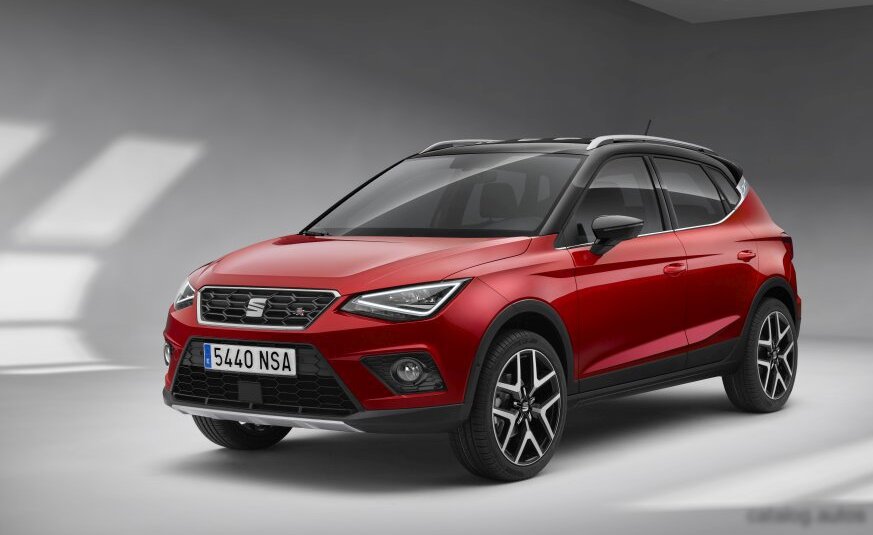
The Seat Arona 1.6 TDI (95 hp) DSG was a front-wheel-drive subcompact SUV produced by the Spanish automaker Seat from 2017 to 2019. Positioned as an entry-level offering within the Arona range, it aimed to provide a fuel-efficient and practical option for urban drivers. The Arona itself, launched in 2017, represented Seat’s entry into the rapidly growing B-segment crossover market, sharing its platform – the Volkswagen Group’s PQ25 – with the Volkswagen Polo and Audi A1. This particular variant, combining the 1.6-liter diesel engine with a seven-speed dual-clutch transmission (DSG), was a key component of the initial Arona lineup, offering a balance between affordability and convenience.
Technical Specifications
| Brand | Seat |
| Model | Arona |
| Generation | Arona |
| Type (Engine) | 1.6 TDI (95 Hp) DSG |
| Start of production | 2017 |
| End of production | 2019 |
| Powertrain Architecture | Internal Combustion engine |
| Body type | SUV |
| Seats | 5 |
| Doors | 5 |
| Fuel consumption (urban) | 4.5 l/100 km (52.3 US mpg, 62.8 UK mpg, 22.2 km/l) |
| Fuel consumption (extra urban) | 4 l/100 km (58.8 US mpg, 70.6 UK mpg, 25 km/l) |
| Fuel consumption (combined) | 4.2 l/100 km (56 US mpg, 67.3 UK mpg, 23.8 km/l) |
| CO2 emissions | 108-109 g/km |
| Fuel Type | Diesel |
| Acceleration 0 – 100 km/h | 12.8 sec |
| Acceleration 0 – 62 mph | 12.8 sec |
| Acceleration 0 – 60 mph | 12.2 sec |
| Maximum speed | 174 km/h (108.12 mph) |
| Emission standard | Euro 6 |
| Weight-to-power ratio | 13.1 kg/Hp, 76.3 Hp/tonne |
| Weight-to-torque ratio | 5 kg/Nm, 200.8 Nm/tonne |
| Power | 95 Hp @ 2750-4600 rpm |
| Power per litre | 59.4 Hp/l |
| Torque | 250 Nm @ 1500-2600 rpm (184.39 lb.-ft. @ 1500-2600 rpm) |
| Engine layout | Front, Transverse |
| Engine Model/Code | DGTD |
| Engine displacement | 1598 cm3 (97.52 cu. in.) |
| Number of cylinders | 4 |
| Engine configuration | Inline |
| Cylinder Bore | 79.5 mm (3.13 in.) |
| Piston Stroke | 80.5 mm (3.17 in.) |
| Compression ratio | 16.2:1 |
| Number of valves per cylinder | 4 |
| Fuel injection system | Diesel Commonrail |
| Engine aspiration | Turbocharger, Intercooler |
| Engine oil capacity | 4.7 l (4.97 US qt | 4.14 UK qt) |
| Coolant | 8 l (8.45 US qt | 7.04 UK qt) |
| Kerb Weight | 1245 kg (2744.76 lbs.) |
| Max. weight | 1830 kg (4034.46 lbs.) |
| Max load | 585 kg (1289.7 lbs.) |
| Trunk (boot) space – minimum | 400 l (14.13 cu. ft.) |
| Trunk (boot) space – maximum | 1280 l (45.2 cu. ft.) |
| Fuel tank capacity | 40 l (10.57 US gal | 8.8 UK gal) |
| Permitted trailer load with brakes (12%) | 1100 kg (2425.08 lbs.) |
| Permitted trailer load without brakes | 660 kg (1455.05 lbs.) |
| Permitted towbar download | 55 kg (121.25 lbs.) |
| Length | 4138 mm (162.91 in.) |
| Width | 1780 mm (70.08 in.) |
| Width including mirrors | 1942 mm (76.46 in.) |
| Height | 1552 mm (61.1 in.) |
| Wheelbase | 2566 mm (101.02 in.) |
| Front track | 1503 mm (59.17 in.) |
| Rear (Back) track | 1486 mm (58.5 in.) |
| Front overhang | 803 mm (31.61 in.) |
| Rear overhang | 769 mm (30.28 in.) |
| Ride height (ground clearance) | 190 mm (7.48 in.) |
| Minimum turning circle (turning diameter) | 11 m (36.09 ft.) |
| Front suspension | Independent type McPherson |
| Rear suspension | Coil spring, Elastic beam |
| Front brakes | Ventilated discs |
| Rear brakes | Disc |
| Gearbox | 7 gears, automatic transmission DSG |
| Tires size | 205/60 R16; 205/55 R17; 215/45 R18 |
| Wheel rims size | 6J x 16; 6.5J x 17; 7J x 18 |
INTRODUCTION
The Seat Arona 1.6 TDI (95 hp) DSG, produced between 2017 and 2019, was a key variant in the initial Arona lineup. Built on the Volkswagen Group’s PQ25 platform (also known as the A05 platform), it shared its underpinnings with models like the VW Polo and Audi A1. The Arona was designed to appeal to buyers seeking a stylish, practical, and relatively affordable crossover. This 1.6 TDI DSG model specifically targeted customers prioritizing fuel economy and ease of driving, making it a popular choice in European markets where diesel engines and automatic transmissions were highly favored. It sat towards the lower end of the Arona range, offering a more accessible price point compared to higher-powered petrol or diesel options.
Powertrain & Engine Architecture
The heart of the Arona 1.6 TDI was the DGTD engine, a 1.6-liter inline-four cylinder diesel engine. This engine, a common unit within the Volkswagen Group, utilized a common rail direct injection system to deliver fuel directly into the combustion chamber, maximizing efficiency and reducing emissions. A turbocharger with an intercooler was employed to boost power output. The engine produced 95 horsepower at 2750-4600 rpm and 250 Nm (184 lb-ft) of torque between 1500-2600 rpm. The torque curve was relatively flat, providing good responsiveness at lower engine speeds. Paired with this engine was a seven-speed dual-clutch transmission (DSG). This DSG gearbox offered quick and smooth gear changes, contributing to a more refined driving experience compared to a traditional manual transmission. The DSG’s programming was tuned for fuel efficiency and comfort, rather than outright performance.
Driving Characteristics
The Arona 1.6 TDI DSG wasn’t designed to be a performance car. Acceleration from 0 to 100 km/h (0-62 mph) took around 12.8 seconds, and top speed was limited to 174 km/h (108 mph). The focus was on usability and efficiency. The DSG transmission helped to mask some of the engine’s limitations, providing seamless gear changes and keeping the engine within its optimal power band. However, compared to the more powerful petrol versions of the Arona, or even the higher-output diesel variants, this model felt noticeably slower, particularly when fully loaded or tackling uphill climbs. The gear ratios were optimized for fuel economy, meaning the engine could feel slightly strained at higher speeds. The front-wheel-drive configuration provided predictable handling, but lacked the all-weather capability of an all-wheel-drive system.
Equipment & Trim Levels
The Arona 1.6 TDI DSG typically came with a reasonable level of standard equipment. This included air conditioning, electric front windows, a touchscreen infotainment system with Bluetooth connectivity, and a suite of safety features such as ABS, ESC (Electronic Stability Control), and multiple airbags. Higher trim levels, such as Style or Xcellence, added features like alloy wheels, rear parking sensors, cruise control, and a larger touchscreen display. Interior upholstery was typically cloth, with options for partial leather trim on higher-spec models. Optional extras included a panoramic sunroof, navigation system, and advanced driver-assistance systems like lane assist and adaptive cruise control.
Chassis & Braking
The Arona 1.6 TDI utilized a McPherson strut suspension setup at the front and a torsion beam suspension at the rear. This configuration provided a good balance between ride comfort and handling. The torsion beam rear suspension was a cost-effective solution, but it didn’t offer the same level of sophistication as a multi-link setup. Braking duties were handled by ventilated discs at the front and solid discs at the rear. The braking system was adequate for the vehicle’s weight and performance, providing sufficient stopping power in most driving conditions. Electric power steering was standard, offering light and precise steering feel.
Market Reception & Comparison
The Seat Arona 1.6 TDI DSG was generally well-received by automotive critics as a practical and fuel-efficient option. Reviewers praised its comfortable ride, spacious interior, and user-friendly technology. However, some criticized its relatively modest performance and the somewhat basic interior materials. Compared to the 1.0 TSI petrol version, the 1.6 TDI offered better fuel economy and more torque, but at the expense of acceleration. The higher-output 2.0 TDI variants provided significantly more power, but came with a higher price tag. In terms of reliability, the 1.6 TDI engine proved to be generally robust, although DSG transmissions can sometimes require maintenance or repairs over the long term.
Legacy
The Seat Arona 1.6 TDI DSG remains a relatively common sight on the used car market. Its fuel efficiency and practicality continue to appeal to buyers seeking an affordable and economical crossover. While the 1.6 TDI engine has been superseded by newer, more efficient diesel engines, it remains a reliable and capable unit. The DSG transmission, if properly maintained, can provide years of smooth and reliable operation. However, potential buyers should be aware of the potential for DSG maintenance costs and should ensure that the vehicle has a full service history. The Arona 1.6 TDI DSG represents a solid entry point into the subcompact SUV segment, offering a good balance of practicality, efficiency, and affordability.
