
Technical Specifications
| Brand | Skoda |
| Model | Karoq |
| Generation | Karoq |
| Type (Engine) | 2.0 TDI (116 Hp) DSG |
| Start of production | November, 2020 |
| End of production | November, 2021 |
| Powertrain Architecture | Internal Combustion engine |
| Body type | SUV |
| Seats | 5 |
| Doors | 5 |
| Fuel consumption at Low speed (WLTP) | 6.5 l/100 km (36.2 US mpg, 43.5 UK mpg, 15.4 km/l) |
| Fuel consumption at Medium speed (WLTP) | 4.5 l/100 km (52.3 US mpg, 62.8 UK mpg, 22.2 km/l) |
| Fuel consumption at high speed (WLTP) | 4.1 l/100 km (57.4 US mpg, 68.9 UK mpg, 24.4 km/l) |
| Fuel consumption at very high speed (WLTP) | 5.1 l/100 km (46.1 US mpg, 55.4 UK mpg, 19.6 km/l) |
| Combined fuel consumption (WLTP) | 4.9 l/100 km (48 US mpg, 57.6 UK mpg, 20.4 km/l) |
| CO2 emissions (WLTP) | 128 g/km |
| Fuel consumption (economy) – urban (NEDC) | 5.1 l/100 km (46.1 US mpg, 55.4 UK mpg, 19.6 km/l) |
| Fuel consumption (economy) – extra urban (NEDC) | 3.6 l/100 km (65.3 US mpg, 78.5 UK mpg, 27.8 km/l) |
| Fuel consumption (economy) – combined (NEDC) | 4.1 l/100 km (57.4 US mpg, 68.9 UK mpg, 24.4 km/l) |
| CO2 emissions (NEDC) | 109 g/km |
| Fuel Type | Diesel |
| Acceleration 0 – 100 km/h | 11 sec |
| Acceleration 0 – 62 mph | 11 sec |
| Acceleration 0 – 60 mph | 10.5 sec |
| Maximum speed | 189 km/h (117.44 mph) |
| Emission standard | Euro 6d-ISC-FCM |
| Weight-to-power ratio | 12.1 kg/Hp, 82.6 Hp/tonne |
| Weight-to-torque ratio | 4.7 kg/Nm, 213.5 Nm/tonne |
| Power | 116 Hp @ 2750-4250 rpm |
| Power per litre | 58.9 Hp/l |
| Torque | 300 Nm @ 1600-2500 rpm (221.27 lb.-ft. @ 1600-2500 rpm) |
| Engine layout | Front, Transverse |
| Engine Model/Code | EA288 / DTRD |
| Engine displacement | 1968 cm3 (120.09 cu. in.) |
| Number of cylinders | 4 |
| Engine configuration | Inline |
| Cylinder Bore | 81 mm (3.19 in.) |
| Piston Stroke | 95.5 mm (3.76 in.) |
| Number of valves per cylinder | 4 |
| Fuel injection system | Diesel Commonrail |
| Engine aspiration | Turbocharger, Intercooler |
| Valvetrain | DOHC |
| Engine oil capacity | 4.7 l (4.97 US qt | 4.14 UK qt) |
| Kerb Weight | 1405 kg (3097.49 lbs.) |
| Max. weight | 2005 kg (4420.27 lbs.) |
| Max load | 600 kg (1322.77 lbs.) |
| Trunk (boot) space – minimum | 521 l (18.4 cu. ft.) |
| Trunk (boot) space – maximum | 1630 l (57.56 cu. ft.) |
| Fuel tank capacity | 50 l (13.21 US gal | 11 UK gal) |
| AdBlue tank | 14.5 l (3.83 US gal | 3.19 UK gal) |
| Max. roof load | 75 kg (165.35 lbs.) |
| Permitted trailer load with brakes (8%) | 1700 kg (3747.86 lbs.) |
| Permitted trailer load with brakes (12%) | 1500 kg (3306.93 lbs.) |
| Permitted trailer load without brakes | 730 kg (1609.37 lbs.) |
| Permitted towbar download | 90 kg (198.42 lbs.) |
| Length | 4382 mm (172.52 in.) |
| Width | 1841 mm (72.48 in.) |
| Width including mirrors | 2025 mm (79.72 in.) |
| Height | 1603 mm (63.11 in.) |
| Wheelbase | 2638 mm (103.86 in.) |
| Front track | 1576 mm (62.05 in.) |
| Rear (Back) track | 1541 mm (60.67 in.) |
| Front overhang | 877 mm (34.53 in.) |
| Rear overhang | 866 mm (34.09 in.) |
| Ride height (ground clearance) | 163 mm (6.42 in.) |
| Drag coefficient (Cd) | 0.324 |
| Minimum turning circle (turning diameter) | 10.9 m (35.76 ft.) |
| Approach angle | 18.4° |
| Departure angle | 18.7° |
| Drivetrain Architecture | The Internal combustion engine (ICE) drives the front wheels of the vehicle. |
| Drive wheel | Front wheel drive |
| Number of gears and type of gearbox | 7 gears, automatic transmission DSG |
| Front suspension | Independent type McPherson, Transverse stabilizer |
| Rear suspension | Torsion |
| Front brakes | Ventilated discs |
| Rear brakes | Disc |
| Assisting systems | ABS (Anti-lock braking system) |
| Steering type | Steering rack and pinion |
| Power steering | Electric Steering |
| Tires size | 215/55 R17; 215/50 R18 |
| Wheel rims size | 7J x 17; 7J x 18 |
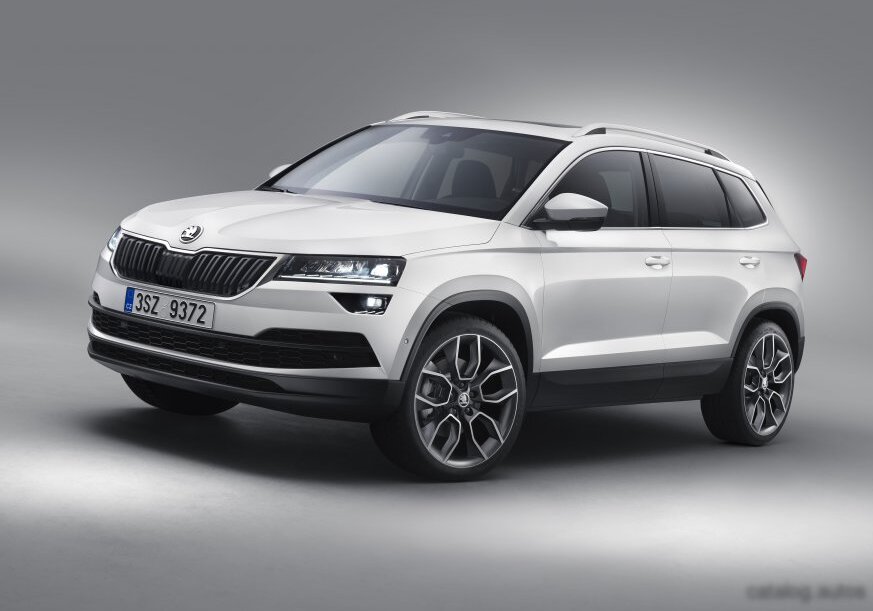
The Skoda Karoq 2.0 TDI (116 hp) DSG was a front-wheel-drive compact SUV manufactured by Skoda Auto, a Czech automaker, between November 2020 and November 2021. It occupied a mid-range position within the broader Karoq lineup, aiming to strike a balance between fuel economy, practicality, and driving comfort. The Karoq, introduced in 2017, was Skoda’s replacement for the popular Yeti, marking their entry into the burgeoning compact SUV segment. This particular variant, powered by the EA288 engine and a 7-speed DSG transmission, was primarily marketed in European countries where diesel engines remained favored due to their fuel efficiency and suitability for long-distance travel.
Powertrain & Engine Architecture
The Karoq 2.0 TDI (116 hp) featured the Volkswagen Group’s EA288 series of diesel engines. The specific engine code, DTRD, denotes a 2.0-liter, inline-four cylinder diesel. This engine employed a common rail direct fuel injection system, delivering fuel at high pressure for optimized combustion. A turbocharger, coupled with an intercooler, boosted power output and improved efficiency. To meet the stringent Euro 6d-ISC-FCM emissions standards, the engine incorporated a Diesel Particulate Filter (DPF). The engine generated 116 horsepower between 2750 and 4250 rpm, and 300 Nm (221 lb-ft) of torque from 1600 to 2500 rpm. Power was transferred to the front wheels through a 7-speed dual-clutch transmission (DSG). The DSG transmission provided rapid and seamless gear changes, enhancing the driving experience compared to a conventional automatic.
Driving Characteristics
The 116 hp 2.0 TDI paired with the DSG transmission offered adequate, though not sporty, performance. Acceleration from 0 to 100 km/h (0-62 mph) took around 11 seconds. The DSG transmission effectively matched the engine’s torque curve, providing responsive acceleration in most everyday driving scenarios. However, when compared to the more powerful 2.0 TDI 150 hp version of the Karoq, this variant felt noticeably slower, especially when carrying a full load or ascending steep hills. The gear ratios were optimized for fuel efficiency, occasionally resulting in the engine feeling somewhat strained at higher speeds. The front-wheel-drive configuration delivered predictable handling, but lacked the all-weather capabilities of the optional all-wheel-drive system available on other Karoq models.
Equipment & Trim Levels
The Karoq 2.0 TDI (116 hp) DSG generally came with a solid set of standard features. These typically included air conditioning, a touchscreen infotainment system with Apple CarPlay and Android Auto integration, alloy wheels, and a comprehensive suite of safety technologies such as ABS, ESC (Electronic Stability Control), and multiple airbags. Interior upholstery was usually cloth, with leather upgrades available as an option. Popular optional extras included parking sensors, a rearview camera, adaptive cruise control, and a panoramic sunroof. Trim levels varied depending on the market, but generally offered progressive enhancements in interior comfort and technology.
Chassis & Braking
The Karoq’s chassis utilized an independent McPherson strut suspension at the front and a torsion beam suspension at the rear. This configuration provided a comfortable ride, effectively absorbing road imperfections. The front brakes were ventilated discs, while the rear brakes were solid discs. The braking system offered reliable stopping power for the vehicle’s weight and performance. A transverse stabilizer bar was incorporated into the front suspension to minimize body roll during cornering maneuvers.
Market Reception & Comparison
The Skoda Karoq 2.0 TDI (116 hp) DSG was generally well-regarded by automotive journalists as a practical and fuel-efficient SUV. However, some critics pointed out that the engine felt somewhat underpowered compared to alternative options. Fuel economy was a significant strength, with combined WLTP figures averaging around 4.9 l/100 km (48 US mpg). Compared to the 1.6 TDI version, the 2.0 TDI offered increased torque and a smoother driving experience. In contrast to the 2.0 TDI 150 hp, it provided a more affordable entry point into the Karoq range, albeit at the cost of performance.
Legacy
The EA288 engine, in its various forms, has demonstrated a generally good level of reliability. However, like all modern diesel engines, it can be susceptible to issues with the DPF and EGR (Exhaust Gas Recirculation) systems, particularly with frequent short trips. The 7-speed DSG transmission is typically durable, but requires scheduled maintenance – specifically, fluid changes – to ensure its longevity. In the used car market, the Karoq 2.0 TDI (116 hp) DSG represents a compelling value proposition for buyers seeking a practical, fuel-efficient, and well-equipped compact SUV. Its lower price point compared to higher-output versions makes it an attractive choice for budget-conscious consumers.
