Technical Specifications
| Brand | Seat |
| Model | Arona |
| Generation | Arona (facelift 2021) |
| Type (Engine) | 1.0 TSI (110 Hp) |
| Start of production | June, 2021 |
| End of production | February, 2024 |
| Powertrain Architecture | Internal Combustion engine |
| Body type | SUV |
| Seats | 5 |
| Doors | 5 |
| Combined fuel consumption (WLTP) | 5.3-5.7 l/100 km (44.4 – 41.3 US mpg, 53.3 – 49.6 UK mpg, 18.9 – 17.5 km/l) |
| CO2 emissions (WLTP) | 119-129 g/km |
| Fuel consumption (urban) | 6 l/100 km (39.2 US mpg, 47.1 UK mpg, 16.7 km/l) |
| Fuel consumption (extra urban) | 4.4 l/100 km (53.5 US mpg, 64.2 UK mpg, 22.7 km/l) |
| Fuel consumption (combined) | 5 l/100 km (47 US mpg, 56.5 UK mpg, 20 km/l) |
| CO2 emissions (NEDC) | 114 g/km |
| Fuel Type | Petrol (Gasoline) |
| Acceleration 0 – 100 km/h | 10.3 sec |
| Acceleration 0 – 62 mph | 10.3 sec |
| Acceleration 0 – 60 mph | 9.8 sec |
| Maximum speed | 190 km/h (118.06 mph) |
| Emission standard | Euro 6 AP |
| Weight-to-power ratio | 10.4 kg/Hp, 96.4 Hp/tonne |
| Weight-to-torque ratio | 5.7 kg/Nm, 175.3 Nm/tonne |
| Power | 110 Hp @ 5500 rpm |
| Power per litre | 110.1 Hp/l |
| Torque | 200 Nm @ 2000-3500 rpm (147.51 lb.-ft. @ 2000-3500 rpm) |
| Engine layout | Front, Transverse |
| Engine Model/Code | DLA |
| Engine displacement | 999 cm3 (60.96 cu. in.) |
| Number of cylinders | 3 |
| Engine configuration | Inline |
| Cylinder Bore | 74.5 mm (2.93 in.) |
| Piston Stroke | 76.4 mm (3.01 in.) |
| Compression ratio | 11.5:1 |
| Number of valves per cylinder | 4 |
| Fuel injection system | Direct injection |
| Engine aspiration | Turbocharger, Intercooler |
| Engine oil capacity | 4 l (4.23 US qt | 3.52 UK qt) |
| Coolant capacity | 10 l (10.57 US qt | 8.8 UK qt) |
| Kerb Weight | 1141 kg (2515.47 lbs.) |
| Max. weight | 1730 kg (3814 lbs.) |
| Max load | 589 kg (1298.52 lbs.) |
| Trunk (boot) space – minimum | 400 l (14.13 cu. ft.) |
| Trunk (boot) space – maximum | 1280 l (45.2 cu. ft.) |
| Fuel tank capacity | 40 l (10.57 US gal | 8.8 UK gal) |
| Max. roof load | 75 kg (165.35 lbs.) |
| Permitted trailer load (braked) | 1100 kg (2425.08 lbs.) |
| Permitted trailer load (unbraked) | 600 kg (1322.77 lbs.) |
| Permitted towbar download | 55 kg (121.25 lbs.) |
| Length | 4153 mm (163.5 in.) |
| Width | 1780 mm (70.08 in.) |
| Width (with mirrors) | 1942 mm (76.46 in.) |
| Height | 1552 mm (61.1 in.) |
| Wheelbase | 2566 mm (101.02 in.) |
| Front track | 1513 mm (59.57 in.) |
| Rear track | 1495 mm (58.86 in.) |
| Front overhang | 809 mm (31.85 in.) |
| Rear overhang | 778 mm (30.63 in.) |
| Turning circle | 10.6 m (34.78 ft.) |
| Drivetrain | Front wheel drive |
| Number of gears | 6 |
| Gearbox type | Manual transmission |
| Front suspension | Independent type McPherson |
| Rear suspension | Coil spring, Elastic beam |
| Front brakes | Ventilated discs, 276×24 mm |
| Rear brakes | Disc, 230×9 mm |
| Steering type | Steering rack and pinion |
| Power steering | Electric |
| Tires size | 205/60 R16 92H; 205/55 R17 91V; 215/45 R18 89V |
| Wheel rims size | 6J x 16 ET45; 6.5J x 17 ET48; 7J x 18 ET47 |
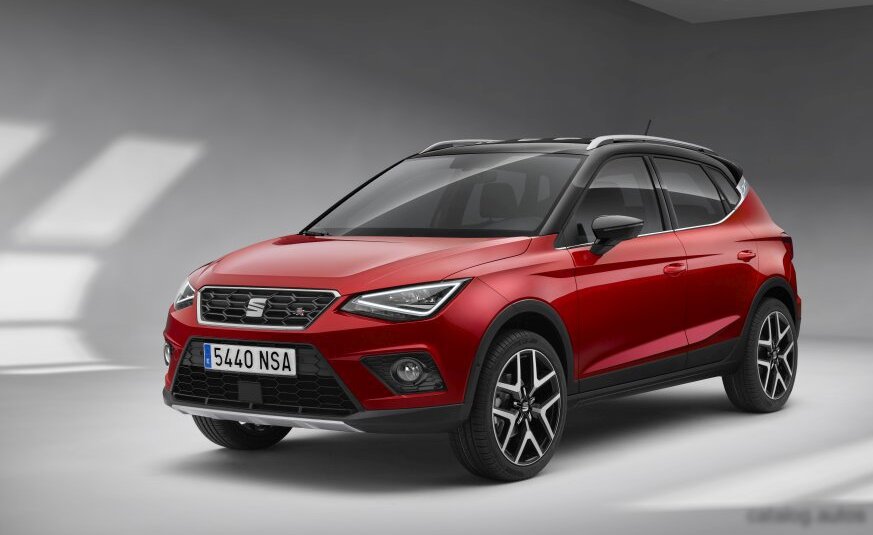
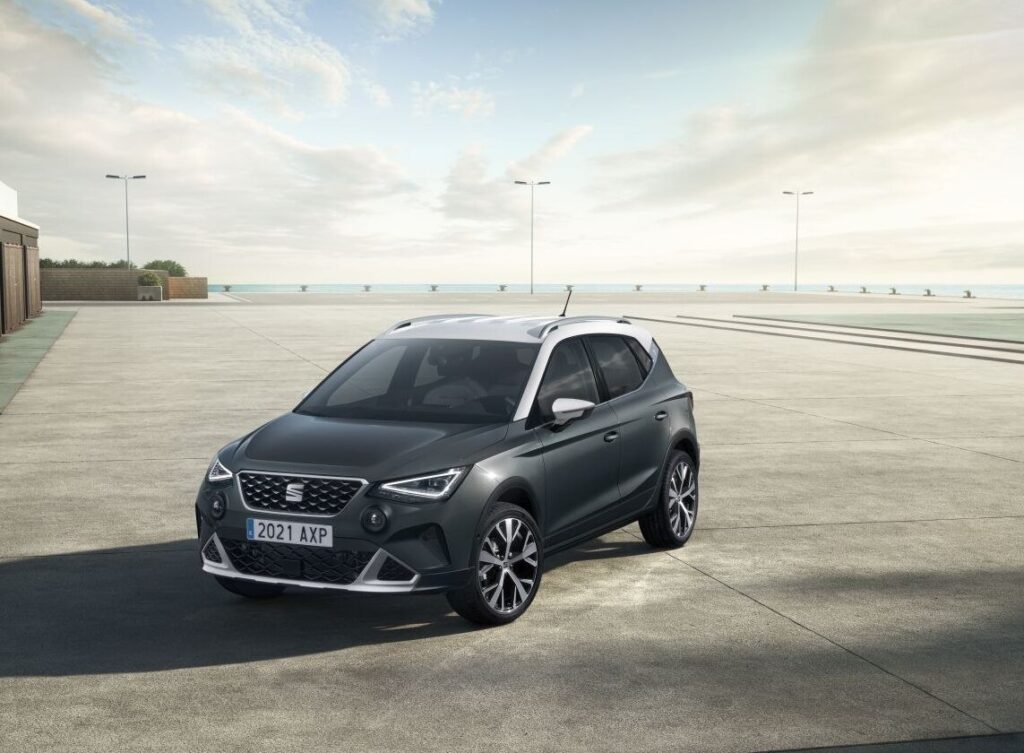
The Seat Arona (facelift, introduced in June 2021 and produced through February 2024) 1.0 TSI 110 horsepower variant represents a key offering within the broader Arona subcompact SUV range. Positioned as a mid-range option, it aimed to balance fuel efficiency with acceptable performance for everyday driving. This iteration of the Arona falls within the Volkswagen Group’s PQ25 platform, shared with models like the Volkswagen T-Cross and Audi Q2, and was primarily marketed in Europe as an affordable and practical urban vehicle. The facelift brought updated styling, improved technology, and refinements to the powertrain options, including this 1.0 TSI engine.
Powertrain & Engine Architecture
The heart of this Arona variant is the 1.0 TSI (Turbocharged Stratified Injection) engine, specifically the DLA engine code. This is a three-cylinder, 1.0-liter (999 cc) petrol engine featuring direct fuel injection and a turbocharger with intercooling. The engine produces 110 horsepower at 5500 rpm and 200 Nm (147.51 lb-ft) of torque between 2000 and 3500 rpm. The engine utilizes a variable valve timing system to optimize performance and efficiency. The 6-speed manual transmission was standard, offering a relatively long gearing aimed at maximizing fuel economy. The engine’s compact size and lightweight construction contribute to the Arona’s overall balanced handling.
Driving Characteristics
The 1.0 TSI 110 hp Arona delivers adequate performance for urban and highway driving, though it isn’t particularly sporty. Acceleration from 0-100 km/h (0-62 mph) takes around 10.3 seconds. The turbocharger provides a noticeable boost in power, but the engine can feel somewhat strained when pushed hard, especially when fully loaded. The manual transmission offers precise shifts, but the gear ratios are geared towards economy rather than outright acceleration. Compared to higher-output versions of the Arona, such as those with the 1.5 TSI engine, this variant feels less responsive and requires more driver input for overtaking maneuvers. However, it provides a more engaging driving experience than the diesel options.
Equipment & Trim Levels
The 1.0 TSI 110 hp Arona typically came equipped with a reasonable level of standard features. These included air conditioning, a touchscreen infotainment system with Apple CarPlay and Android Auto compatibility, Bluetooth connectivity, and a suite of safety features such as ABS, ESC (Electronic Stability Control), and multiple airbags. Higher trim levels offered additional features like automatic climate control, parking sensors, a rear-view camera, and alloy wheels. Interior upholstery was typically cloth, with options for upgraded materials on higher trims. The dashboard layout was functional and modern, with a focus on ease of use.
Chassis & Braking
The Arona’s chassis features a McPherson strut front suspension and a torsion beam rear suspension. This setup provides a comfortable ride quality, absorbing bumps and imperfections in the road effectively. The front brakes are ventilated discs, while the rear brakes are solid discs. The steering is electrically assisted, providing light and precise control. The suspension tuning is geared towards comfort rather than sporty handling, resulting in a slight degree of body roll in corners. The Arona’s relatively lightweight construction helps to mitigate this effect.
Market Reception & Comparison
The Seat Arona 1.0 TSI 110 hp was generally well-received by automotive critics as a practical and affordable subcompact SUV. It was praised for its fuel efficiency, comfortable ride, and user-friendly technology. However, some critics noted that the engine could feel underpowered, especially when carrying passengers or luggage. Compared to other trims in the Arona lineup, the 1.0 TSI offered a good balance between price and performance. It was a popular choice for buyers who prioritized fuel economy and practicality over outright performance. The 1.5 TSI offered more power, but at a higher price point. The diesel variants provided better fuel economy but were often more expensive to maintain.
Legacy
The 1.0 TSI engine has proven to be a relatively reliable powertrain in the Arona, although some owners have reported issues with the turbocharger and fuel injectors. Regular maintenance, including oil changes and filter replacements, is crucial for ensuring long-term reliability. In the used car market, the 1.0 TSI Arona represents a good value proposition, offering a practical and fuel-efficient option for urban drivers. Its compact size and easy maneuverability make it well-suited for city driving, and its reasonable running costs make it an attractive option for budget-conscious buyers. The facelifted models, like the 2021-2024 versions, are particularly desirable due to their updated styling and improved technology.