
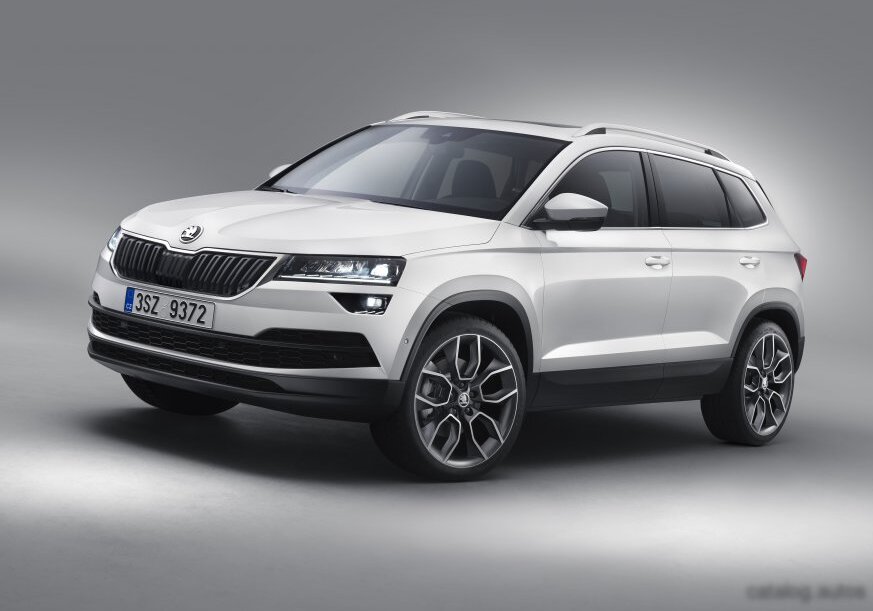
The Skoda Karoq 2.0 TDI 4×4 Automatic, produced from 2017 to November 2021, represents a significant offering within Skoda’s compact SUV lineup. Positioned as a mid-to-upper trim level, it catered to buyers seeking a blend of practicality, fuel efficiency, and all-weather capability. The Karoq, launched as a successor to the Yeti, aimed to provide a more spacious and refined experience while retaining the brand’s reputation for value. This particular variant, equipped with the 2.0-liter TDI engine and a seven-speed automatic transmission, was primarily marketed in Europe, where diesel-powered SUVs with all-wheel drive were highly popular. It slots into the A-segment SUV category, competing with vehicles like the Nissan Qashqai, Kia Sportage, and Volkswagen Tiguan.
Technical Specifications
| Brand | Skoda |
| Model | Karoq |
| Generation | Karoq |
| Type (Engine) | 2.0 TDI (150 Hp) 4×4 Automatic |
| Start of production | 2017 |
| End of production | November, 2021 |
| Powertrain Architecture | Internal Combustion engine |
| Body type | SUV |
| Seats | 5 |
| Doors | 5 |
| Fuel consumption (economy) – urban | 5.7 l/100 km (41.3 US mpg, 49.6 UK mpg, 17.5 km/l) |
| Fuel consumption (economy) – extra urban | 4.9 l/100 km (48 US mpg, 57.6 UK mpg, 20.4 km/l) |
| Fuel consumption (economy) – combined | 5.2 l/100 km (45.2 US mpg, 54.3 UK mpg, 19.2 km/l) |
| CO2 emissions | 134 g/km |
| Fuel Type | Diesel |
| Acceleration 0 – 100 km/h | 9.3 sec |
| Acceleration 0 – 62 mph | 9.3 sec |
| Acceleration 0 – 60 mph | 8.8 sec |
| Maximum speed | 195 km/h (121.17 mph) |
| Emission standard | Euro 6 |
| Weight-to-power ratio | 10.1 kg/Hp, 98.9 Hp/tonne |
| Weight-to-torque ratio | 4.5 kg/Nm, 224.3 Nm/tonne |
| Power | 150 Hp @ 3500-4000 rpm |
| Power per litre | 76.2 Hp/l |
| Torque | 340 Nm @ 1750-3000 rpm (250.77 lb.-ft. @ 1750-3000 rpm) |
| Engine layout | Front, Transverse |
| Engine Model/Code | EA288 / DFFA |
| Engine displacement | 1968 cm3 (120.09 cu. in.) |
| Number of cylinders | 4 |
| Engine configuration | Inline |
| Cylinder Bore | 81 mm (3.19 in.) |
| Piston Stroke | 95.5 mm (3.76 in.) |
| Compression ratio | 16.2:1 |
| Number of valves per cylinder | 4 |
| Fuel injection system | Diesel Commonrail |
| Engine aspiration | Turbocharger, Intercooler |
| Engine oil capacity | 4.7 l (4.97 US qt | 4.14 UK qt) |
| Kerb Weight | 1516 kg (3342.21 lbs.) |
| Max. weight | 2128 kg (4691.44 lbs.) |
| Max load | 612 kg (1349.23 lbs.) |
| Trunk (boot) space – minimum | 521 l (18.4 cu. ft.) |
| Trunk (boot) space – maximum | 1630 l (57.56 cu. ft.) |
| Fuel tank capacity | 55 l (14.53 US gal | 12.1 UK gal) |
| Max. roof load | 75 kg (165.35 lbs.) |
| Permitted trailer load with brakes (12%) | 2000 kg (4409.25 lbs.) |
| Permitted trailer load without brakes | 750 kg (1653.47 lbs.) |
| Length | 4382 mm (172.52 in.) |
| Width | 1841 mm (72.48 in.) |
| Height | 1607 mm (63.27 in.) |
| Wheelbase | 2630 mm (103.54 in.) |
| Front track | 1576 mm (62.05 in.) |
| Rear (Back) track | 1547 mm (60.91 in.) |
| Minimum turning circle (turning diameter) | 10.8 m (35.43 ft.) |
| Drive wheel | All wheel drive (4×4) |
| Number of gears and type of gearbox | 7 gears, automatic transmission |
| Front brakes | Ventilated discs |
| Rear brakes | Disc |
Powertrain & Engine Architecture
The heart of the Karoq 2.0 TDI 4×4 Automatic is the Volkswagen Group’s EA288 engine family. Specifically, the DFFA code designates a 2.0-liter, four-cylinder diesel engine. This engine utilizes a common rail direct injection system, delivering fuel at extremely high pressures for optimized combustion. The engine features a turbocharger with an intercooler, enhancing power output and efficiency. The valvetrain employs four valves per cylinder, contributing to improved breathing and overall performance. The seven-speed dual-clutch transmission (DSG) is a key component, offering smooth and rapid gear changes. This transmission is known for its efficiency and responsiveness, although earlier versions of the DSG were sometimes subject to reliability concerns. The engine is transversely mounted, a common layout for front-wheel-drive and all-wheel-drive vehicles.
Driving Characteristics
The 150 horsepower and 340 Nm (250 lb-ft) of torque provided by the 2.0 TDI engine, coupled with the all-wheel-drive system and seven-speed automatic, resulted in a capable and comfortable driving experience. Acceleration from 0-60 mph took approximately 8.8 seconds, which was respectable for the segment, but noticeably slower than the petrol-powered Karoq variants or those equipped with manual transmissions. The DSG transmission generally held gears longer to maximize fuel economy, but offered quick downshifts when needed for overtaking or climbing hills. The all-wheel-drive system provided enhanced traction in slippery conditions, making it a suitable vehicle for year-round use. The automatic transmission prioritized smooth operation over outright sportiness, making it ideal for everyday commuting and long-distance journeys.
Equipment & Trim Levels
The Karoq 2.0 TDI 4×4 Automatic typically came well-equipped, reflecting its position as a mid-range to upper-range trim. Standard features often included alloy wheels, air conditioning, a touchscreen infotainment system with Apple CarPlay and Android Auto compatibility, and a suite of safety features such as ABS, electronic stability control, and multiple airbags. Higher trim levels offered options like leather upholstery, a panoramic sunroof, adaptive cruise control, and a premium sound system. Interior upholstery was typically cloth on base models, with leather options available. The dashboard layout was clean and functional, with a focus on ergonomics.
Chassis & Braking
The Karoq’s chassis was designed to balance comfort and handling. It utilized independent suspension on all four wheels, providing a relatively smooth ride. Front brakes were ventilated discs, while rear brakes were solid discs. The steering was electric power-assisted, offering a light and precise feel. The all-wheel-drive system employed a multi-plate clutch, automatically distributing torque between the front and rear axles as needed. Stabilizer bars were fitted to both the front and rear axles to reduce body roll during cornering.
Market Reception & Comparison
The Skoda Karoq 2.0 TDI 4×4 Automatic was generally well-received by automotive critics. It was praised for its spacious interior, comfortable ride, and fuel efficiency. However, some reviewers noted that the engine could feel a little underpowered, especially when fully loaded. Compared to the petrol-powered Karoq variants, the TDI offered superior fuel economy but less outright performance. The 1.6 TDI versions were more affordable but offered significantly less power. The 2.0 TDI struck a balance between performance and economy, making it a popular choice for those who frequently drove long distances or needed the added traction of all-wheel drive.
Legacy
The EA288 engine, while generally reliable, has been known to exhibit issues with diesel particulate filter (DPF) clogging, particularly on vehicles used primarily for short journeys. Regular servicing and the use of high-quality diesel fuel are crucial for maintaining the longevity of this powertrain. The DSG transmission, while efficient, can require more frequent maintenance than a traditional automatic gearbox. Today, the Karoq 2.0 TDI 4×4 Automatic represents a solid used car option, offering a good blend of practicality, fuel efficiency, and all-weather capability. Its reputation for reliability, combined with Skoda’s value-for-money proposition, ensures continued demand in the used car market.
