
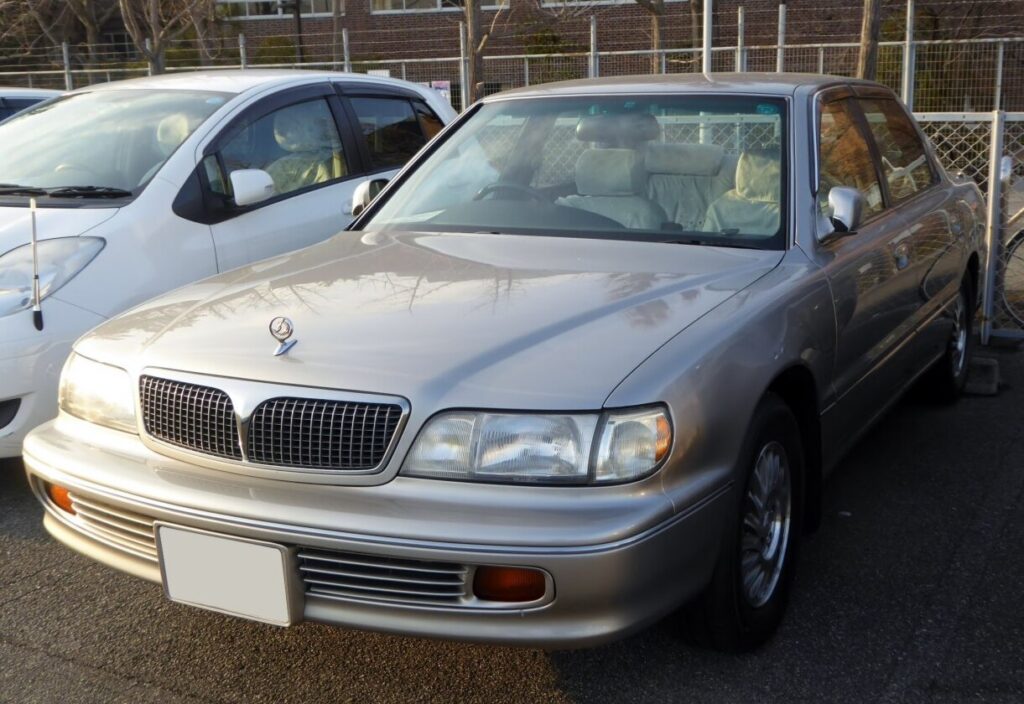
The Mitsubishi Debonair (S27) 3.0 i V6, produced between 1992 and 1999, represented the third generation of Mitsubishi’s flagship luxury sedan. Positioned as a direct competitor to Japanese rivals like the Toyota Crown and Nissan Cima, the Debonair aimed to offer a sophisticated and comfortable driving experience. The S27 generation, built on the Debonair platform, was characterized by its elegant styling, spacious interior, and advanced features for its time. This particular variant, equipped with the 3.0-liter V6 engine and a four-speed automatic transmission, occupied a mid-to-upper range position within the Debonair lineup, offering a balance of performance and refinement.
Technical Specifications
| Brand | Mitsubishi |
| Model | Debonair |
| Generation | Debonair (S27) |
| Type (Engine) | 3.0 i V6 (170 Hp) |
| Start of production | 1992 |
| End of production | 1999 |
| Powertrain Architecture | Internal Combustion engine |
| Body type | Sedan |
| Seats | 5 |
| Doors | 4 |
| Fuel consumption (combined) | 8.8 l/100 km (26.7 US mpg, 32.1 UK mpg, 11.4 km/l) |
| Fuel Type | Petrol (Gasoline) |
| Weight-to-power ratio | 9.4 kg/Hp, 106.9 Hp/tonne |
| Weight-to-torque ratio | 6.4 kg/Nm, 156 Nm/tonne |
| Power | 170 Hp @ 5500 rpm |
| Power per litre | 57.2 Hp/l |
| Torque | 248 Nm @ 3000 rpm (182.92 lb.-ft. @ 3000 rpm) |
| Engine layout | Front, Transverse |
| Engine displacement | 2972 cm3 (181.36 cu. in.) |
| Number of cylinders | 6 |
| Engine configuration | V-engine |
| Cylinder Bore | 91.1 mm (3.59 in.) |
| Piston Stroke | 76 mm (2.99 in.) |
| Compression ratio | 10:1 |
| Number of valves per cylinder | 2 |
| Fuel injection system | Multi-port manifold injection |
| Engine aspiration | Naturally aspirated engine |
| Valvetrain | OHC |
| Kerb Weight | 1590 kg (3505.35 lbs.) |
| Fuel tank capacity | 72 l (19.02 US gal | 15.84 UK gal) |
| Length | 4975 mm (195.87 in.) |
| Width | 1815 mm (71.46 in.) |
| Height | 1440 mm (56.69 in.) |
| Wheelbase | 2745 mm (108.07 in.) |
| Front track | 1545 mm (60.83 in.) |
| Rear track | 1550 mm (61.02 in.) |
| Drivetrain Architecture | The Internal combustion engine (ICE) drives the front wheels of the vehicle. |
| Drive wheel | Front wheel drive |
| Number of gears and type of gearbox | 4 gears, automatic transmission |
| Front suspension | Spring Strut |
| Rear suspension | Coil spring |
| Front brakes | Ventilated discs |
| Rear brakes | Ventilated discs |
| Assisting systems | ABS (Anti-lock braking system) |
| Steering type | Steering rack and pinion |
| Power steering | Hydraulic Steering |
| Tires size | 205/65 R15 H |
Powertrain & Engine Architecture
The heart of the Debonair 3.0 i V6 is the 6A12 engine, a 2.972-liter (181.36 cubic inches) naturally aspirated V6. This engine utilizes a 60-degree V-angle, contributing to a smoother power delivery and reduced vibrations. The engine employs a multi-port fuel injection system, delivering fuel directly to each cylinder for optimized combustion. The overhead camshaft (OHC) valvetrain, with two valves per cylinder, manages the intake and exhaust processes. The 4-speed automatic transmission, a common choice for luxury vehicles of the era, was designed to provide smooth and effortless gear changes. While not a particularly advanced transmission by modern standards, it was well-suited to the engine’s torque curve and the Debonair’s intended purpose as a comfortable cruiser.
Driving Characteristics
The 170 horsepower and 248 Nm (182.92 lb-ft) of torque produced by the 3.0L V6 and automatic transmission combination provided adequate, though not exhilarating, performance. Acceleration was respectable for the time, but the Debonair was never intended to be a sports sedan. The automatic transmission, while smooth, did result in some power loss compared to the available manual transmission options. Gear ratios were tuned for comfortable cruising, prioritizing relaxed highway driving over quick acceleration. The front-wheel-drive layout contributed to predictable handling, but lacked the dynamic capabilities of rear-wheel-drive competitors. Overall, the driving experience was characterized by refinement and ease of use, rather than outright performance.
Equipment & Trim Levels
The Debonair 3.0 i V6 typically came well-equipped, reflecting its position as a luxury vehicle. Standard features often included power windows, power locks, air conditioning, and a high-quality audio system. Interior upholstery was typically cloth or leather, with woodgrain accents adorning the dashboard and door panels. Optional extras could include a sunroof, upgraded audio systems, and power-adjustable seats. The trim level of the 3.0 i V6 often sat between the base models and the top-of-the-line variants, offering a good balance of features and price.
Chassis & Braking
The Debonair S27 utilized a conventional front-engine, front-wheel-drive layout. Suspension consisted of a MacPherson strut setup at the front and a coil spring arrangement at the rear. This configuration provided a comfortable ride, absorbing bumps and imperfections in the road effectively. Braking duties were handled by ventilated disc brakes on all four wheels, providing adequate stopping power. An Anti-lock Braking System (ABS) was standard, enhancing safety and control during emergency braking situations. The steering system employed a rack-and-pinion setup with hydraulic power assistance, offering precise and effortless steering.
Market Reception & Comparison
The Mitsubishi Debonair 3.0 i V6 was generally well-received by critics in Japan, praised for its comfortable ride, spacious interior, and refined engine. However, it often faced criticism for its relatively conservative styling compared to some of its European and American competitors. Compared to the lower-displacement 2.0-liter and 2.5-liter Debonair models, the 3.0 i V6 offered significantly more power and torque, resulting in improved acceleration and highway cruising ability. However, it also came with a higher price tag and slightly lower fuel economy. Compared to the more performance-oriented variants, the automatic transmission version prioritized comfort and ease of driving.
Legacy
The Mitsubishi Debonair S27, including the 3.0 i V6 variant, has developed a modest following among enthusiasts. The 6A12 engine is generally considered to be a reliable unit, although regular maintenance is crucial to prevent issues. The automatic transmission, while durable, can be prone to wear and tear over time. Today, well-maintained Debonairs are becoming increasingly collectible, particularly those with low mileage and original features. The car represents a unique chapter in Mitsubishi’s history, showcasing the company’s ambition to compete in the luxury sedan segment. Finding parts can be challenging, but a dedicated community of owners and enthusiasts helps to keep these cars on the road.
