
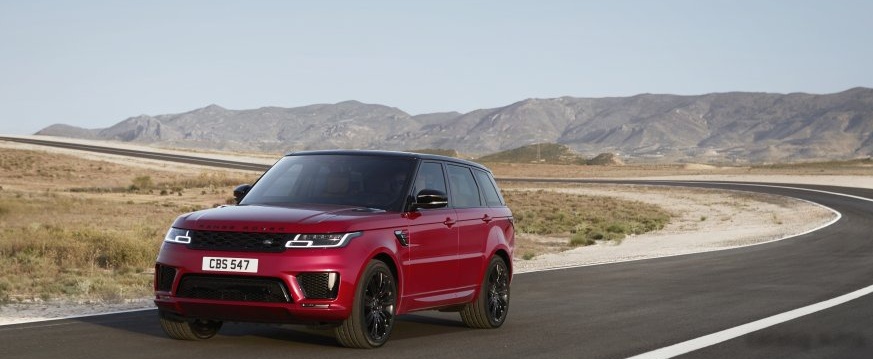
The Land Rover Range Rover Sport II SVR 5.0 V8, produced from 2017 to May 2022, represents the high-performance variant of the second-generation Range Rover Sport (L494) following a significant facelift in 2017. Positioned as the flagship model within the Range Rover Sport lineup, the SVR aimed to deliver uncompromising performance and luxury, competing directly with high-performance SUVs from Porsche, BMW, and Mercedes-Benz. This variant distinguished itself through a supercharged 5.0-liter V8 engine, aggressive styling cues, and a focus on dynamic handling. It built upon the foundation of the L494 platform, which itself was a significant departure from the first-generation Range Rover Sport, offering increased refinement and technological advancements.
Technical Specifications
| Brand | Land Rover |
| Model | Range Rover Sport |
| Generation | Range Rover Sport II (facelift 2017) |
| Type (Engine) | SVR 5.0 V8 (575 Hp) AWD Automatic Supercharged |
| Start of production | 2017 |
| End of production | May, 2022 |
| Powertrain Architecture | Internal Combustion engine |
| Body type | SUV |
| Seats | 5 |
| Doors | 5 |
| Fuel consumption (urban) | 18 l/100 km (13.1 US mpg, 15.7 UK mpg, 5.6 km/l) |
| Fuel consumption (extra urban) | 9.9 l/100 km (23.8 US mpg, 28.5 UK mpg, 10.1 km/l) |
| Fuel consumption (combined) | 12.8 l/100 km (18.4 US mpg, 22.1 UK mpg, 7.8 km/l) |
| CO2 emissions | 294 g/km |
| Fuel Type | Petrol (Gasoline) |
| Acceleration 0 – 100 km/h | 4.5 sec |
| Acceleration 0 – 62 mph | 4.5 sec |
| Acceleration 0 – 60 mph | 4.3 sec |
| Maximum speed | 283 km/h (175.85 mph) |
| Emission standard | Euro 6 |
| Weight-to-power ratio | 4 kg/Hp, 248.9 Hp/tonne |
| Weight-to-torque ratio | 3.3 kg/Nm, 303 Nm/tonne |
| Power | 575 Hp @ 6000-6500 rpm |
| Power per litre | 115 Hp/l |
| Torque | 700 Nm @ 3500-5000 rpm (516.29 lb.-ft. @ 3500-5000 rpm) |
| Engine layout | Front, Longitudinal |
| Engine Model/Code | 508PS |
| Engine displacement | 5000 cm3 (305.12 cu. in.) |
| Number of cylinders | 8 |
| Engine configuration | V-engine |
| Cylinder Bore | 92.5 mm (3.64 in.) |
| Piston Stroke | 93 mm (3.66 in.) |
| Compression ratio | 9.5:1 |
| Number of valves per cylinder | 4 |
| Fuel injection system | Direct injection |
| Engine aspiration | Supercharger, Intercooler |
| Engine oil capacity | 8 l (8.45 US qt | 7.04 UK qt) |
| Coolant | 8.83 l (9.33 US qt | 7.77 UK qt) |
| Kerb Weight | 2310 kg (5092.68 lbs.) |
| Max. weight | 3000 kg (6613.87 lbs.) |
| Max load | 690 kg (1521.19 lbs.) |
| Trunk (boot) space – minimum | 780 l (27.55 cu. ft.) |
| Trunk (boot) space – maximum | 1686 l (59.54 cu. ft.) |
| Fuel tank capacity | 104 l (27.47 US gal | 22.88 UK gal) |
| Max. roof load | 100 kg (220.46 lbs.) |
| Permitted trailer load with brakes (12%) | 3000 kg (6613.87 lbs.) |
| Permitted trailer load without brakes | 750 kg (1653.47 lbs.) |
| Permitted towbar download | 120 kg (264.55 lbs.) |
| Length | 4879 mm (192.09 in.) |
| Width with mirrors folded | 2073 mm (81.61 in.) |
| Width including mirrors | 2220 mm (87.4 in.) |
| Height | 1803 mm (70.98 in.) |
| Wheelbase | 2923 mm (115.08 in.) |
| Front track | 1693 mm (66.65 in.) |
| Rear (Back) track | 1686 mm (66.38 in.) |
| Ride height (ground clearance) | 213-278 mm (8.39 – 10.94 in.) |
| Drag coefficient (Cd) | 0.35 |
| Minimum turning circle (turning diameter) | 12.5 m (41.01 ft.) |
| Approach angle | 24.3-33.0° |
| Departure angle | 24.9-31.0° |
| Ramp-over (brakeover) angle | 19.4-27.2° |
| Wading depth | 800-850 mm (31.5 – 33.46 in.) |
| Drivetrain Architecture | The Internal combustion engine (ICE) drives permanently the four wheels of the vehicle. |
| Drive wheel | All wheel drive (4×4) |
| Number of gears and type of gearbox | 8 gears, automatic transmission |
| Front suspension | Air suspension |
| Rear suspension | Air suspension |
| Front brakes | Ventilated discs |
| Rear brakes | Ventilated discs |
| Assisting systems | ABS (Anti-lock braking system) |
| Steering type | Steering rack and pinion |
| Power steering | Electric Steering |
INTRODUCTION
The 2017 facelift of the Range Rover Sport II saw the introduction of the SVR variant with a significant power upgrade. This model year marked a pivotal point for the SVR, solidifying its position as a performance SUV. Built on the L494 platform, the SVR benefited from advancements in chassis technology and lightweight materials, contributing to its impressive performance figures. The SVR was designed to appeal to drivers seeking a blend of luxury, practicality, and exhilarating performance, offering a more focused driving experience than the standard Range Rover Sport models.
Powertrain & Engine Architecture
At the heart of the Range Rover Sport SVR lies the 508PS 5.0-liter supercharged V8 engine. This engine, part of the Jaguar Land Rover AJ family, utilizes a Roots-type supercharger for instant throttle response and significant power delivery. Direct fuel injection ensures precise fuel metering, maximizing efficiency and power output. The engine boasts a 9.5:1 compression ratio and four valves per cylinder. The eight-speed automatic transmission, sourced from ZF, is specifically tuned for the SVR to provide quick and precise gear changes. This transmission features a wider gear ratio spread than the standard Range Rover Sport transmissions, optimizing both acceleration and fuel economy. The SVR also incorporates a sophisticated all-wheel-drive system with a rear-biased torque distribution, enhancing its dynamic capabilities.
Driving Characteristics
The Range Rover Sport SVR delivers a markedly different driving experience compared to other variants in the lineup. The 575 horsepower and 516 lb-ft of torque translate into blistering acceleration – 0-60 mph in approximately 4.3 seconds. The tuned suspension, featuring air springs and adaptive dampers, provides a firm yet controlled ride, minimizing body roll during cornering. The exhaust note is significantly more aggressive than other Range Rover Sport models, thanks to a revised exhaust system with active valves. While the SVR offers impressive on-road performance, it retains the Range Rover’s off-road capability, albeit with a slightly firmer ride quality. The eight-speed automatic transmission shifts quickly and smoothly, but some drivers may prefer the greater control offered by a manual transmission, which was not available on this model.
Equipment & Trim Levels
The SVR trim level came standard with a comprehensive array of luxury and performance features. Interior appointments included sport seats upholstered in perforated leather, unique SVR badging, and carbon fiber trim accents. Standard equipment also included a premium Meridian sound system, a panoramic sunroof, and a suite of advanced driver-assistance systems. Optional extras included a sliding panoramic roof, various exterior styling packages, and upgraded interior trim materials. The SVR’s interior was designed to convey a sense of sporty luxury, differentiating it from the more comfort-oriented standard Range Rover Sport models.
Chassis & Braking
The SVR benefits from a reinforced chassis and upgraded suspension components. The air suspension system is specifically tuned for the SVR, offering a lower ride height and stiffer spring rates. Larger brakes, with ventilated discs at all four corners, provide ample stopping power. The SVR also features a more aggressive aerodynamic package, including a revised front bumper, side skirts, and rear spoiler, to improve stability at high speeds. The steering is precise and well-weighted, providing the driver with a confident feel on the road.
Market Reception & Comparison
The Range Rover Sport SVR was generally well-received by automotive critics, who praised its performance, handling, and luxurious interior. However, some reviewers noted its relatively high fuel consumption and firm ride quality. Compared to the standard Range Rover Sport models, the SVR offered a significantly more engaging driving experience, but at the expense of some comfort. Against competitors like the Porsche Cayenne Turbo and BMW X5 M, the SVR offered a unique blend of British luxury and high-performance capability. The fuel economy, averaging around 18.4 US mpg combined, was typical for a high-performance SUV of its class, but significantly lower than the more fuel-efficient diesel or hybrid Range Rover Sport variants.
Legacy
The Range Rover Sport SVR 5.0 V8 has established itself as a desirable and collectible SUV. The supercharged V8 engine, while known for its complexity, has proven to be relatively reliable with proper maintenance. The SVR’s combination of performance, luxury, and off-road capability has made it a popular choice among enthusiasts. On the used car market, well-maintained examples command a premium price, reflecting their performance potential and exclusivity. The SVR represents a high point in the Range Rover Sport lineage, showcasing Land Rover’s ability to create a truly compelling performance SUV.


