
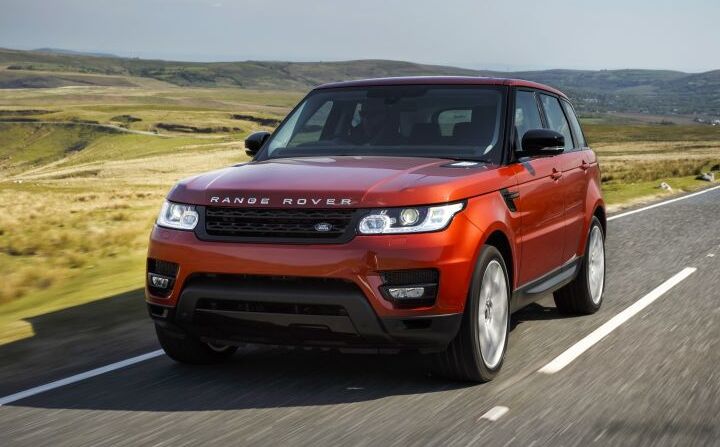
The Land Rover Range Rover Sport II SVR 5.0 V8, produced from 2014 to 2017, represents the high-performance variant of the second-generation Range Rover Sport (L494). Positioned as the flagship model, the SVR aimed to deliver a more engaging driving experience and significantly enhanced performance compared to the standard Range Rover Sport trims. It competed directly with high-performance luxury SUVs like the Porsche Cayenne Turbo and BMW X5 M. This model year range represents the initial launch of the SVR, establishing its presence as a potent force in the performance SUV segment.
Technical Specifications
| Brand | Land Rover |
| Model | Range Rover Sport |
| Generation | Range Rover Sport II |
| Type (Engine) | SVR 5.0 V8 (550 Hp) AWD Automatic |
| Start of production | 2014 |
| End of production | 2017 |
| Powertrain Architecture | Internal Combustion engine |
| Body type | SUV |
| Seats | 5 |
| Doors | 5 |
| Fuel consumption (economy) – urban | 18.3 l/100 km (12.9 US mpg, 15.4 UK mpg, 5.5 km/l) |
| Fuel consumption (economy) – extra urban | 9.7 l/100 km (24.2 US mpg, 29.1 UK mpg, 10.3 km/l) |
| Fuel consumption (economy) – combined | 12.8 l/100 km (18.4 US mpg, 22.1 UK mpg, 7.8 km/l) |
| CO2 emissions | 298 g/km |
| Fuel Type | Petrol (Gasoline) |
| Acceleration 0 – 100 km/h | 4.7 sec |
| Acceleration 0 – 62 mph | 4.7 sec |
| Acceleration 0 – 60 mph | 4.5 sec |
| Maximum speed | 260 km/h (161.56 mph) |
| Emission standard | Euro 5 |
| Weight-to-power ratio | 4.2 kg/Hp, 235.5 Hp/tonne |
| Weight-to-torque ratio | 3.4 kg/Nm, 291.2 Nm/tonne |
| Power | 550 Hp @ 6000-6500 rpm |
| Power per litre | 110 Hp/l |
| Torque | 680 Nm @ 3500-4000 rpm (501.54 lb.-ft. @ 3500-4000 rpm) |
| Engine layout | Front, Longitudinal |
| Engine Model/Code | 508PS |
| Engine displacement | 5000 cm3 (305.12 cu. in.) |
| Number of cylinders | 8 |
| Engine configuration | V-engine |
| Cylinder Bore | 92.5 mm (3.64 in.) |
| Piston Stroke | 93 mm (3.66 in.) |
| Compression ratio | 9.5:1 |
| Number of valves per cylinder | 4 |
| Fuel injection system | Direct injection |
| Engine aspiration | Supercharger, Intercooler |
| Engine oil capacity | 8 l (8.45 US qt | 7.04 UK qt) |
| Coolant | 8.83 l (9.33 US qt | 7.77 UK qt) |
| Kerb Weight | 2335 kg (5147.79 lbs.) |
| Fuel tank capacity | 105 l (27.74 US gal | 23.1 UK gal) |
| Length | 4872 mm (191.81 in.) |
| Width | 2019 mm (79.49 in.) |
| Width with mirrors folded | 2073 mm (81.61 in.) |
| Height | 1780 mm (70.08 in.) |
| Wheelbase | 2923 mm (115.08 in.) |
| Drag coefficient (Cd) | 0.38 |
| Minimum turning circle | 12.3 m (40.35 ft.) |
| Approach angle | 22.4° |
| Departure angle | 22.5° |
| Drive wheel | All wheel drive (4×4) |
| Number of gears | 8 |
| Gearbox type | automatic transmission |
| Front suspension | Air suspension |
| Rear suspension | Air suspension |
| Front brakes | Ventilated discs |
| Rear brakes | Ventilated discs |
| Assisting systems | ABS (Anti-lock braking system) |
| Steering type | Steering rack and pinion |
| Power steering | Electric Steering |
| Tires size | 275/45 R21 110Y; 295/40 R22 |
| Wheel rims size | 9.5J x 21; 9.5J x 22 |
INTRODUCTION
The Range Rover Sport II SVR, launched in 2014, was the product of Jaguar Land Rover’s Special Vehicle Operations (SVO) division. It was designed to inject a significant dose of performance into the Range Rover Sport lineup, transforming the luxurious SUV into a genuine contender in the high-performance segment. Built on the L494 platform, shared with the standard Range Rover Sport, the SVR distinguished itself through extensive modifications to the engine, chassis, and aerodynamics. The initial production run spanned from 2014 to 2017, establishing the SVR as a benchmark for performance SUVs.
Powertrain & Engine Architecture
At the heart of the SVR lies the 5.0-liter supercharged V8 engine, designated as the 508PS unit. This engine is a significant upgrade over the standard Range Rover Sport’s V8 options. It utilizes a Roots-type supercharger, providing instant boost and a characteristic whine. Direct fuel injection ensures precise fuel delivery, maximizing power and efficiency. The engine boasts a 9.5:1 compression ratio and four valves per cylinder. The engine’s architecture is longitudinal, positioned at the front of the vehicle. The SVR exclusively employed an eight-speed automatic transmission, ZF’s 8HP70 model, known for its smooth shifts and responsiveness. This transmission was specifically calibrated for the SVR to provide quicker gear changes and a more aggressive driving experience.
Driving Characteristics
The SVR’s driving experience is markedly different from other Range Rover Sport variants. The 550 horsepower and 501.54 lb-ft of torque deliver exhilarating acceleration, with a 0-60 mph time of around 4.5 seconds. The supercharger provides immediate throttle response, making the vehicle feel surprisingly agile for its size. The eight-speed automatic transmission is well-matched to the engine, providing smooth and quick shifts. While the SVR retains the Range Rover Sport’s inherent comfort, the suspension is noticeably firmer, and the steering is more direct. Compared to the standard V8 or the diesel variants, the SVR offers a far more engaging and sporty driving experience, sacrificing some ride comfort for increased performance. The all-wheel-drive system provides excellent traction, ensuring confident handling in various conditions.
Equipment & Trim Levels
The SVR came generously equipped as standard. Interior features included sport seats upholstered in premium leather, often with unique SVR badging and contrast stitching. A leather-wrapped steering wheel, aluminum pedal caps, and distinctive interior trim elements further differentiated the SVR from other Range Rover Sport models. Standard technology included a touchscreen infotainment system, navigation, and a premium sound system. Optional extras included a panoramic sunroof, upgraded leather options, and various driver-assistance features. The SVR’s trim level was essentially a fully-loaded version of the Range Rover Sport, with a focus on performance-oriented aesthetics and features.
Chassis & Braking
The SVR’s chassis received significant upgrades to handle the increased power. The suspension was revised with stiffer springs and dampers, and the ride height was lowered for improved handling. Larger stabilizer bars were fitted to reduce body roll. The braking system was also upgraded with larger front rotors and Brembo calipers, providing enhanced stopping power. The SVR retained the Range Rover Sport’s air suspension system, allowing for adjustable ride height and improved off-road capability, although the focus was primarily on on-road performance. The tires were also wider and lower profile, contributing to improved grip and handling.
Market Reception & Comparison
The Range Rover Sport SVR was generally well-received by automotive critics. It was praised for its impressive performance, luxurious interior, and distinctive styling. However, some critics noted that the firmer suspension compromised ride comfort compared to the standard Range Rover Sport. Fuel economy was also a concern, with combined fuel consumption figures around 18.4 US mpg. Compared to rivals like the Porsche Cayenne Turbo, the SVR offered a more luxurious and comfortable interior, but the Cayenne Turbo often outperformed it in terms of outright handling. Against the BMW X5 M, the SVR provided a more refined and sophisticated experience, while the X5 M was more focused on track performance.
Legacy
The Range Rover Sport SVR established Land Rover’s SVO division as a credible force in the high-performance SUV market. The initial 2014-2017 model years have proven to be relatively reliable, although maintenance costs can be high due to the complexity of the engine and drivetrain. The supercharged V8 engine, while powerful, requires regular servicing. On the used car market, these early SVR models hold their value reasonably well, appealing to buyers seeking a blend of luxury, performance, and exclusivity. The SVR paved the way for subsequent, even more powerful iterations, solidifying its place as a significant model in the Range Rover Sport lineage.


