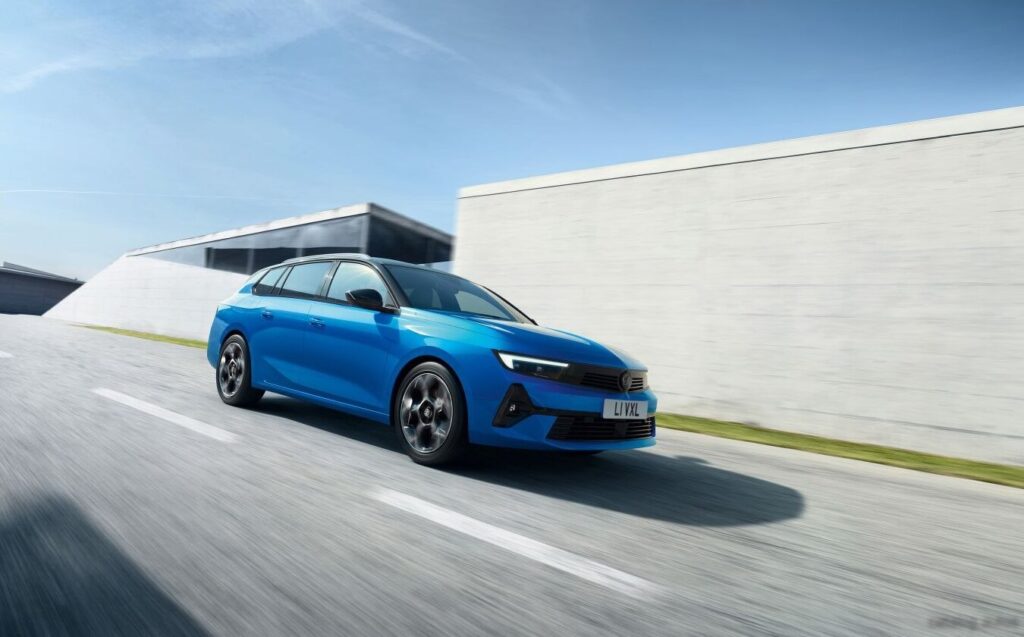
The Vauxhall Astra Mk VIII Sports Tourer 1.2 Turbo (136 hp) Mild Hybrid e-DCT, launched in February 2024, represents a key offering within the eighth generation of the Astra lineup. Positioned as a mid-range variant, it combines a compact turbocharged gasoline engine with a 48-volt mild hybrid system and a dual-clutch transmission, aiming to balance fuel efficiency with acceptable performance in the popular European-market station wagon (estate) segment. This model is part of the broader Astra Mk VIII family, built on the Stellantis EMP2 platform, alongside hatchback and other powertrain options.
Technical Specifications
| Brand | Vauxhall |
| Model | Astra |
| Generation | Astra Mk VIII Sports Tourer |
| Type (Engine) | 1.2 Turbo (136 Hp) Mild Hybrid e-DCT |
| Start of production | February, 2024 |
| Powertrain Architecture | MHEV (Mild Hybrid Electric Vehicle) |
| Body type | Station wagon (estate) |
| Seats | 5 |
| Doors | 5 |
| Combined fuel consumption (WLTP) | 4.8-5.1 l/100 km (49 – 46.1 US mpg, 58.9 – 55.4 UK mpg, 20.8 – 19.6 km/l) |
| CO2 emissions (WLTP) | 108-114 g/km |
| Fuel Type | Petrol (Gasoline) |
| Acceleration 0 – 100 km/h | 9.3 sec |
| Acceleration 0 – 62 mph | 9.3 sec |
| Acceleration 0 – 60 mph | 8.8 sec |
| Maximum speed | 210 km/h (130.49 mph) |
| Emission standard | Euro 6.4 |
| Gross battery capacity | 0.89 kWh |
| Net (usable) battery capacity | 0.432 kWh |
| Battery voltage | 48 V |
| Battery technology | Lithium-ion (Li-Ion) |
| Battery location | Under the front seats |
| All-electric range | 1 km (0.62 mi) |
| Electric motor power | 28 Hp |
| Electric motor Torque | 55 Nm (40.57 lb.-ft.) |
| Electric motor location | Integrated into the transmission |
| Electric motor type | Synchronous |
| Power | 136 Hp @ 5500 rpm |
| Torque | 230 Nm @ 1750 rpm (169.64 lb.-ft. @ 1750 rpm) |
| Engine layout | Front, Transverse |
| Engine Model/Code | EB2LTDH2 |
| Engine displacement | 1199 cm3 (73.17 cu. in.) |
| Number of cylinders | 3 |
| Engine configuration | Inline |
| Cylinder Bore | 75 mm (2.95 in.) |
| Piston Stroke | 90.5 mm (3.56 in.) |
| Number of valves per cylinder | 4 |
| Fuel injection system | Direct injection |
| Engine aspiration | Turbocharger, Intercooler |
| Valvetrain | DOHC, VVT |
| Engine oil capacity | 3.5 l (3.7 US qt | 3.08 UK qt) |
| Max. weight | 1990 kg (4387.2 lbs.) |
| Trunk (boot) space – minimum | 597 l (21.08 cu. ft.) |
| Trunk (boot) space – maximum | 1634 l (57.7 cu. ft.) |
| Fuel tank capacity | 52 l (13.74 US gal | 11.44 UK gal) |
| Permitted trailer load with brakes (12%) | 1100 kg (2425.08 lbs.) |
| Permitted trailer load without brakes | 600 kg (1322.77 lbs.) |
| Length | 4642 mm (182.76 in.) |
| Width | 1860 mm (73.23 in.) |
| Width including mirrors | 2062 mm (81.18 in.) |
| Height | 1443 mm (56.81 in.) |
| Wheelbase | 2732 mm (107.56 in.) |
| Front overhang | 906 mm (35.67 in.) |
| Rear overhang | 1004 mm (39.53 in.) |
| Minimum turning circle | 10.71 m (35.14 ft.) |
| Drivetrain Architecture | Front wheel drive. MHEV. ICE and electric motor drive front wheels. |
| Number of gears and type of gearbox | 6 gears, automatic transmission e-DCT |
| Front suspension | Independent, McPherson with coil spring and anti-roll bar |
| Rear suspension | Coil spring, Torsion |
| Front brakes | Ventilated discs |
| Rear brakes | Disc |
| Tires size | 225/45 R17; 225/40 R18 |
| Wheel rims size | 7.5J x 17; 7.5J x 18; 8J x 18 |
INTRODUCTION
The Vauxhall Astra Mk VIII Sports Tourer 1.2 Turbo (136 hp) Mild Hybrid e-DCT is a five-door, five-seat station wagon introduced as part of the eighth-generation Astra range. Launched in 2024, it builds upon the success of previous Astra generations, offering a practical and relatively efficient option for families and individuals needing ample cargo space. The “Sports Tourer” designation signifies the estate body style, differentiating it from the hatchback version. This particular variant utilizes a 1.2-liter turbocharged three-cylinder engine coupled with a 48-volt mild hybrid system and a seven-speed dual-clutch transmission (e-DCT), aiming to improve fuel economy and reduce emissions while providing a comfortable driving experience. It slots into the middle of the Sports Tourer lineup, offering a balance between affordability and features.
Powertrain & Engine Architecture
At the heart of this Astra variant lies the EB2LTDH2 engine, a 1.2-liter turbocharged three-cylinder gasoline engine. This engine is part of the PureTech family developed by the PSA Group (now Stellantis). It features direct fuel injection, a variable valve timing system (VVT), and an intercooled turbocharger to optimize power and efficiency. The engine produces 136 horsepower at 5500 rpm and 230 Nm (169.64 lb-ft) of torque at 1750 rpm. The mild hybrid system consists of a 48-volt battery and an integrated electric motor. This system provides a power boost during acceleration and allows for regenerative braking, capturing energy that would otherwise be lost during deceleration. The e-DCT seven-speed dual-clutch transmission offers quick and smooth gear changes, contributing to both performance and fuel efficiency. The transmission’s programming is tuned to prioritize fuel economy in normal driving conditions, with sportier settings available for more spirited driving.
Driving Characteristics
The 1.2 Turbo (136 hp) with the e-DCT transmission delivers a generally refined driving experience. Acceleration from 0 to 62 mph takes 9.3 seconds, which is adequate for everyday driving but doesn’t offer particularly sporty performance. The mild hybrid system provides a noticeable boost during initial acceleration, helping to fill in any turbo lag. The e-DCT transmission shifts quickly and smoothly, and the gear ratios are well-chosen for both urban and highway driving. Compared to the more powerful Astra variants, such as those with larger engines, this version feels less eager to accelerate, but it offers a more relaxed and fuel-efficient driving experience. The steering is light and precise, making it easy to maneuver in tight spaces. The suspension is tuned for comfort, providing a smooth ride over most road surfaces.
Equipment & Trim Levels
The Astra Mk VIII Sports Tourer 1.2 Turbo (136 hp) Mild Hybrid e-DCT typically comes equipped with a good level of standard features. These often include a touchscreen infotainment system with Apple CarPlay and Android Auto compatibility, a digital instrument cluster, automatic climate control, and a suite of safety features such as lane departure warning, automatic emergency braking, and traffic sign recognition. Interior upholstery is typically cloth, with options for leather or partial leather upgrades. Higher trim levels may add features such as heated seats, a panoramic sunroof, and adaptive cruise control. Optional extras often include a premium audio system, parking assist, and a 360-degree camera system.
Chassis & Braking
The Astra Sports Tourer utilizes an independent McPherson strut suspension setup at the front and a torsion beam suspension at the rear. This configuration provides a good balance between ride comfort and handling. The chassis is relatively lightweight, contributing to the car’s agility. The braking system consists of ventilated discs at the front and solid discs at the rear. Anti-lock braking system (ABS) and electronic stability control (ESC) are standard features, providing enhanced safety and control. The steering is an electric power-assisted rack and pinion system, offering precise and responsive steering feel.
Market Reception & Comparison
The Astra Mk VIII Sports Tourer 1.2 Turbo (136 hp) Mild Hybrid e-DCT has been generally well-received by automotive critics. It is praised for its fuel efficiency, comfortable ride, and well-equipped interior. However, some reviewers have noted that the engine can feel a bit strained when fully loaded or driving uphill. Compared to other trims in the Astra lineup, this variant offers a more affordable entry point into the Sports Tourer range. It provides a good balance between performance and economy, making it a popular choice for buyers who prioritize practicality and fuel efficiency over outright performance. Competitors in this segment include the Skoda Octavia Estate, Ford Focus Estate, and Volkswagen Golf Estate.
Legacy
The long-term reliability of the EB2LTDH2 engine and the e-DCT transmission remains to be fully established, as the model is relatively new. However, the PureTech engine family has a generally good reputation for reliability, although some earlier versions experienced issues with timing chain wear. The mild hybrid system is expected to improve the car’s overall efficiency and reduce emissions, contributing to its long-term sustainability. In the used car market, this variant is likely to appeal to buyers seeking a practical, fuel-efficient, and well-equipped station wagon. Its relatively affordable price point and good fuel economy will likely make it a popular choice for budget-conscious buyers.