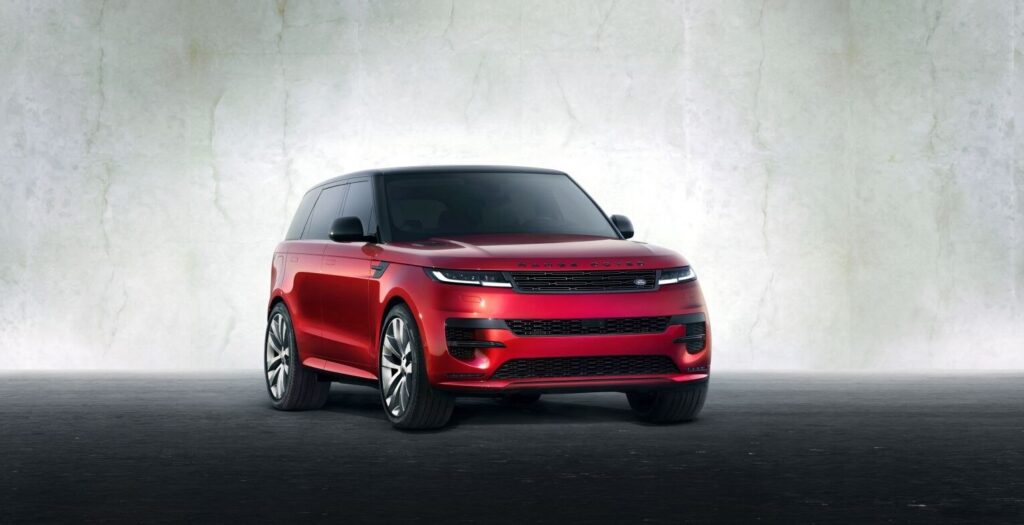
The Land Rover Range Rover Sport III 3.0 D300, launched in May 2022, represents the third generation of the Range Rover Sport, positioned as a dynamic and technologically advanced luxury SUV. This particular variant, powered by a 3.0-liter inline-six diesel engine producing 301 horsepower and incorporating mild hybrid technology, occupies a significant position in the lineup, offering a balance between performance, efficiency, and refinement. It’s built on the MLA (Modular Longitudinal Architecture) platform, shared with the latest Range Rover, emphasizing its premium status and advanced engineering. The D300 trim serves as a compelling option for buyers seeking a powerful yet relatively economical Range Rover Sport, bridging the gap between the entry-level models and the higher-performance P530 and P550 gasoline variants.
Technical Specifications
| Brand | Land Rover |
| Model | Range Rover Sport |
| Generation | Range Rover Sport III |
| Type (Engine) | 3.0 D300 (301 Hp) Mild Hybrid iAWD Automatic |
| Start of production | May, 2022 |
| Powertrain Architecture | MHEV (Mild Hybrid Electric Vehicle) |
| Body type | SUV |
| Seats | 5 |
| Doors | 5 |
| Fuel consumption at Low speed (WLTP) | 10.8-12.3 l/100 km (21.8 – 19.1 US mpg) |
| Fuel consumption at Medium speed (WLTP) | 7.7-8.1 l/100 km (30.5 – 29 US mpg) |
| Fuel consumption at high speed (WLTP) | 5.9-6.4 l/100 km (39.9 – 36.8 US mpg) |
| Fuel consumption at very high speed (WLTP) | 7.2-7.9 l/100 km (32.7 – 29.8 US mpg) |
| Combined fuel consumption (WLTP) | 7.4-8.1 l/100 km (31.8 – 29 US mpg) |
| CO2 emissions (WLTP) | 194-211 g/km |
| Fuel Type | Diesel |
| Acceleration 0 – 100 km/h | 6.6 sec |
| Acceleration 0 – 62 mph | 6.6 sec |
| Acceleration 0 – 60 mph | 6.3 sec |
| Maximum speed | 218 km/h (135.46 mph) |
| Emission standard | Euro 6d |
| Weight-to-power ratio | 7.7 kg/Hp, 130 Hp/tonne |
| Weight-to-torque ratio | 3.6 kg/Nm, 280.8 Nm/tonne |
| Battery voltage | 48 V |
| Power | 301 Hp @ 4000 rpm |
| Torque | 650 Nm @ 1500-2500 rpm (479.42 lb.-ft. @ 1500-2500 rpm) |
| Engine layout | Front, Longitudinal |
| Engine Model/Code | Ingenium / DT306 |
| Engine displacement | 2997 cm3 (182.89 cu. in.) |
| Number of cylinders | 6 |
| Engine configuration | Inline |
| Cylinder Bore | 83 mm (3.27 in.) |
| Piston Stroke | 92.31 mm (3.63 in.) |
| Compression ratio | 15.5:1 |
| Number of valves per cylinder | 4 |
| Fuel injection system | Diesel Commonrail |
| Engine aspiration | Turbocharger, Intercooler |
| Engine oil capacity | 10.4 l (10.99 US qt | 9.15 UK qt) |
| Kerb Weight | 2315 kg (5103.7 lbs.) |
| Max. weight | 3220 kg (7098.88 lbs.) |
| Max load | 905 kg (1995.18 lbs.) |
| Trunk (boot) space – minimum | 450 l (15.89 cu. ft.) |
| Trunk (boot) space – maximum | 1860 l (65.69 cu. ft.) |
| Fuel tank capacity | 80 l (21.13 US gal | 17.6 UK gal) |
| AdBlue tank | 20 l (5.28 US gal | 4.4 UK gal) |
| Max. roof load | 100 kg (220.46 lbs.) |
| Permitted trailer load with brakes (12%) | 3500 kg (7716.18 lbs.) |
| Permitted trailer load without brakes | 750 kg (1653.47 lbs.) |
| Permitted towbar download | 150 kg (330.69 lbs.) |
| Length | 4946 mm (194.72 in.) |
| Width with mirrors folded | 2043 mm (80.43 in.) |
| Width including mirrors | 2209 mm (86.97 in.) |
| Height | 1820 mm (71.65 in.) |
| Wheelbase | 2997 mm (117.99 in.) |
| Front track | 1702 mm (67.01 in.) |
| Rear (Back) track | 1704 mm (67.09 in.) |
| Ride height (ground clearance) | 281 mm (11.06 in.) |
| Drag coefficient (Cd) | 0.29 |
| Minimum turning circle (turning diameter) | 12.53 m (41.11 ft.) |
| Approach angle | 33° |
| Departure angle | 30° |
| Ramp-over (brakeover) angle | 26.9° |
| Wading depth | 900 mm (35.43 in.) |
| Drivetrain Architecture | ICE and electric motor drive rear wheels, front wheels engaged via clutch |
| Drive wheel | All wheel drive (4×4) |
| Number of gears and type of gearbox | 8 gears, automatic transmission ZF |
| Front suspension | Double wishbone |
| Rear suspension | Independent multi-link suspension |
| Front brakes | Ventilated discs, 380 mm |
| Rear brakes | Ventilated discs, 355 mm |
| Steering type | Steering rack and pinion |
| Power steering | Electric Steering |
Powertrain & Engine Architecture
The heart of the Range Rover Sport D300 is Land Rover’s Ingenium 3.0-liter inline-six diesel engine, designated DT306. This engine benefits from a mild hybrid system, utilizing a 48V electric motor to assist the engine during acceleration and enable smoother start-stop operation. The engine employs a sophisticated diesel commonrail fuel injection system, delivering precise fuel metering for optimal combustion. A single turbocharger with an intercooler provides forced induction, boosting power and torque. The engine boasts a high compression ratio of 15.5:1, contributing to its efficiency. The eight-speed automatic transmission, sourced from ZF, is known for its smooth shifts and wide gear ratio spread. This transmission is integral to managing the engine’s substantial 650 Nm (479.42 lb.-ft.) of torque, available from a low 1500 rpm, providing strong pulling power across a broad range of driving conditions.
Driving Characteristics
The D300 variant delivers a refined and capable driving experience. While not as overtly sporty as the higher-powered gasoline models, the 301 horsepower and ample torque provide brisk acceleration – 0-60 mph in around 6.3 seconds. The eight-speed automatic transmission is well-tuned, offering seamless gear changes and contributing to relaxed highway cruising. The mild hybrid system enhances responsiveness, particularly during initial acceleration. Compared to the more powerful P530, the D300 prioritizes fuel efficiency and a more relaxed driving style. The iAWD system (intelligent all-wheel drive) provides excellent traction in various conditions, making it a capable off-roader, though perhaps not as extreme as some dedicated off-road vehicles.
Equipment & Trim Levels
The Range Rover Sport D300 typically comes well-equipped as standard. Features include premium leather upholstery, a touchscreen infotainment system with navigation, a digital instrument cluster, and a comprehensive suite of safety technologies. Common options include adaptive cruise control, a panoramic sunroof, upgraded audio systems (Meridian), and various interior trim packages. The D300 often sits in the mid-range of the Sport lineup, offering a good balance of luxury and features without the premium price tag of the top-spec models.
Chassis & Braking
The Range Rover Sport III utilizes a sophisticated chassis featuring double-wishbone front suspension and an independent multi-link rear suspension. This setup provides a comfortable ride while maintaining good handling characteristics. Air suspension is standard, allowing for adjustable ride height and further enhancing ride comfort. Braking duties are handled by ventilated discs all around – 380mm at the front and 355mm at the rear – providing ample stopping power. ABS (Anti-lock Braking System) and electronic stability control are standard safety features.
Market Reception & Comparison
The Range Rover Sport D300 has been generally well-received by automotive critics. It’s praised for its blend of performance, refinement, and fuel efficiency. Compared to the petrol variants, the D300 offers significantly better fuel economy, making it a more practical choice for drivers covering long distances. Against competitors like the Porsche Cayenne Diesel and BMW X5 xDrive30d, the Range Rover Sport D300 holds its own in terms of luxury, technology, and off-road capability. Some reviewers note that the diesel engine, while powerful, lacks the outright excitement of the gasoline engines.
Legacy
The Ingenium diesel engine family, including the DT306, has proven to be relatively reliable, although, as with any modern diesel, it’s crucial to adhere to recommended maintenance schedules, particularly regarding the diesel particulate filter (DPF). The mild hybrid system adds a layer of complexity, but early indications suggest it’s a robust and dependable technology. On the used car market, the Range Rover Sport D300 is likely to hold its value well, appealing to buyers seeking a luxurious and capable SUV with reasonable running costs. Its combination of performance, technology, and brand prestige ensures its continued desirability in the years to come.