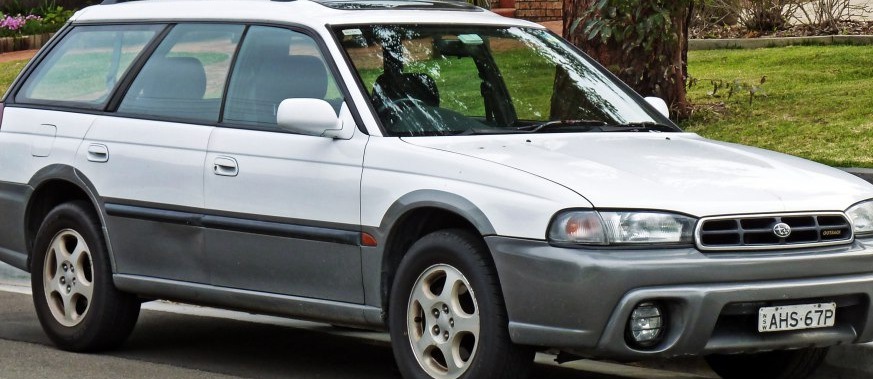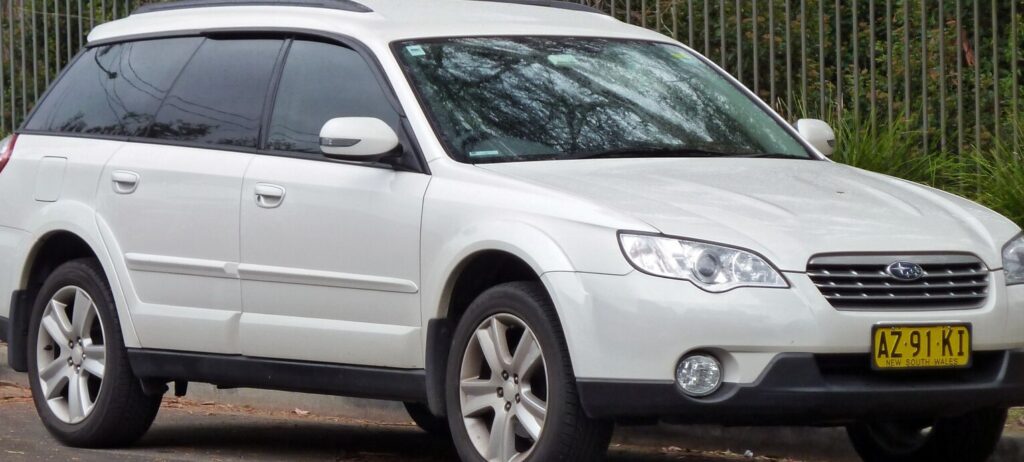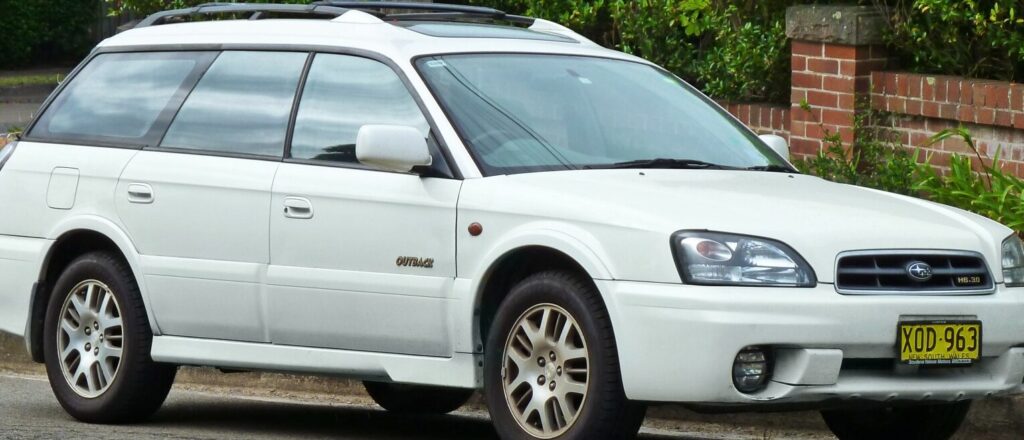
The Subaru Outback II (BE/BH) 3.0i 4WD, produced between 1999 and 2003, represented a significant evolution of Subaru’s popular all-wheel-drive wagon. Building upon the success of the original Outback, the BE/BH generation offered increased refinement, improved safety features, and a more powerful engine option in the form of the 3.0-liter flat-six. This variant occupied the premium position within the Outback lineup, offering a blend of performance, practicality, and all-weather capability aimed at buyers seeking a versatile and capable vehicle. It was primarily marketed in North America, Europe, and Australia, where the demand for all-wheel-drive vehicles was strong.
Technical Specifications
| Brand | Subaru |
| Model | Outback |
| Generation | Outback II (BE, BH) |
| Type | 3.0 i 4WD (209 Hp) |
| Start of production | 1999 |
| End of production | 2003 |
| Powertrain Architecture | Internal Combustion engine |
| Body type | Station wagon (estate) |
| Seats | 5 |
| Doors | 5 |
| Fuel consumption (urban) | 14 l/100 km (16.8 US mpg, 20.2 UK mpg, 7.1 km/l) |
| Fuel consumption (extra urban) | 7.6 l/100 km (30.9 US mpg, 37.2 UK mpg, 13.2 km/l) |
| Fuel consumption (combined) | 9.9 l/100 km (23.8 US mpg, 28.5 UK mpg, 10.1 km/l) |
| Fuel Type | Petrol (Gasoline) |
| Acceleration 0 – 100 km/h | 8.9 sec |
| Acceleration 0 – 62 mph | 8.9 sec |
| Acceleration 0 – 60 mph | 8.5 sec |
| Maximum speed | 210 km/h (130.49 mph) |
| Emission standard | Euro 3 |
| Weight-to-power ratio | 7.7 kg/Hp, 129.8 Hp/tonne |
| Power | 209 Hp @ 6600 rpm |
| Power per litre | 69.7 Hp/l |
| Engine layout | Front, Longitudinal |
| Engine Model/Code | EZ30 |
| Engine displacement | 3000 cm3 (183.07 cu. in.) |
| Number of cylinders | 6 |
| Engine configuration | Boxer |
| Cylinder Bore | 89.2 mm (3.51 in.) |
| Piston Stroke | 80 mm (3.15 in.) |
| Number of valves per cylinder | 4 |
| Fuel injection system | Multi-port manifold injection |
| Engine aspiration | Naturally aspirated engine |
| Valvetrain | DOHC |
| Engine oil capacity | 5.5 l (5.81 US qt | 4.84 UK qt) |
| Coolant capacity | 7.9 l (8.35 US qt | 6.95 UK qt) |
| Kerb Weight | 1610 kg (3549.44 lbs.) |
| Max. weight | 2085 kg (4596.64 lbs.) |
| Max load | 475 kg (1047.2 lbs.) |
| Trunk (boot) space – minimum | 459 l (16.21 cu. ft.) |
| Trunk (boot) space – maximum | 1649 l (58.23 cu. ft.) |
| Fuel tank capacity | 64 l (16.91 US gal | 14.08 UK gal) |
| Length | 4730 mm (186.22 in.) |
| Width | 1770 mm (69.69 in.) |
| Height | 1545 mm (60.83 in.) |
| Wheelbase | 2670 mm (105.12 in.) |
| Front track | 1495 mm (58.86 in.) |
| Rear track | 1485 mm (58.46 in.) |
| Drive wheel | All wheel drive (4×4) |
| Number of gears | 4 |
| Gearbox type | Automatic transmission |
| Front suspension | Spring Strut |
| Rear suspension | Coil spring |
| Front brakes | Ventilated discs |
| Rear brakes | Disc |
| Assisting systems | ABS (Anti-lock braking system) |
| Steering type | Steering rack and pinion |
| Power steering | Hydraulic Steering |
| Tires size | 215/60 R16; 215/55 R17 |
| Wheel rims size | 16; 17 |
INTRODUCTION
The Subaru Outback II (BE/BH) 3.0i 4WD, launched in 1999, was a key model in Subaru’s expansion into the increasingly popular crossover segment. It built upon the foundation of the Legacy wagon, adding increased ground clearance, rugged styling cues, and standard all-wheel drive. The 3.0i variant, distinguished by its larger displacement engine, was positioned as the top-of-the-line Outback, offering a more refined and powerful driving experience. The BE chassis was produced from 1999-2003, with a minor facelift introducing the BH series in 2001. This generation Outback was a significant seller for Subaru, particularly in markets where all-weather capability was highly valued.
Powertrain & Engine Architecture
The heart of the 3.0i Outback is the EZ30 3.0-liter horizontally-opposed six-cylinder “boxer” engine. This engine, a hallmark of Subaru engineering, features a 60-degree V-angle and utilizes multi-port fuel injection. The EZ30 engine produced 209 horsepower at 6,600 rpm and 210 lb-ft of torque. The engine’s flat configuration contributes to a low center of gravity, enhancing handling stability. Paired with the EZ30 was a four-speed automatic transmission, offering smooth and relatively quick shifts. This transmission was chosen for its balance of efficiency and drivability, although it lacked the sportiness of a manual gearbox. The automatic transmission featured adaptive shift logic, adjusting shift points based on driving conditions and throttle input.
Driving Characteristics
The 3.0i Outback offered a noticeably more spirited driving experience compared to the 2.5-liter four-cylinder models. The extra power and torque of the EZ30 engine provided confident acceleration, especially when merging onto highways or overtaking slower traffic. While not a sports car, the Outback 3.0i felt composed and capable on winding roads, thanks to its all-wheel-drive system and relatively firm suspension tuning. The four-speed automatic transmission, while generally smooth, could sometimes feel a bit dated compared to newer transmissions with more gears. The gear ratios were optimized for cruising comfort and fuel efficiency, rather than outright performance. Compared to a manual transmission equipped Outback, the automatic version sacrificed some driver engagement but gained ease of use, particularly in urban environments.
Equipment & Trim Levels
The 3.0i Outback typically came well-equipped, reflecting its position as the premium trim level. Standard features often included air conditioning, power windows and locks, a CD player, and alloy wheels. Higher-end models could be equipped with leather upholstery, a sunroof, heated front seats, and a premium sound system. Optional extras also included automatic climate control and a navigation system. Interior materials were generally of good quality, providing a comfortable and refined cabin environment. The dashboard layout was functional and user-friendly, with logically placed controls.
Chassis & Braking
The Outback II utilized a MacPherson strut front suspension and a double-wishbone rear suspension, providing a comfortable ride and predictable handling. The suspension was tuned to balance on-road comfort with off-road capability. The 3.0i models typically featured larger stabilizer bars compared to the base models, further enhancing handling stability. Braking duties were handled by ventilated disc brakes at all four corners, providing ample stopping power. An Anti-lock Braking System (ABS) was standard, enhancing safety in emergency braking situations. The Outback’s relatively high ground clearance allowed it to tackle moderate off-road terrain with ease.
Market Reception & Comparison
The Outback 3.0i was generally well-received by automotive critics, who praised its spacious interior, comfortable ride, and capable all-wheel-drive system. The engine was lauded for its smooth power delivery and refined character. However, some critics noted that the four-speed automatic transmission felt a bit dated and that the fuel economy was not particularly impressive. Compared to the 2.5-liter Outback models, the 3.0i offered a significant performance upgrade but came at a higher price point. Compared to competitors like the Volvo XC70 and the Honda CR-V, the Outback 3.0i offered a unique combination of all-wheel-drive capability, wagon practicality, and a distinctive boxer engine.
Legacy
The Subaru Outback II (BE/BH) 3.0i 4WD remains a popular choice among used car buyers seeking a reliable and versatile vehicle. The EZ30 engine, while known for its potential for head gasket issues (a common problem with early Subaru boxer engines), is generally considered durable when properly maintained. Regular oil changes and coolant flushes are crucial for preventing engine problems. The Outback’s all-wheel-drive system is highly regarded for its dependability and effectiveness in challenging weather conditions. Today, well-maintained examples of the 3.0i Outback are sought after by enthusiasts and those who appreciate its unique blend of practicality, performance, and all-weather capability. Its lasting appeal is a testament to Subaru’s commitment to building durable and capable vehicles.