
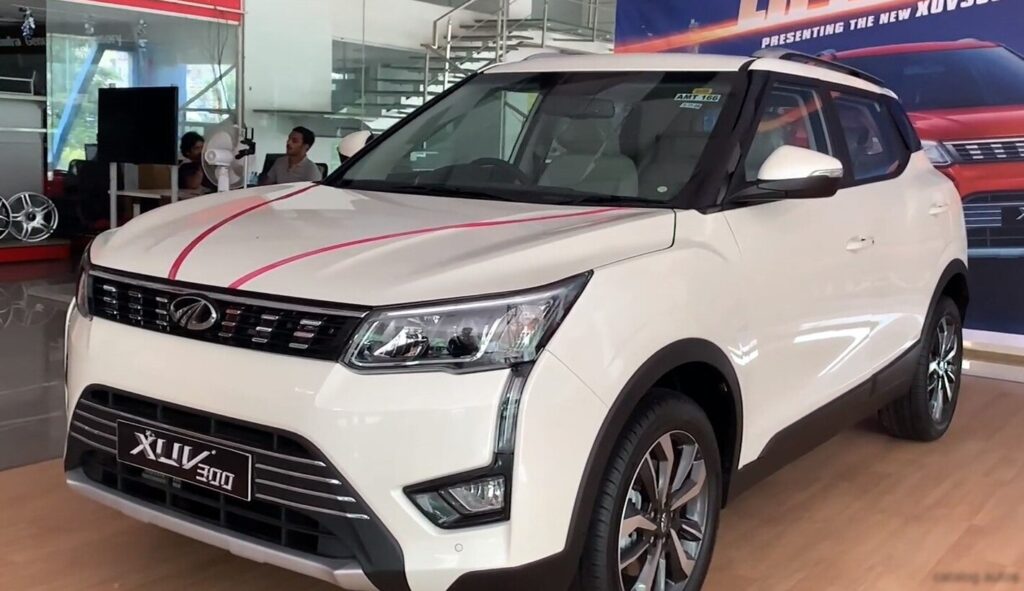
The Mahindra XUV300 1.2 TGDi, producing 130 horsepower, was a subcompact SUV manufactured by the Indian automaker Mahindra & Mahindra from February 2019 to April 2024. Positioned as a more performance-oriented variant within the XUV300 lineup, it aimed to attract buyers seeking a more engaging driving experience than the standard diesel offerings. The XUV300, in general, represented Mahindra’s entry into the rapidly growing sub-4 meter SUV segment, a popular category in the Indian market driven by tax benefits and urban practicality. This particular variant was designed to compete with similarly sized petrol-powered SUVs from Maruti Suzuki, Hyundai, and Tata Motors.
Technical Specifications
| Brand | Mahindra |
| Model | XUV300 |
| Generation | XUV300 |
| Type (Engine) | 1.2 TGDi (130 Hp) |
| Start of production | February, 2019 |
| End of production | April, 2024 |
| Powertrain Architecture | Internal Combustion engine |
| Body type | SUV |
| Seats | 5 |
| Doors | 5 |
| Fuel Type | Petrol (Gasoline) |
| Emission standard | BS-VI |
| Power | 130 Hp @ 5000 rpm |
| Power per litre | 108.6 Hp/l |
| Torque | 230 Nm @ 1500-3750 rpm (169.64 lb.-ft. @ 1500-3750 rpm) |
| Engine layout | Front, Transverse |
| Engine Model/Code | mStallion |
| Engine displacement | 1197 cm3 (73.05 cu. in.) |
| Number of cylinders | 3 |
| Engine configuration | Inline |
| Number of valves per cylinder | 4 |
| Fuel injection system | Direct injection |
| Engine aspiration | Turbocharger, Intercooler |
| Engine oil capacity | 4 l (4.23 US qt | 3.52 UK qt) |
| Fuel tank capacity | 42 l (11.1 US gal | 9.24 UK gal) |
| Length | 3995 mm (157.28 in) |
| Width | 1821 mm (71.69 in) |
| Height | 1627 mm (64.06 in) |
| Wheelbase | 2600 mm (102.36 in) |
| Minimum turning circle | 10.6 m (34.78 ft) |
| Drivetrain Architecture | Front wheel drive, Internal Combustion engine (ICE) |
| Drive wheel | Front wheel drive |
| Number of gears | 6 |
| Gearbox type | Manual transmission |
| Front suspension | Independent type McPherson, Transverse stabilizer |
| Rear suspension | Coil spring, Torsion |
| Front brakes | Disc |
| Rear brakes | Disc |
| Assisting systems | ABS (Anti-lock braking system) |
| Steering type | Steering rack and pinion |
| Power steering | Electric Steering |
| Tires size | 205/65 R16 |
| Wheel rims size | 16 |
Powertrain & Engine Architecture
The heart of the XUV300 1.2 TGDi is the mStallion engine, a 1.2-liter, three-cylinder turbocharged petrol engine. This engine represented a significant step forward for Mahindra, being one of the first entirely in-house developed engines in recent years. The ‘TGDi’ designation stands for Turbocharged Gasoline Direct Injection, highlighting the key technologies employed. Direct injection allows for precise fuel delivery, improving efficiency and performance. The turbocharger, coupled with an intercooler, forces more air into the cylinders, boosting power output. The engine utilizes a dual overhead camshaft (DOHC) valvetrain with four valves per cylinder, optimizing airflow for enhanced performance. The six-speed manual transmission was the sole gearbox option for this variant, providing drivers with full control over the engine’s power delivery. The engine’s relatively small displacement and turbocharging were intended to balance performance with fuel economy, a crucial consideration for the Indian market.
Driving Characteristics
The 130 hp output and 230 Nm of torque provided a noticeable improvement in performance compared to the diesel-powered XUV300 models. The peak torque, available from a low 1500 rpm, offered good responsiveness in city driving and made overtaking at highway speeds relatively effortless. However, the three-cylinder engine’s inherent characteristics were still present – a slightly rougher idle and a more pronounced engine note compared to four-cylinder engines. The six-speed manual transmission was well-matched to the engine, with gear ratios designed to maximize acceleration and fuel efficiency. While not a sports car, the XUV300 1.2 TGDi offered a more engaging driving experience than many of its competitors, particularly those equipped with automatic transmissions. The front-wheel-drive configuration provided predictable handling, and the suspension setup offered a comfortable ride on most road surfaces.
Equipment & Trim Levels
The XUV300 1.2 TGDi was typically offered in higher trim levels, such as W8 and W8 Opt, reflecting its position as the performance variant. Standard equipment included features like alloy wheels, a touchscreen infotainment system with Apple CarPlay and Android Auto connectivity, automatic climate control, and a rear parking camera. Higher trims added features like leatherette upholstery, a sunroof, and additional safety features such as seven airbags. The interior design was generally modern and functional, with a focus on practicality and ease of use. Optional extras included a wider range of exterior color options and accessory packages.
Chassis & Braking
The XUV300 utilized a McPherson strut front suspension and a torsion beam rear suspension. This setup provided a good balance between ride comfort and handling. The front and rear disc brakes offered adequate stopping power for the vehicle’s weight and performance. An Anti-lock Braking System (ABS) was standard, enhancing safety during emergency braking situations. The electric power steering provided light and precise steering feel, making it easy to maneuver in urban environments. The chassis was designed to meet stringent safety standards, incorporating high-strength steel for improved crash protection.
Market Reception & Comparison
The XUV300 1.2 TGDi was generally well-received by automotive critics in India. Reviewers praised its punchy engine, engaging driving dynamics, and well-equipped interior. However, some criticisms were leveled at the three-cylinder engine’s refinement and the lack of an automatic transmission option. Compared to the diesel-powered XUV300, the 1.2 TGDi offered superior performance but slightly lower fuel economy. Against competitors like the Maruti Suzuki Vitara Brezza and Hyundai Venue, the XUV300 1.2 TGDi stood out with its more powerful engine and spacious interior. However, the competition often offered automatic transmission options, which were becoming increasingly popular among buyers.
Legacy
The Mahindra XUV300 1.2 TGDi, despite its relatively short production run, played a crucial role in establishing Mahindra as a serious contender in the subcompact SUV segment. The mStallion engine proved to be a capable and reliable powerplant, and the XUV300’s overall package offered a compelling value proposition. On the used car market, the 1.2 TGDi variants tend to command a slightly higher price than the diesel models, reflecting their performance advantage. While long-term reliability data is still emerging, early reports suggest that the mStallion engine is proving to be durable and relatively maintenance-free. The XUV300 1.2 TGDi represents a significant step forward for Mahindra, showcasing the company’s growing engineering capabilities and its commitment to delivering innovative and exciting vehicles.
