
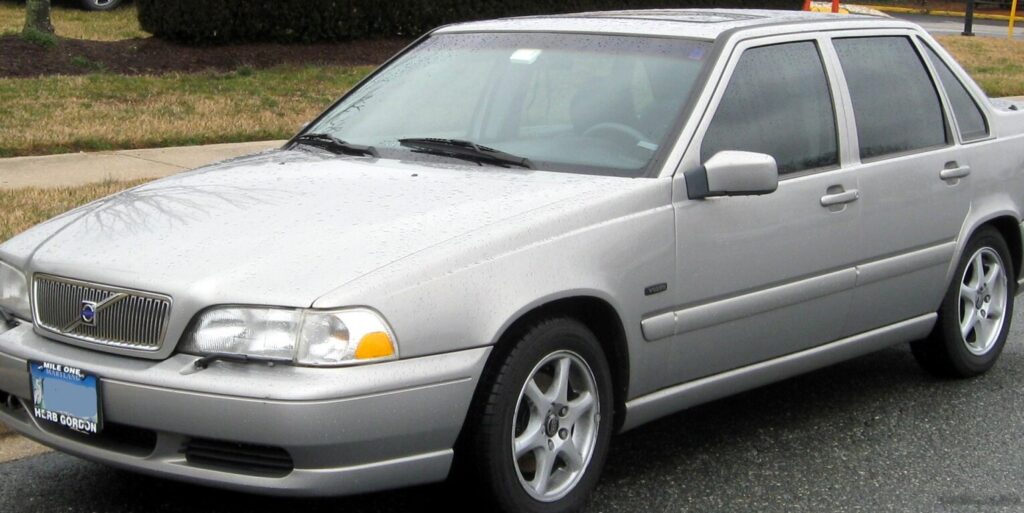
The Volvo S70 2.4i 20V Automatic, produced between 1996 and 2000, represented a significant evolution in Volvo’s mid-size sedan offerings. Part of the S70/V70 series (the V70 being the wagon variant), it was positioned as a comfortable and safe family vehicle, competing with models like the BMW 5 Series, Audi A6, and Mercedes-Benz E-Class. This particular variant, equipped with the 2.4-liter inline-five engine and a four-speed automatic transmission, served as a popular, though not the highest-performance, option within the S70 lineup. It was built on Volvo’s P80 platform, shared with the first generation Volvo V70.
Technical Specifications
| Brand | Volvo |
| Model | S70 |
| Generation | S70 |
| Type (Engine) | 2.4i 20V (170 Hp) Automatic |
| Start of production | 1996 |
| End of production | 2000 |
| Powertrain Architecture | Internal Combustion engine |
| Body type | Sedan |
| Seats | 5 |
| Doors | 4 |
| Fuel consumption (urban) | 12.3 l/100 km (19.1 US mpg) |
| Fuel consumption (extra urban) | 6.9 l/100 km (34.1 US mpg) |
| Fuel Type | Petrol (Gasoline) |
| Acceleration 0 – 100 km/h | 10 sec |
| Acceleration 0 – 62 mph | 10 sec |
| Acceleration 0 – 60 mph | 9.5 sec |
| Maximum speed | 200 km/h (124.27 mph) |
| Weight-to-power ratio | 8.4 kg/Hp |
| Weight-to-torque ratio | 6.5 kg/Nm |
| Power | 170 Hp @ 6100 rpm |
| Torque | 220 Nm @ 4700 rpm (162.26 lb.-ft. @ 4700 rpm) |
| Engine layout | Front, Transverse |
| Engine Model/Code | B5254S |
| Engine displacement | 2435 cm3 (148.59 cu. in.) |
| Number of cylinders | 5 |
| Engine configuration | Inline |
| Cylinder Bore | 83 mm (3.27 in.) |
| Piston Stroke | 90 mm (3.54 in.) |
| Compression ratio | 10.3:1 |
| Number of valves per cylinder | 4 |
| Fuel injection system | Multi-port manifold injection |
| Engine aspiration | Naturally aspirated |
| Valvetrain | DOHC |
| Engine oil capacity | 5.8 l (6.13 US qt | 5.1 UK qt) |
| Coolant capacity | 7.2 l (7.61 US qt | 6.34 UK qt) |
| Kerb Weight | 1430 kg (3152.61 lbs.) |
| Max. weight | 1890 kg (4166.74 lbs.) |
| Max load | 460 kg (1014.13 lbs.) |
| Trunk (boot) space – minimum | 470 l (16.6 cu. ft.) |
| Fuel tank capacity | 70 l (18.49 US gal | 15.4 UK gal) |
| Length | 4720 mm (185.83 in.) |
| Width | 1760 mm (69.29 in.) |
| Height | 1400 mm (55.12 in.) |
| Wheelbase | 2660 mm (104.72 in.) |
| Front track | 1520 mm (59.84 in.) |
| Rear track | 1470 mm (57.87 in.) |
| Drivetrain Architecture | Front wheel drive |
| Number of gears | 4 |
| Gearbox type | Automatic transmission |
| Front suspension | Wishbone |
| Rear suspension | Coil spring |
| Front brakes | Ventilated discs |
| Rear brakes | Disc |
| Assisting systems | ABS (Anti-lock braking system) |
| Steering type | Steering rack and pinion |
| Power steering | Hydraulic |
| Tires size | 205/55 R15 |
| Wheel rims size | 15 |
Powertrain & Engine Architecture
The heart of the S70 2.4i was the B5254S engine, a 2.4-liter inline-five cylinder powerplant. This engine was a hallmark of Volvo’s engineering, offering a smooth and relatively refined driving experience. The “20V” designation indicates the engine featured 20 valves (four valves per cylinder) operated by a dual overhead camshaft (DOHC) design. Fuel delivery was handled by a multi-port fuel injection system, providing precise fuel metering for improved efficiency and performance. The B5254S engine was known for its durability and relatively simple maintenance requirements. Paired with this engine was a four-speed automatic transmission, designed for smooth shifts and ease of use. While not offering the sporty responsiveness of a manual transmission, it catered to drivers prioritizing comfort and convenience.
Driving Characteristics
The S70 2.4i Automatic delivered a comfortable and predictable driving experience. With 170 horsepower and 162 lb-ft of torque, acceleration was adequate for everyday driving, achieving 0-60 mph in around 9.5 seconds. However, it wasn’t a particularly quick car compared to some of its European rivals. The automatic transmission, while smooth, did contribute to a slight loss of power compared to the available manual transmission options. Gear ratios were tuned for fuel efficiency and comfortable cruising rather than outright performance. The front-wheel-drive configuration provided predictable handling, but lacked the dynamic capabilities of rear-wheel-drive competitors. The overall driving experience was geared towards relaxed touring and daily commuting.
Equipment & Trim Levels
The S70 2.4i Automatic typically came standard with a respectable level of equipment. This included power windows, power locks, a sunroof, and air conditioning. Interior upholstery was generally cloth, though leather was available as an option. Dashboard design was typical of Volvo in the late 1990s – functional and ergonomically focused, with a clear and straightforward layout. Optional extras included a premium audio system, heated front seats, and automatic climate control. Safety features were a Volvo hallmark, and the S70 2.4i came standard with ABS brakes and side-impact protection systems.
Chassis & Braking
The S70 utilized a front suspension system based on wishbones, providing a comfortable ride and decent handling characteristics. The rear suspension employed coil springs, contributing to the car’s overall stability. Braking duties were handled by ventilated discs at the front and solid discs at the rear. ABS (Anti-lock Braking System) was standard, enhancing braking performance and safety. Steering was rack and pinion, with hydraulic power assistance for ease of maneuvering. The S70’s chassis was designed to prioritize comfort and safety over sporty handling, resulting in a relatively soft and forgiving ride.
Market Reception & Comparison
The S70 2.4i Automatic was generally well-received by automotive critics as a safe, comfortable, and reliable family sedan. However, it wasn’t often praised for its performance or handling. Compared to the more powerful S70 T5 (turbocharged) variant, the 2.4i offered significantly less acceleration and a less engaging driving experience. Fuel economy was reasonable for its class, averaging around 19 mpg in the city and 34 mpg on the highway. The 2.4i was often seen as a more sensible and affordable alternative to the higher-performance models, appealing to buyers prioritizing practicality and value.
Legacy
The Volvo S70 2.4i Automatic has proven to be a relatively durable and reliable vehicle. The B5254S engine is known for its longevity, and with proper maintenance, can accumulate high mileage. Today, the S70 2.4i can be found on the used car market at affordable prices. While not a collector’s item, it remains a viable option for buyers seeking a safe, comfortable, and reliable used sedan. Common issues include wear and tear on suspension components and potential for oil leaks as the engine ages. However, parts availability is generally good, and the relatively simple mechanical design makes it a relatively easy car to maintain for DIY mechanics.
