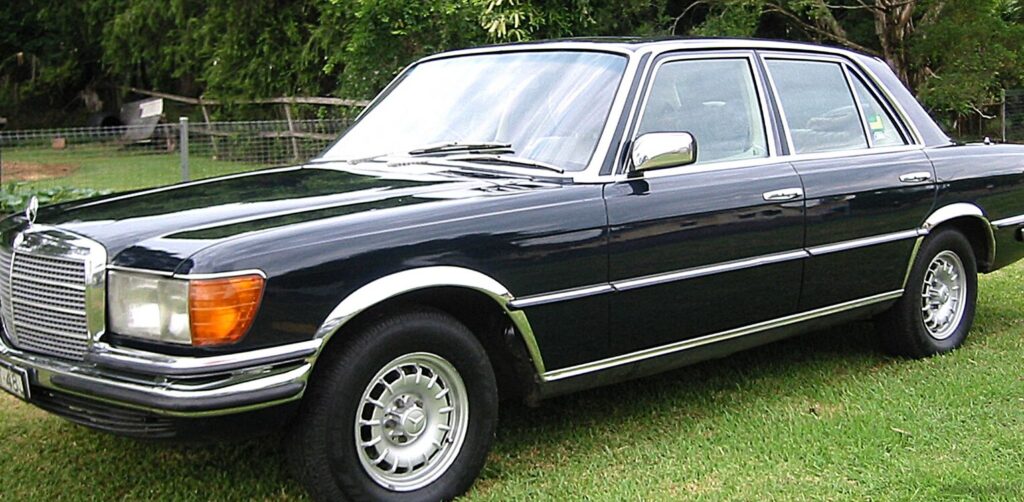
The Mercedes-Benz W116 series, produced from August 1972 to July 1980, represented a significant leap forward in luxury and safety for the German automaker. The 280 S, powered by the M110 V28 engine and paired with an automatic transmission, occupied a middle ground within the W116 lineup. Positioned above the entry-level 280 but below the more powerful 350 and 450 models, the 280 S aimed to deliver a refined driving experience with a balance of performance and fuel economy, appealing to buyers prioritizing comfort and prestige over outright speed. It was a mainstay of the S-Class range during its production run, embodying the brand’s commitment to engineering excellence.
Technical Specifications
| Brand | Mercedes-Benz |
| Model | S-class |
| Generation | S-class SE (W116) |
| Type (Engine) | 280 S (160 Hp) Automatic |
| Start of production | August, 1972 |
| End of production | July, 1980 |
| Powertrain Architecture | Internal Combustion engine |
| Body type | Sedan |
| Seats | 5 |
| Doors | 4 |
| Fuel consumption (combined) | 12.5 l/100 km (18.8 US mpg, 22.6 UK mpg, 8 km/l) |
| Fuel Type | Petrol (Gasoline) |
| Acceleration 0 – 100 km/h | 12.5 sec |
| Acceleration 0 – 62 mph | 12.5 sec |
| Acceleration 0 – 60 mph | 11.9 sec |
| Maximum speed | 185 km/h (114.95 mph) |
| Weight-to-power ratio | 10.1 kg/Hp, 99.4 Hp/tonne |
| Weight-to-torque ratio | 7.1 kg/Nm, 140.4 Nm/tonne |
| Power | 160 Hp @ 5500 rpm |
| Power per litre | 58.3 Hp/l |
| Torque | 226 Nm @ 4000 rpm (166.69 lb.-ft. @ 4000 rpm) |
| Engine layout | Front, Longitudinal |
| Engine Model/Code | M 110 V 28 / 110.922 |
| Engine displacement | 2746 cm3 (167.57 cu. in.) |
| Number of cylinders | 6 |
| Engine configuration | Inline |
| Cylinder Bore | 86 mm (3.39 in.) |
| Piston Stroke | 78.8 mm (3.1 in.) |
| Compression ratio | 9:1 |
| Number of valves per cylinder | 2 |
| Fuel injection system | Carburettor |
| Engine aspiration | Naturally aspirated engine |
| Valvetrain | DOHC |
| Engine oil capacity | 7 l (7.4 US qt | 6.16 UK qt) |
| Coolant | 10.5 l (11.1 US qt | 9.24 UK qt) |
| Kerb Weight | 1610 kg (3549.44 lbs.) |
| Max. weight | 2130 kg (4695.85 lbs.) |
| Max load | 520 kg (1146.4 lbs.) |
| Trunk (boot) space – minimum | 530 l (18.72 cu. ft.) |
| Fuel tank capacity | 96 l (25.36 US gal | 21.12 UK gal) |
| Length | 4960 mm (195.28 in.) |
| Width | 1870 mm (73.62 in.) |
| Height | 1425 mm (56.1 in.) |
| Wheelbase | 2860 mm (112.6 in.) |
| Front track | 1521 mm (59.88 in.) |
| Rear (Back) track | 1505 mm (59.25 in.) |
| Drivetrain Architecture | The Internal combustion engine (ICE) drives the rear wheels of the vehicle. |
| Drive wheel | Rear wheel drive |
| Number of gears and type of gearbox | 4 gears, automatic transmission |
| Front suspension | Double wishbone |
| Rear suspension | Trailing arm |
| Front brakes | Ventilated discs |
| Rear brakes | Disc |
| Steering type | Cone worm with recirculation balls |
| Power steering | Hydraulic Steering |
| Tires size | Front wheel tires: 195/75 R14Rear wheel tires: 195/75 R14 |
| Wheel rims size | Front wheel rims: 6J x 14Rear wheel rims: 6J x 14 |
Powertrain & Engine Architecture
The heart of the 280 S was the M110 V28 2.8-liter inline-six engine. This engine, a descendant of Mercedes-Benz’s long-standing six-cylinder tradition, featured a cast-iron block and aluminum cylinder head. It utilized a single overhead camshaft (SOHC) design, operating two valves per cylinder. Fuel delivery was managed by a Solex 35/40 PHH carburetor, a common setup for the era. The M110 was known for its smoothness and durability, though its carbureted fuel system was becoming increasingly outdated by the late 1970s. The engine produced 160 horsepower at 5,500 rpm and 226 Nm (166.69 lb-ft) of torque at 4,000 rpm. The automatic transmission was a four-speed unit, providing relatively smooth shifts but lacking the responsiveness of a manual gearbox. This transmission was designed for comfort and ease of use, aligning with the S-Class’s luxury focus.
Driving Characteristics
The 280 S Automatic offered a comfortable, albeit not particularly sporty, driving experience. Acceleration from 0 to 60 mph took around 11.9 seconds, and top speed was approximately 115 mph. The automatic transmission, while smooth, resulted in some power loss compared to the available manual transmission. Gear ratios were optimized for cruising, making the car well-suited for long highway journeys. The engine delivered adequate power for everyday driving, but overtaking maneuvers required careful planning. Compared to the 350 and 450 S models, the 280 S felt noticeably less powerful, but it also offered better fuel economy.
Equipment & Trim Levels
The 280 S came standard with a generous array of features for its time, including power steering, power-assisted disc brakes, central locking, and a high-quality radio. The interior was typically upholstered in leather or high-grade cloth, with wood trim adorning the dashboard and door panels. Optional extras included air conditioning, sunroof, and a more advanced audio system. The level of equipment reflected the S-Class’s position as a flagship luxury sedan. The dashboard layout was functional and elegant, with clearly marked gauges and controls.
Chassis & Braking
The W116 chassis featured independent suspension all around, with double wishbones at the front and a trailing arm setup at the rear. This configuration provided a comfortable ride and good handling characteristics. The 280 S utilized ventilated disc brakes at the front and solid discs at the rear, offering adequate stopping power for its weight class. Hydraulic power steering was standard, making the car easy to maneuver at low speeds. Stabilizer bars were fitted to both the front and rear axles to reduce body roll during cornering.
Market Reception & Comparison
The 280 S was generally well-received by automotive critics, who praised its comfort, refinement, and build quality. However, some reviewers noted its relatively modest performance compared to its larger-engined siblings. Fuel economy was considered reasonable for a luxury car of its size, but it was still significantly lower than more modern vehicles. Compared to the 350 S, the 280 S offered a more affordable entry point into the S-Class range, but at the expense of performance. The 280 S also faced competition from other luxury sedans, such as the BMW E3 and the Jaguar XJ.
Legacy
The W116 S-Class, including the 280 S variant, is now considered a classic car. The M110 engine, while not the most powerful of its time, is known for its reliability and longevity. Well-maintained examples of the 280 S are highly sought after by collectors and enthusiasts. The car’s robust construction and relatively simple mechanicals make it easier to maintain than many more modern vehicles. Today, the 280 S represents a bygone era of automotive luxury, offering a unique blend of comfort, style, and engineering excellence. Finding parts can be a challenge, but a dedicated community and readily available resources help keep these cars on the road.