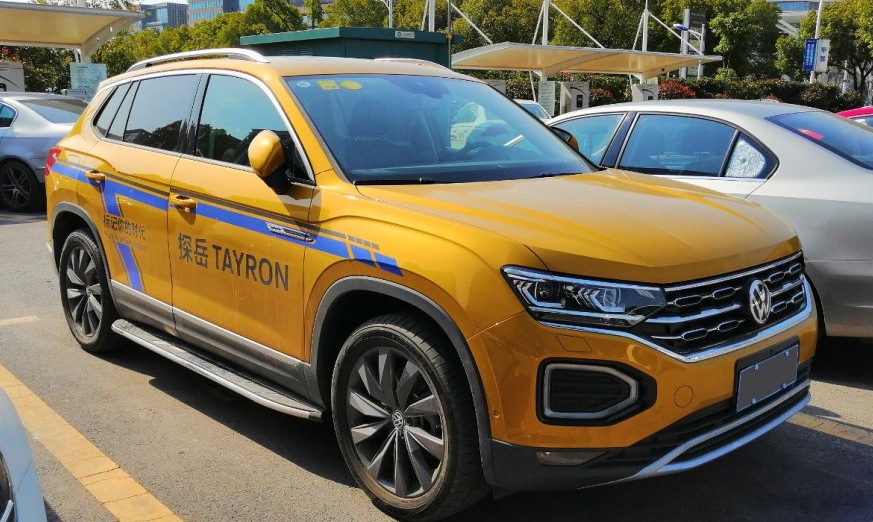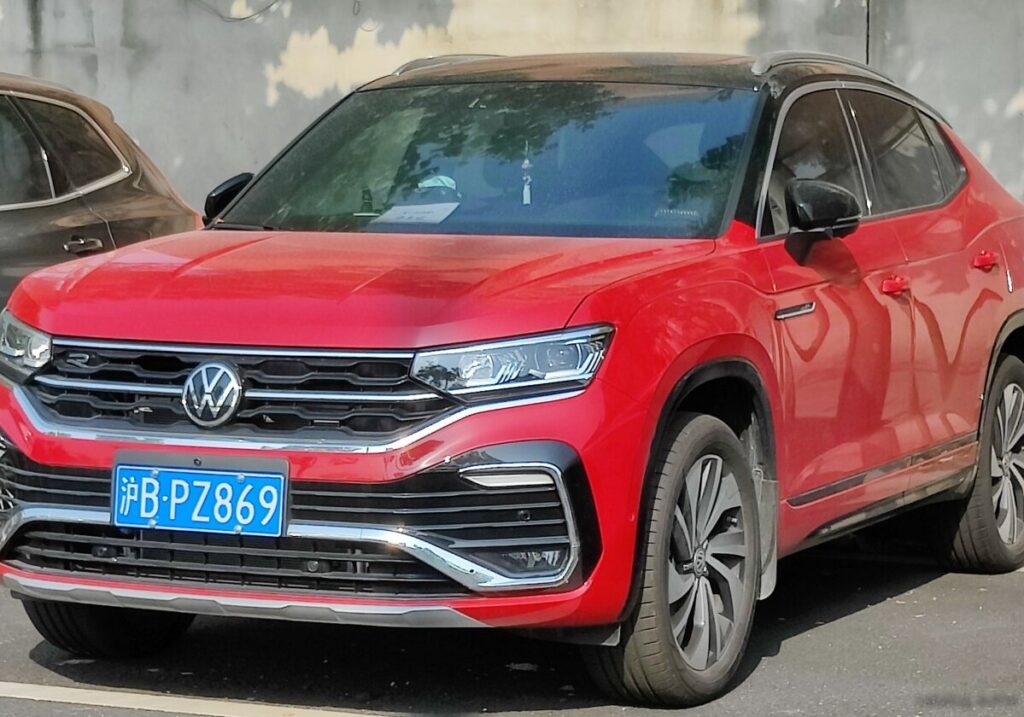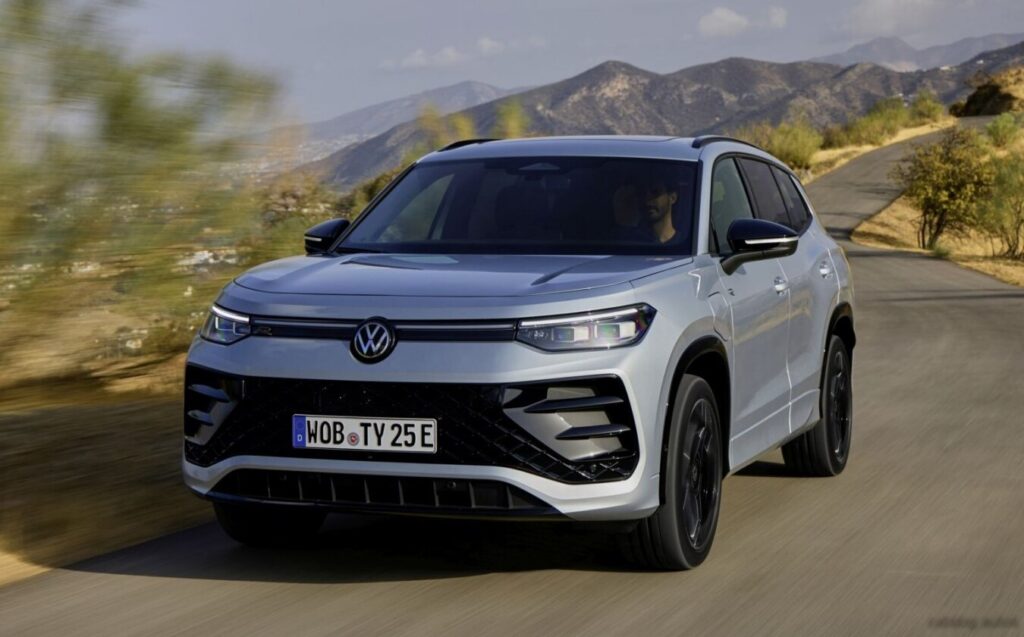
The Volkswagen Tayron II 1.5 TSI eHybrid DSG, introduced in November 2024, represents Volkswagen’s entry into the increasingly competitive plug-in hybrid SUV market. Positioned as a mid-range offering within the broader Tayron II lineup, this variant balances performance, efficiency, and technology. The Tayron II itself is a significant model for Volkswagen, primarily targeted towards the Chinese market, where larger SUVs are highly favored. This particular eHybrid version aims to appeal to buyers seeking a more environmentally conscious vehicle without sacrificing the practicality and space expected of an SUV. It builds upon the foundation of the first-generation Tayron, offering updated styling, improved technology, and a more refined driving experience.
Technical Specifications
| Brand | Volkswagen |
| Model | Tayron |
| Generation | Tayron II |
| Type (Engine) | 1.5 TSI (272 Hp) eHybrid DSG |
| Start of production | November, 2024 |
| Powertrain Architecture | PHEV (Plug-in Hybrid Electric Vehicle) |
| Body type | SUV |
| Seats | 5 |
| Doors | 5 |
| Combined fuel consumption (WLTP) | 0.4-0.5 l/100 km (588 – 470.4 US mpg, 706.2 – 565 UK mpg, 250 – 200 km/l) |
| CO2 emissions (WLTP) | 10-12 g/km |
| Fuel Type | Petrol / electricity |
| Acceleration 0 – 100 km/h | 7.3 sec |
| Acceleration 0 – 62 mph | 7.3 sec |
| Acceleration 0 – 60 mph | 6.9 sec |
| Maximum speed | 215 km/h (133.59 mph) |
| Emission standard | Euro 6e |
| Weight-to-power ratio | 6.9 kg/Hp, 145.2 Hp/tonne |
| Weight-to-torque ratio | 4.7 kg/Nm, 213.6 Nm/tonne |
| Gross battery capacity | 25.7 kWh |
| Net (usable) battery capacity | 19.7 kWh |
| Battery technology | Lithium nickel manganese cobalt oxides (Li-NMC) |
| Battery location | Under the rear seats |
| All-electric range (WLTP) | 112-119 km (69.59 – 73.94 mi) |
| Average Energy consumption (WLTP) | 17.7-18.7 kWh/100 km (28.49 – 30.09 kWh/100 mi, 118 – 112 MPGe, 5.6 – 5.3 km/kWh, 3.5 – 3.3 mi/kWh) |
| Engine Power | 177 Hp @ 5000 rpm |
| Engine Torque | 250 Nm @ 1500-4000 rpm (184.39 lb.-ft. @ 1500-4000 rpm) |
| Engine layout | Front, Transverse |
| Engine Model/Code | EA211 evo2 |
| Engine displacement | 1498 cm3 (91.41 cu. in.) |
| Number of cylinders | 4 |
| Engine configuration | Inline |
| Cylinder Bore | 74.5 mm (2.93 in.) |
| Piston Stroke | 85.9 mm (3.38 in.) |
| Number of valves per cylinder | 4 |
| Fuel injection system | Direct injection |
| Engine aspiration | Turbocharger, Intercooler |
| Valvetrain | DOHC |
| Kerb Weight | 1873 kg (4129.26 lbs.) |
| Max. weight | 2500 kg (5511.56 lbs.) |
| Max load | 627 kg (1382.3 lbs.) |
| Trunk (boot) space – minimum | 705 l (24.9 cu. ft.) |
| Trunk (boot) space – maximum | 1915 l (67.63 cu. ft.) |
| Fuel tank capacity | 45 l (11.89 US gal | 9.9 UK gal) |
| Permitted trailer load with brakes (12%) | 2000 kg (4409.25 lbs.) |
| Permitted trailer load without brakes | 750 kg (1653.47 lbs.) |
| Permitted towbar download | 100 kg (220.46 lbs.) |
| Length | 4792 mm (188.66 in.) |
| Width | 1866 mm (73.46 in.) |
| Width including mirrors | 2151 mm (84.69 in.) |
| Height | 1666 mm (65.59 in.) |
| Wheelbase | 2789 mm (109.8 in.) |
| Front track | 1584-1588 mm (62.36 – 62.52 in.) |
| Rear (Back) track | 1575-1579 mm (62.01 – 62.17 in.) |
| Drag coefficient (Cd) | 0.28 |
| Minimum turning circle (turning diameter) | 12.1 m (39.7 ft.) |
| Front suspension | Independent, type McPherson with coil spring and anti-roll bar |
| Rear suspension | Independent multi-link spring suspension with stabilizer |
| Front brakes | Ventilated discs |
| Drive wheel | Front wheel drive |
| Number of gears and type of gearbox | 6 gears, automatic transmission DSG |
INTRODUCTION
The Volkswagen Tayron II 1.5 TSI eHybrid DSG is a five-seater compact SUV that debuted in late 2024. It’s built on Volkswagen’s modular transverse matrix (MQB) platform, specifically tailored for the Chinese market. The “II” designation signifies a substantial update over the original Tayron, with a focus on modern design, enhanced technology, and improved efficiency. This eHybrid variant combines a 1.5-liter turbocharged gasoline engine with an electric motor and a relatively large battery pack, offering a significant all-electric range and reduced emissions. The Tayron II aims to compete with other popular SUVs in China, such as the Honda CR-V, Toyota RAV4, and domestic offerings from brands like Geely and BYD.
Powertrain & Engine Architecture
At the heart of the Tayron II 1.5 TSI eHybrid is Volkswagen’s EA211 evo2 1.5-liter turbocharged four-cylinder gasoline engine. This engine, producing 177 horsepower at 5000 rpm and 250 Nm (184 lb-ft) of torque between 1500-4000 rpm, features direct fuel injection and a sophisticated turbocharging system. The engine utilizes a Miller cycle for improved thermal efficiency. Coupled with this is an 115 hp electric motor integrated between the engine and the seven-speed dual-clutch transmission (DSG). The combined system output reaches 272 horsepower and 400 Nm (295 lb-ft) of torque. The 25.7 kWh (gross) / 19.7 kWh (net) lithium-ion battery pack, utilizing Li-NMC chemistry, is positioned under the rear seats, minimizing impact on passenger space. The eHybrid system allows for both all-electric driving and blended operation, seamlessly switching between the two power sources. The DSG transmission is calibrated to optimize efficiency and responsiveness in both electric and hybrid modes.
Driving Characteristics
The Tayron II 1.5 TSI eHybrid DSG offers a refined and comfortable driving experience. In all-electric mode, the vehicle provides near-silent operation and brisk acceleration, particularly in urban environments. The electric motor delivers instant torque, making for responsive performance. When the gasoline engine engages, the transition is generally smooth and unobtrusive. The combined power output of 272 hp provides ample power for highway overtaking and spirited driving. The seven-speed DSG transmission shifts quickly and efficiently, contributing to a responsive feel. While not a sports SUV, the Tayron II eHybrid offers a balanced and engaging driving experience. The relatively low center of gravity, thanks to the battery pack’s placement, aids in handling stability.
Equipment & Trim Levels
The Tayron II 1.5 TSI eHybrid DSG typically comes well-equipped, reflecting its position as a mid-range offering. Standard features generally include automatic climate control, a touchscreen infotainment system with Apple CarPlay and Android Auto compatibility, a digital instrument cluster, and a suite of advanced driver-assistance systems (ADAS) such as adaptive cruise control, lane-keeping assist, and automatic emergency braking. Interior upholstery is typically a combination of leatherette and fabric, with higher trims offering full leather options. Optional extras may include a panoramic sunroof, premium sound system, heated and ventilated front seats, and a 360-degree camera system.
Chassis & Braking
The Tayron II utilizes an independent suspension setup, with a McPherson strut configuration at the front and a multi-link setup at the rear. This provides a comfortable ride quality and good handling characteristics. Stabilizer bars are fitted to both axles to reduce body roll during cornering. The braking system consists of ventilated disc brakes at the front and solid disc brakes at the rear. ABS (Anti-lock Braking System) is standard, along with electronic brake-force distribution and brake assist. The electric steering system provides light and precise steering feel.
Market Reception & Comparison
The Tayron II 1.5 TSI eHybrid DSG has been well-received in the Chinese market, where demand for plug-in hybrid SUVs is strong. Critics have praised its spacious interior, comfortable ride, and efficient powertrain. Compared to the standard gasoline-powered Tayron II variants, the eHybrid offers significantly improved fuel economy and reduced emissions. It also provides the benefit of all-electric driving for shorter commutes. Compared to other plug-in hybrid SUVs in its class, the Tayron II eHybrid offers a competitive combination of performance, range, and features. However, some reviewers have noted that the battery pack’s placement slightly reduces cargo space compared to non-hybrid versions.
Legacy
The long-term reliability of the Tayron II 1.5 TSI eHybrid DSG remains to be seen, as it is a relatively new model. However, Volkswagen’s EA211 engine family has a proven track record of reliability, and the DSG transmission is a well-established technology. The battery pack is expected to have a lifespan of at least eight years or 160,000 kilometers (100,000 miles). As the automotive industry continues to shift towards electrification, the Tayron II eHybrid represents Volkswagen’s commitment to offering a wider range of environmentally friendly vehicles. Its success in the Chinese market will likely influence Volkswagen’s future hybrid and electric vehicle strategies globally.