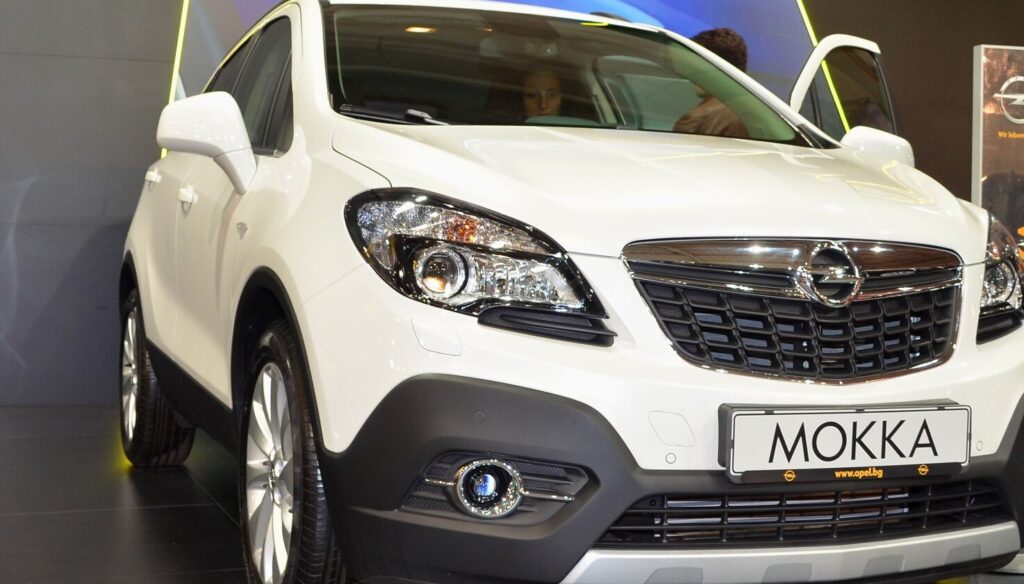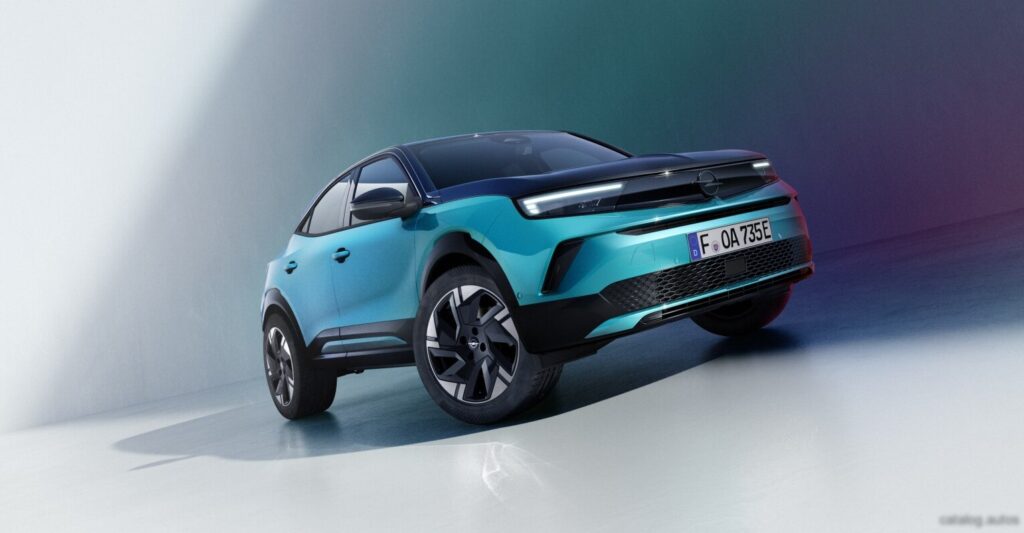
The Opel Mokka B, particularly the facelifted version introduced in October 2024, represents a significant step forward for Opel’s subcompact SUV offering. This variant, equipped with a 1.2-liter turbocharged engine producing 136 horsepower, occupies a central position within the Mokka B lineup, bridging the gap between more economical base models and higher-performance or fully electric options. The Mokka B is a key model for Opel, designed to appeal to a broad customer base seeking a stylish, practical, and technologically advanced vehicle in the competitive European market. This version is primarily aimed at buyers who prefer a traditional gasoline powertrain with a balance of performance and fuel efficiency.
Technical Specifications
| Brand | Opel |
| Model | Mokka |
| Generation | Mokka B (facelift 2024) |
| Type (Engine) | 1.2 Turbo (136 Hp) |
| Start of production | October, 2024 |
| Powertrain Architecture | Internal Combustion engine |
| Body type | SUV |
| Seats | 5 |
| Doors | 5 |
| Fuel consumption at Low speed (WLTP) | 6.7 l/100 km (35.1 US mpg, 42.2 UK mpg, 14.9 km/l) |
| Fuel consumption at Medium speed (WLTP) | 5.3 l/100 km (44.4 US mpg, 53.3 UK mpg, 18.9 km/l) |
| Fuel consumption at high speed (WLTP) | 4.9 l/100 km (48 US mpg, 57.6 UK mpg, 20.4 km/l) |
| Fuel consumption at very high speed (WLTP) | 6.2 l/100 km (37.9 US mpg, 45.6 UK mpg, 16.1 km/l) |
| Combined fuel consumption (WLTP) | 5.7 l/100 km (41.3 US mpg, 49.6 UK mpg, 17.5 km/l) |
| CO2 emissions (WLTP) | 129 g/km |
| Fuel Type | Petrol (Gasoline) |
| Acceleration 0 – 100 km/h | 8.9 sec |
| Acceleration 0 – 62 mph | 8.9 sec |
| Acceleration 0 – 60 mph | 8.5 sec |
| Maximum speed | 208 km/h (129.25 mph) |
| Emission standard | Euro 6e |
| Weight-to-power ratio | 9 kg/Hp, 111.6 Hp/tonne |
| Weight-to-torque ratio | 5.3 kg/Nm, 188.7 Nm/tonne |
| Power | 136 Hp @ 5500 rpm |
| Power per litre | 113.4 Hp/l |
| Torque | 230 Nm @ 1750 rpm (169.64 lb.-ft. @ 1750 rpm) |
| Engine layout | Front, Transverse |
| Engine displacement | 1199 cm3 (73.17 cu. in.) |
| Number of cylinders | 3 |
| Engine configuration | Inline |
| Cylinder Bore | 75 mm (2.95 in.) |
| Piston Stroke | 90.5 mm (3.56 in.) |
| Number of valves per cylinder | 4 |
| Fuel injection system | Direct injection |
| Engine aspiration | Turbocharger, Intercooler |
| Valvetrain | DOHC |
| Engine systems | Start & Stop System, Particulate filter |
| Kerb Weight | 1219 kg (2687.43 lbs.) |
| Max. weight | 1690 kg (3725.81 lbs.) |
| Max load | 471 kg (1038.38 lbs.) |
| Trunk (boot) space – minimum | 350 l (12.36 cu. ft.) |
| Trunk (boot) space – maximum | 1105 l (39.02 cu. ft.) |
| Fuel tank capacity | 44 l (11.62 US gal | 9.68 UK gal) |
| Max. roof load | 75 kg (165.35 lbs.) |
| Permitted trailer load with brakes (12%) | 1200 kg (2645.55 lbs.) |
| Permitted trailer load without brakes | 645 kg (1421.98 lbs.) |
| Permitted towbar download | 55 kg (121.25 lbs.) |
| Length | 4150 mm (163.39 in.) |
| Width | 1787 mm (70.35 in.) |
| Width including mirrors | 1987 mm (78.23 in.) |
| Height | 1535 mm (60.43 in.) |
| Wheelbase | 2557 mm (100.67 in.) |
| Front track | 1548 mm (60.94 in.) |
| Rear (Back) track | 1548 mm (60.94 in.) |
| Front overhang | 881 mm (34.69 in.) |
| Rear overhang | 712 mm (28.03 in.) |
| Minimum turning circle (turning diameter) | 11.08 m (36.35 ft.) |
| Drivetrain Architecture | The Internal combustion engine (ICE) drives the front wheels of the vehicle. |
| Drive wheel | Front wheel drive |
| Number of gears and type of gearbox | 6 gears, manual transmission |
| Front brakes | Ventilated discs |
| Rear brakes | Disc |
| Assisting systems | ABS (Anti-lock braking system) |
| Steering type | Steering rack and pinion |
| Power steering | Electric Steering |
| Tires size | 215/65 R16; 215/60 R17; 195/60 R18; 215/55 R18 |
| Wheel rims size | 6.5J x 16; 6.5J x 17; 6.5J x 18; 7J x 18 |
INTRODUCTION
The Opel Mokka B facelift, launched in October 2024, builds upon the foundation laid by the original Mokka B, which debuted in 2020. Positioned as a direct competitor to vehicles like the Renault Captur, Peugeot 2008, and Volkswagen T-Cross, the Mokka B represents Opel’s commitment to a more modern and expressive design language. The 1.2 Turbo variant, producing 136 horsepower, is a key component of the Mokka B range, offering a balance of performance, fuel economy, and affordability. It’s built on the Common Modular Platform (CMP) shared with other Stellantis brands, allowing for flexibility in powertrain options, including fully electric versions.
Powertrain & Engine Architecture
At the heart of the Mokka B 1.2 Turbo is the PSA-developed (now Stellantis) 1.2 PureTech three-cylinder gasoline engine. This engine, designated as the EB2DT, utilizes direct fuel injection and a single-scroll turbocharger with an intercooler to deliver a respectable 136 hp at 5500 rpm and 230 Nm (169.64 lb-ft) of torque at 1750 rpm. The engine incorporates advanced technologies such as variable valve timing and a particulate filter to meet stringent Euro 6e emission standards. The engine’s compact size and lightweight construction contribute to the Mokka B’s overall efficiency. The 6-speed manual transmission is standard on this variant, providing precise gear changes and a relatively engaging driving experience. The transmission is designed to handle the engine’s torque output effectively, offering smooth acceleration and decent highway cruising ability.
Driving Characteristics
The Mokka B 1.2 Turbo offers a comfortable and composed driving experience. While not overtly sporty, the 136 hp engine provides sufficient power for everyday driving situations, including overtaking and merging onto highways. Acceleration from 0 to 60 mph takes approximately 8.5 seconds. The manual transmission allows for greater driver control, but the gear ratios are tuned for fuel efficiency rather than outright performance. The steering is light and precise, making it easy to maneuver in urban environments. The suspension is well-tuned, providing a good balance between ride comfort and handling. Compared to higher-output versions of the Mokka B, this variant feels less eager to accelerate, but it compensates with improved fuel economy and a more relaxed driving experience.
Equipment & Trim Levels
The Mokka B 1.2 Turbo typically comes well-equipped, even in base trim levels. Standard features often include a 7-inch touchscreen infotainment system with Apple CarPlay and Android Auto compatibility, a digital instrument cluster, air conditioning, and a suite of safety features such as automatic emergency braking, lane departure warning, and traffic sign recognition. Higher trim levels add features like a larger touchscreen, navigation system, adaptive cruise control, and premium upholstery. Optional extras include a panoramic sunroof, heated seats, and a premium sound system. Interior materials are generally of good quality, with a focus on creating a modern and stylish cabin environment.
Chassis & Braking
The Mokka B utilizes a front-wheel-drive chassis with a MacPherson strut front suspension and a torsion beam rear suspension. This setup provides a good balance between ride comfort and handling. The brakes consist of ventilated discs at the front and solid discs at the rear, providing adequate stopping power for the vehicle’s weight and performance. ABS (Anti-lock Braking System) is standard, along with electronic stability control. The steering is an electric power-assisted rack and pinion system, offering light and precise steering feel.
Market Reception & Comparison
The Opel Mokka B 1.2 Turbo has been generally well-received by automotive critics. It’s praised for its stylish design, comfortable ride, and good fuel economy. However, some critics have noted that the engine can feel a bit underpowered, especially when fully loaded or driving uphill. Compared to the more powerful 1.5 Diesel or the all-electric Mokka-e, the 1.2 Turbo offers a more affordable entry point into the Mokka B range. Its fuel economy is competitive with other subcompact SUVs in its class, achieving around 41.3 US mpg on the combined WLTP cycle. Reliability reports are still emerging, but the PSA-derived engine has a generally good reputation for durability.
Legacy
The Opel Mokka B 1.2 Turbo represents a significant step forward for Opel in the subcompact SUV segment. Its combination of stylish design, practical features, and efficient powertrain makes it a compelling choice for buyers seeking a versatile and affordable vehicle. While the long-term reliability of this specific powertrain remains to be fully assessed, the underlying engine technology has proven to be durable in other applications. As the automotive industry continues to shift towards electrification, the Mokka B 1.2 Turbo will likely serve as a transitional model, offering a familiar gasoline-powered option for those not yet ready to embrace electric vehicles. On the used car market, this variant is expected to hold its value reasonably well, particularly among buyers seeking a well-equipped and fuel-efficient subcompact SUV.