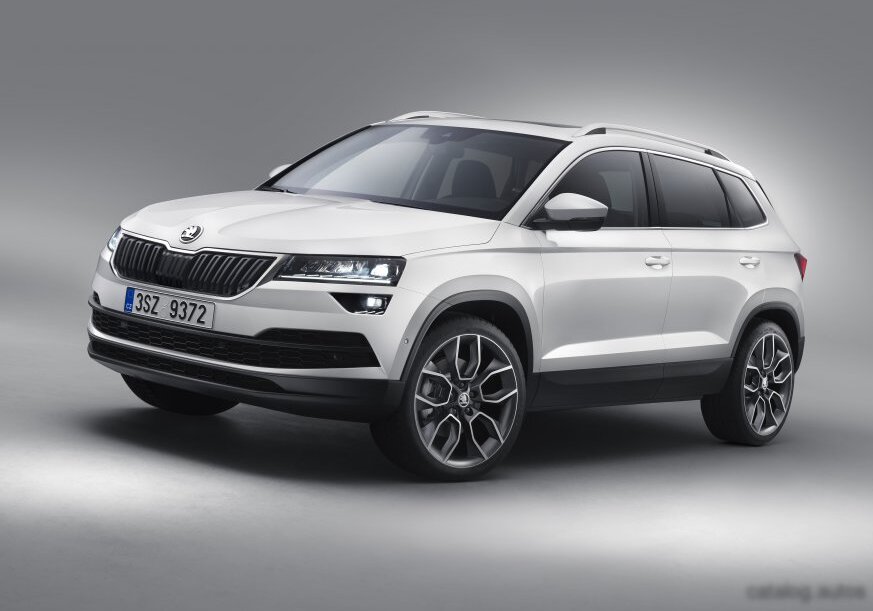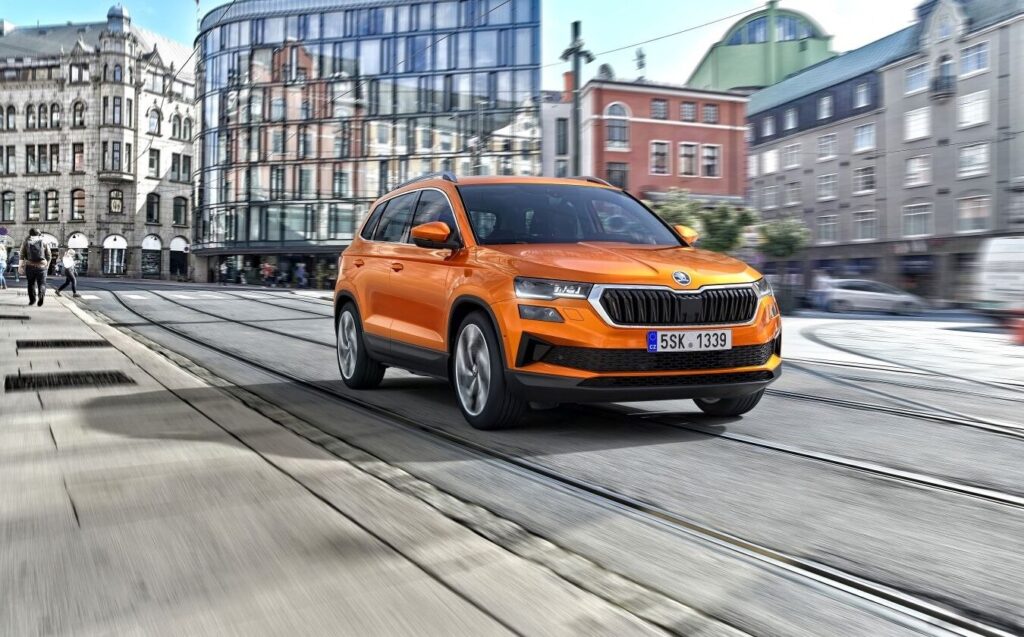
The Skoda Karoq (facelift, introduced in November 2021) 2.0 TSI 4×4 DSG represents a significant offering in Skoda’s compact SUV lineup. Positioned as a mid-to-upper trim level, this variant combines a potent turbocharged engine with all-wheel drive and a dual-clutch transmission, aiming to deliver a blend of performance, practicality, and all-weather capability. It builds upon the foundation of the Karoq, which itself is based on the Volkswagen Group’s MQB platform (A1/A7), shared with models like the Volkswagen Tiguan and SEAT Ateca. The 2021 facelift brought styling updates, enhanced technology, and refinements to the powertrain options, solidifying the Karoq’s position in the competitive European SUV market.
Technical Specifications
| Brand | Skoda |
| Model | Karoq |
| Generation | Karoq (facelift 2021) |
| Type (Engine) | 2.0 TSI (190 Hp) 4×4 DSG |
| Start of production | November, 2021 |
| Powertrain Architecture | Internal Combustion engine |
| Body type | SUV |
| Seats | 5 |
| Doors | 5 |
| Combined fuel consumption (WLTP) | 7.5-8.1 l/100 km (31.4 – 29 US mpg, 37.7 – 34.9 UK mpg, 13.3 – 12.3 km/l) |
| CO2 emissions (WLTP) | 171-184 g/km |
| Fuel Type | Petrol (Gasoline) |
| Acceleration 0 – 100 km/h | 7 sec |
| Acceleration 0 – 62 mph | 7 sec |
| Acceleration 0 – 60 mph | 6.7 sec |
| Maximum speed | 221 km/h (137.32 mph) |
| Emission standard | Euro 6 AP |
| Weight-to-power ratio | 7.9 kg/Hp, 126 Hp/tonne |
| Weight-to-torque ratio | 4.7 kg/Nm, 212.2 Nm/tonne |
| Power | 190 Hp @ 4200-6000 rpm |
| Power per litre | 95.8 Hp/l |
| Torque | 320 Nm @ 1500-4100 rpm (236.02 lb.-ft. @ 1500-4100 rpm) |
| Engine layout | Front, Transverse |
| Engine Model/Code | EA888 evo4 / DNNA |
| Engine displacement | 1984 cm3 (121.07 cu. in.) |
| Number of cylinders | 4 |
| Engine configuration | Inline |
| Cylinder Bore | 82.5 mm (3.25 in.) |
| Piston Stroke | 92.8 mm (3.65 in.) |
| Compression ratio | 12.2:1 |
| Number of valves per cylinder | 4 |
| Fuel injection system | Direct injection |
| Engine aspiration | Turbocharger, Intercooler |
| Valvetrain | DOHC |
| Engine oil capacity | 5.7 l (6.02 US qt | 5.02 UK qt) |
| Kerb Weight | 1508-1688 kg (3324.57 – 3721.4 lbs.) |
| Max. weight | 2112-2220 kg (4656.16 – 4894.26 lbs.) |
| Max load | 532-604 kg (1172.86 – 1331.59 lbs.) |
| Trunk (boot) space – minimum | 521 l (18.4 cu. ft.) |
| Trunk (boot) space – maximum | 1630 l (57.56 cu. ft.) |
| Fuel tank capacity | 55 l (14.53 US gal | 12.1 UK gal) |
| Max. roof load | 75 kg (165.35 lbs.) |
| Permitted trailer load with brakes (8%) | 1900 kg (4188.78 lbs.) |
| Permitted trailer load with brakes (12%) | 1900 kg (4188.78 lbs.) |
| Permitted trailer load without brakes | 750 kg (1653.47 lbs.) |
| Permitted towbar download | 90 kg (198.42 lbs.) |
| Length | 4384 mm (172.6 in.) |
| Width | 1841 mm (72.48 in.) |
| Width including mirrors | 2025 mm (79.72 in.) |
| Height | 1608 mm (63.31 in.) |
| Wheelbase | 2630 mm (103.54 in.) |
| Front track | 1572 mm (61.89 in.) |
| Rear (Back) track | 1544 mm (60.79 in.) |
| Ride height (ground clearance) | 173 mm (6.81 in.) |
| Drag coefficient (Cd) | 0.327 |
| Minimum turning circle (turning diameter) | 10.9 m (35.76 ft.) |
| Drivetrain Architecture | All wheel drive (4×4). Internal Combustion engine. |
| Number of gears and type of gearbox | 7 gears, automatic transmission DSG |
| Front suspension | Independent, type McPherson with coil spring and anti-roll bar |
| Rear suspension | Independent multi-link spring suspension with stabilizer |
| Front brakes | Ventilated discs |
| Rear brakes | Disc |
| Assisting systems | ABS (Anti-lock braking system) |
| Steering type | Steering rack and pinion |
| Power steering | Electric Steering |
| Tires size | 225/60 R16 |
| Wheel rims size | 6J x 16 |
Powertrain & Engine Architecture
At the heart of the Karoq 2.0 TSI 4×4 DSG lies the EA888 evo4 engine, a 1.984-liter (121.07 cubic inches) turbocharged inline-four cylinder gasoline engine. This engine is a staple in the Volkswagen Group’s portfolio, known for its responsiveness and efficiency. The ‘evo4’ designation signifies the fourth evolution of this engine family, incorporating advancements in fuel injection, combustion chamber design, and thermal management. It utilizes direct fuel injection, delivering fuel directly into the cylinders at high pressure for precise control and improved combustion. The engine also features an integrated exhaust manifold for faster warm-up times and reduced emissions. The turbocharger, coupled with an intercooler, provides a significant boost in power and torque. The engine is paired with a seven-speed dual-clutch transmission (DSG), offering quick and seamless gear changes. The 4×4 system employs a multi-plate clutch, distributing power between the front and rear axles as needed, providing enhanced traction and stability in various driving conditions.
Driving Characteristics
The 190 horsepower and 320 Nm (236 lb-ft) of torque delivered by the 2.0 TSI engine provide brisk acceleration. The 0-60 mph sprint is achieved in approximately 6.7 seconds, and the car reaches a top speed of 137.32 mph. The DSG transmission contributes to a smooth and responsive driving experience, with quick shifts and minimal torque interruption. Compared to lower-powered Karoq variants (like the 1.5 TSI), the 2.0 TSI offers significantly more punch, particularly during overtaking maneuvers and when carrying a full load. While not as overtly sporty as some performance-focused SUVs, the Karoq 2.0 TSI 4×4 provides a confident and capable driving experience. The all-wheel-drive system enhances grip and stability, especially on slippery surfaces. The gear ratios are well-tuned for both everyday driving and highway cruising, providing a balance between fuel efficiency and performance.
Equipment & Trim Levels
The Karoq 2.0 TSI 4×4 DSG typically came well-equipped, reflecting its position as a mid-to-upper trim level. Standard features often included alloy wheels, automatic climate control, a touchscreen infotainment system with Apple CarPlay and Android Auto compatibility, parking sensors, and a suite of safety features such as automatic emergency braking and lane departure warning. Interior upholstery was typically a combination of fabric and leatherette, with options for full leather available. Higher trim levels offered features like a panoramic sunroof, adaptive cruise control, and a premium sound system. The dashboard layout was clean and functional, with a focus on user-friendliness.
Chassis & Braking
The Karoq’s chassis is tuned for comfort and stability. The front suspension utilizes McPherson struts, while the rear features a multi-link setup, providing a good balance between ride quality and handling. Stabilizer bars are fitted to both axles to reduce body roll during cornering. The braking system consists of ventilated discs at the front and solid discs at the rear, providing adequate stopping power. ABS (Anti-lock Braking System) is standard, along with electronic brake-force distribution and brake assist.
Market Reception & Comparison
The Skoda Karoq 2.0 TSI 4×4 DSG was generally well-received by automotive critics. It was praised for its spacious interior, comfortable ride, and strong performance. The fuel economy, while not exceptional, was considered reasonable for a vehicle of its size and capability. Compared to rivals like the Volkswagen Tiguan and SEAT Ateca, the Karoq offered a compelling value proposition, often undercutting them in price while providing similar levels of equipment and performance. The 1.8 TSI variants were often seen as a good compromise between fuel economy and performance, while the diesel models (like the 2.0 TDI) prioritized fuel efficiency.
Legacy
The EA888 engine family, including the version used in the Karoq 2.0 TSI, has proven to be relatively reliable, although regular maintenance is crucial. Common issues can include carbon buildup on the intake valves, which can affect performance over time. The DSG transmission, while generally robust, requires scheduled servicing to ensure smooth operation. In the used car market, the Karoq 2.0 TSI 4×4 DSG holds its value reasonably well, thanks to its strong performance, practicality, and all-wheel-drive capability. It remains a popular choice for buyers seeking a versatile and well-equipped compact SUV.