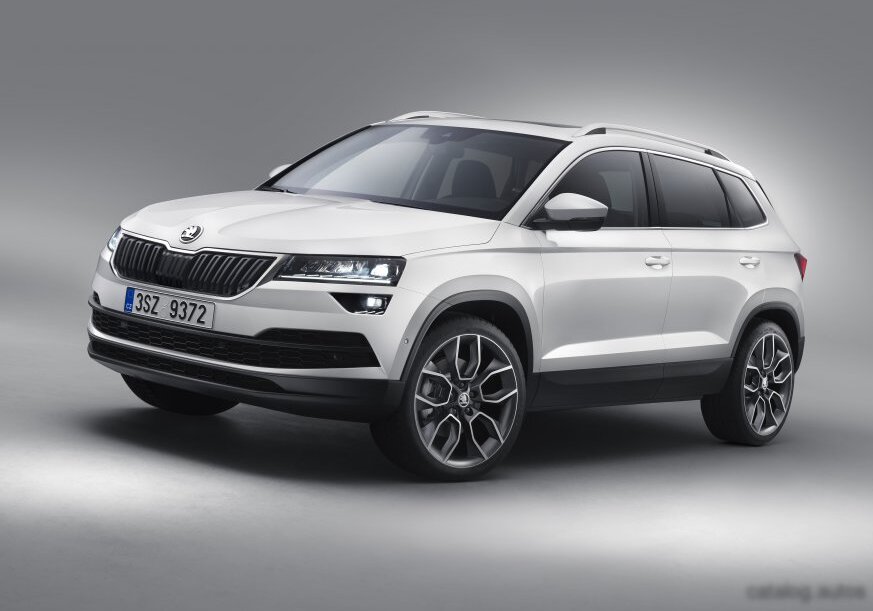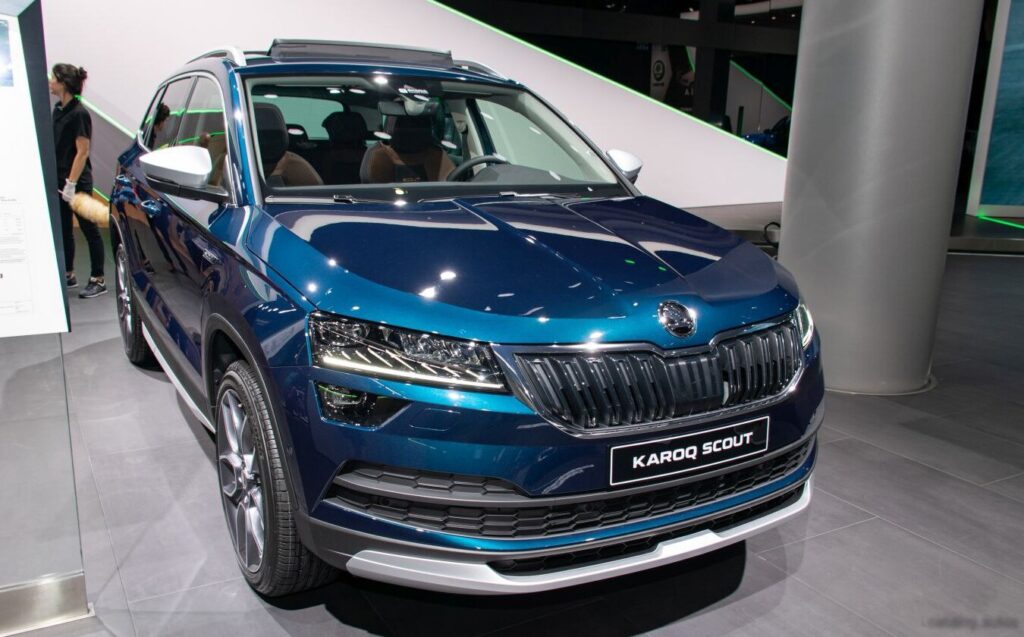
The Skoda Karoq Scout 2.0 TDI 4×4, produced from 2018 to 2019, represents a rugged, all-wheel-drive variant of Skoda’s popular compact SUV. Positioned as a more adventurous trim level within the Karoq range, the Scout aimed to blend practicality with off-road capability. It built upon the standard Karoq’s foundation, offering enhanced styling cues and a more robust drivetrain. The Karoq itself was a key model for Skoda, designed to appeal to families and individuals seeking a versatile and spacious vehicle within the highly competitive European C-segment SUV market. This particular variant, with its 2.0-liter TDI engine and four-wheel drive, was targeted towards buyers who desired both fuel efficiency and the ability to tackle varied terrain.
Technical Specifications
| Brand | Skoda |
| Model | Karoq |
| Generation | Karoq Scout |
| Type (Engine) | 2.0 TDI (150 Hp) 4×4 |
| Start of production | 2018 |
| End of production | 2019 |
| Powertrain Architecture | Internal Combustion engine |
| Body type | SUV |
| Seats | 5 |
| Doors | 5 |
| Fuel consumption (urban) | 6.1 l/100 km (38.6 US mpg) |
| Fuel consumption (extra urban) | 4.5 l/100 km (52.3 US mpg) |
| Fuel consumption (combined) | 5.1 l/100 km (46.1 US mpg) |
| CO2 emissions | 134 g/km |
| Fuel Type | Diesel |
| Acceleration 0 – 100 km/h | 8.9 sec |
| Acceleration 0 – 62 mph | 8.9 sec |
| Acceleration 0 – 60 mph | 8.5 sec |
| Maximum speed | 196 km/h (121.79 mph) |
| Emission standard | Euro 6 |
| Weight-to-power ratio | 10.4 kg/Hp |
| Weight-to-torque ratio | 4.6 kg/Nm |
| Power | 150 Hp @ 3500-4000 rpm |
| Torque | 340 Nm @ 1750-3000 rpm (250.77 lb.-ft.) |
| Engine layout | Front, Transverse |
| Engine Model/Code | EA288 / DFFA |
| Engine displacement | 1968 cm3 (120.09 cu. in.) |
| Number of cylinders | 4 |
| Engine configuration | Inline |
| Fuel injection system | Diesel Commonrail |
| Engine aspiration | Turbocharger, Intercooler |
| Engine oil capacity | 4.7 l (4.97 US qt | 4.14 UK qt) |
| Kerb Weight | 1561 kg (3441.42 lbs.) |
| Max. weight | 2140 kg (4717.89 lbs.) |
| Max load | 579 kg (1276.48 lbs.) |
| Trunk (boot) space – minimum | 588 l (20.77 cu. ft.) |
| Trunk (boot) space – maximum | 1605 l (56.68 cu. ft.) |
| Fuel tank capacity | 55 l (14.53 US gal | 12.1 UK gal) |
| Permitted trailer load with brakes (12%) | 2100 kg (4629.71 lbs.) |
| Permitted towbar download | 84 kg (185.19 lbs.) |
| Length | 4399 mm (173.19 in.) |
| Width | 1841 mm (72.48 in.) |
| Width including mirrors | 2025 mm (79.72 in.) |
| Height | 1607 mm (63.27 in.) |
| Wheelbase | 2630 mm (103.54 in.) |
| Front track | 1576 mm (62.05 in.) |
| Rear track | 1541-1547 mm (60.67 – 60.91 in.) |
| Ride height (ground clearance) | 176 mm (6.93 in.) |
| Approach angle | 18° |
| Departure angle | 19° |
| Drivetrain Architecture | All wheel drive (4×4) |
| Number of gears | 6 |
| Type of gearbox | Manual transmission |
| Front suspension | Independent, type McPherson with coil spring and anti-roll bar |
| Rear suspension | Independent multi-link suspension |
| Front brakes | Ventilated discs |
| Rear brakes | Disc |
Powertrain & Engine Architecture
The Karoq Scout 2.0 TDI 4×4 utilizes the Volkswagen Group’s EA288 engine family, specifically the DFFA code variant. This is a 1968cc, four-cylinder diesel engine employing common-rail direct injection and a turbocharger with an intercooler. The engine produces 150 horsepower at 3500-4000 rpm and a substantial 340 Nm (250.77 lb-ft) of torque between 1750 and 3000 rpm. This broad torque curve is characteristic of modern turbocharged diesel engines, providing strong pulling power across a wide range of engine speeds. The engine also incorporates a diesel particulate filter (DPF) to meet stringent Euro 6 emissions standards. The six-speed manual transmission was the standard offering for this variant, providing drivers with full control over gear selection. The 4×4 system employs a multi-plate clutch, automatically distributing torque between the front and rear axles as needed, enhancing traction in slippery conditions.
Driving Characteristics
The 2.0 TDI engine, coupled with the six-speed manual transmission, delivers a balanced driving experience. While not overtly sporty, the Karoq Scout offers ample power for everyday driving and confident overtaking. The 0-60 mph acceleration time of around 8.5 seconds is respectable for a compact SUV. The manual gearbox allows for precise control, and the engine’s strong low-end torque makes it easy to drive in urban environments. Compared to the lower-powered 1.6 TDI variants, the 2.0 TDI provides a noticeable performance boost. The all-wheel-drive system enhances stability and grip, particularly on loose surfaces, making it a capable vehicle for light off-road excursions. The gear ratios are tuned for a blend of fuel efficiency and usability, rather than outright performance.
Equipment & Trim Levels
The Scout trim level added several distinctive features to the standard Karoq. Standard equipment typically included alloy wheels, silver-colored body cladding, roof rails, and unique interior trim elements. Inside, the Scout often featured fabric and Alcantara upholstery, a leather-wrapped steering wheel, and a touchscreen infotainment system with navigation. Optional extras included features like adaptive cruise control, a panoramic sunroof, and parking sensors. The Scout trim was positioned as a mid-to-high range offering, bridging the gap between the entry-level models and the more luxurious trims.
Chassis & Braking
The Karoq Scout utilizes an independent suspension setup, with McPherson struts at the front and a multi-link system at the rear. This configuration provides a comfortable ride quality and good handling characteristics. The Scout variant typically featured slightly stiffer suspension components compared to the standard Karoq, enhancing body control. Braking duties are handled by ventilated discs at the front and solid discs at the rear, providing adequate stopping power. Anti-lock braking system (ABS) is standard, along with electronic stability control.
Market Reception & Comparison
The Skoda Karoq Scout 2.0 TDI 4×4 was generally well-received by automotive critics. It was praised for its spacious interior, comfortable ride, and capable all-wheel-drive system. The 2.0 TDI engine was considered a good compromise between performance and fuel economy. Compared to other compact SUVs in its class, such as the Nissan Qashqai and Kia Sportage, the Karoq Scout offered a compelling blend of value, practicality, and refinement. The 1.6 TDI variants were more fuel-efficient but lacked the performance of the 2.0 TDI, while higher-powered petrol versions offered more excitement but at the expense of fuel economy.
Legacy
The EA288 engine family, including the DFFA code used in the Karoq Scout, has proven to be relatively reliable, although DPF issues can occur with frequent short journeys. The Karoq itself has established a reputation as a practical and dependable family SUV. On the used car market, the 2.0 TDI 4×4 Scout variant holds its value reasonably well, appealing to buyers seeking a versatile and capable vehicle. Its combination of fuel efficiency, all-wheel drive, and spaciousness continues to make it a popular choice.