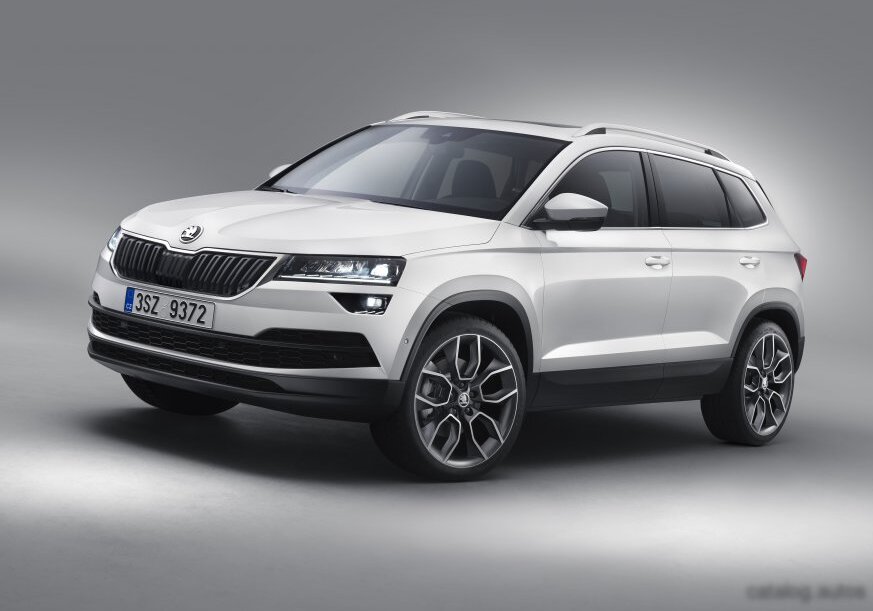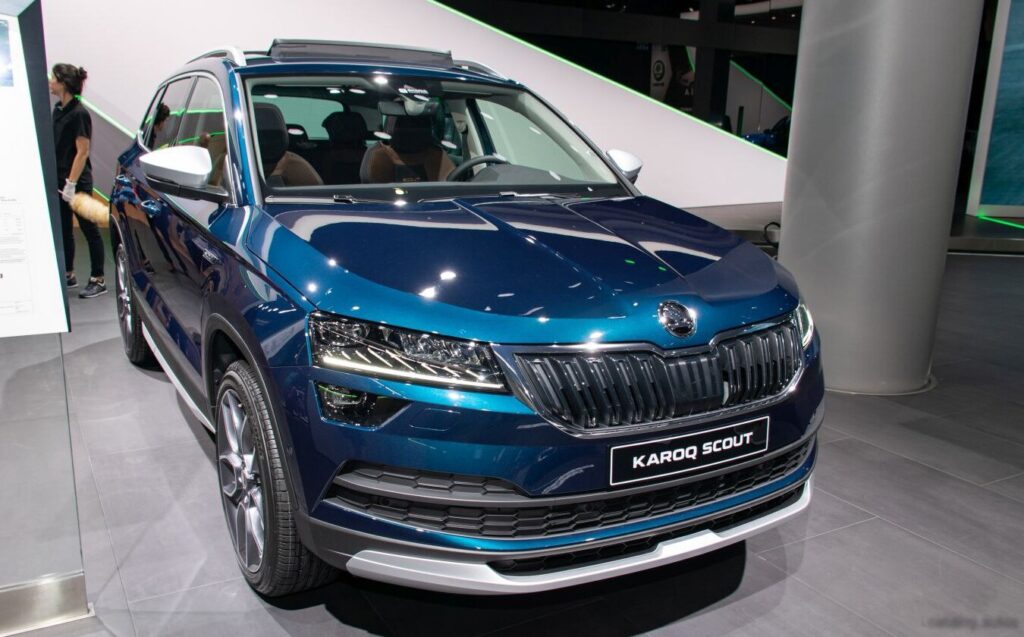
The Skoda Karoq Scout 2.0 TDI 4×4 DSG was a trim level of the Karoq compact SUV produced by the Czech automaker Skoda between 2019 and November 2021. Positioned as the more rugged, all-wheel-drive variant within the Karoq lineup, the Scout aimed to blend practicality, fuel efficiency, and a degree of off-road capability. It represented Skoda’s entry into the increasingly popular segment of small SUVs offering all-weather and light off-road performance. The Karoq itself is based on the Volkswagen Group’s MQB platform (A1), shared with models like the Volkswagen Tiguan and SEAT Ateca.
Technical Specifications
| Brand | Skoda |
| Model | Karoq |
| Generation | Karoq Scout |
| Type (Engine) | 2.0 TDI (150 Hp) 4×4 DSG |
| Start of production | 2019 |
| End of production | November, 2021 |
| Powertrain Architecture | Internal Combustion engine |
| Body type | SUV |
| Seats | 5 |
| Doors | 5 |
| Fuel consumption at Low speed (WLTP) | 8.3 l/100 km (28.3 US mpg, 34 UK mpg, 12 km/l) |
| Fuel consumption at Medium speed (WLTP) | 6.5 l/100 km (36.2 US mpg, 43.5 UK mpg, 15.4 km/l) |
| Fuel consumption at high speed (WLTP) | 5.7 l/100 km (41.3 US mpg, 49.6 UK mpg, 17.5 km/l) |
| Fuel consumption at very high speed (WLTP) | 6.9 l/100 km (34.1 US mpg, 40.9 UK mpg, 14.5 km/l) |
| Combined fuel consumption (WLTP) | 6.6 l/100 km (35.6 US mpg, 42.8 UK mpg, 15.2 km/l) |
| CO2 emissions (WLTP) | 174 g/km |
| Fuel consumption (economy) – urban (NEDC) | 6.1 l/100 km (38.6 US mpg, 46.3 UK mpg, 16.4 km/l) |
| Fuel consumption (economy) – extra urban (NEDC) | 4.7 l/100 km (50 US mpg, 60.1 UK mpg, 21.3 km/l) |
| Fuel consumption (economy) – combined (NEDC) | 5.2 l/100 km (45.2 US mpg, 54.3 UK mpg, 19.2 km/l) |
| CO2 emissions (NEDC) | 137 g/km |
| Fuel Type | Diesel |
| Acceleration 0 – 100 km/h | 9.2 sec |
| Acceleration 0 – 62 mph | 9.2 sec |
| Acceleration 0 – 60 mph | 8.7 sec |
| Maximum speed | 200 km/h (124.27 mph) |
| Emission standard | Euro 6 DG |
| Weight-to-power ratio | 10.1 kg/Hp, 98.9 Hp/tonne |
| Weight-to-torque ratio | 4.5 kg/Nm, 224.3 Nm/tonne |
| Power | 150 Hp @ 3500-4000 rpm |
| Power per litre | 76.2 Hp/l |
| Torque | 340 Nm @ 1750-3000 rpm (250.77 lb.-ft. @ 1750-3000 rpm) |
| Engine layout | Front, Transverse |
| Engine Model/Code | EA288 / DFFA |
| Engine displacement | 1968 cm3 (120.09 cu. in.) |
| Number of cylinders | 4 |
| Engine configuration | Inline |
| Number of valves per cylinder | 4 |
| Fuel injection system | Diesel Commonrail |
| Engine aspiration | Turbocharger, Intercooler |
| Valvetrain | DOHC |
| Engine oil capacity | 4.7 l (4.97 US qt | 4.14 UK qt) |
| Kerb Weight | 1516-1684 kg (3342.21 – 3712.58 lbs.) |
| Max. weight | 2240 kg (4938.35 lbs.) |
| Max load | 556-724 kg (1225.77 – 1596.15 lbs.) |
| Trunk (boot) space – minimum | 588 l (20.77 cu. ft.) |
| Trunk (boot) space – maximum | 1605 l (56.68 cu. ft.) |
| Fuel tank capacity | 50 l (13.21 US gal | 11 UK gal) |
| Max. roof load | 75 kg (165.35 lbs.) |
| Permitted trailer load with brakes (12%) | 2100 kg (4629.71 lbs.) |
| Permitted trailer load without brakes | 750 kg (1653.47 lbs.) |
| Permitted towbar download | 90 kg (198.42 lbs.) |
| Length | 4398 mm (173.15 in.) |
| Width | 1841 mm (72.48 in.) |
| Width including mirrors | 2025 mm (79.72 in.) |
| Height | 1607 mm (63.27 in.) |
| Wheelbase | 2629 mm (103.5 in.) |
| Front track | 1576 mm (62.05 in.) |
| Rear (Back) track | 1547 mm (60.91 in.) |
| Ride height (ground clearance) | 167 mm (6.57 in.) |
| Drag coefficient (Cd) | 0.362 |
| Minimum turning circle (turning diameter) | 10.9 m (35.76 ft.) |
| Drivetrain Architecture | The Internal combustion engine (ICE) drives the front wheels permanently, and the rear wheels are driven through an electrically or mechanically operated clutch if necessary. |
| Drive wheel | All wheel drive (4×4) |
| Number of gears and type of gearbox | 7 gears, automatic transmission DSG |
| Front suspension | Independent, type McPherson with coil spring and anti-roll bar |
| Rear suspension | Independent multi-link spring suspension with stabilizer |
| Front brakes | Ventilated discs |
| Rear brakes | Disc |
| Assisting systems | ABS (Anti-lock braking system) |
| Steering type | Steering rack and pinion |
| Power steering | Electric Steering |
| Tires size | 225/50 R18 |
| Wheel rims size | 7J x 18 |
INTRODUCTION
The Skoda Karoq Scout 2.0 TDI 4×4 DSG, launched in 2019, was a key variant within the second-generation Karoq range. Building upon the standard Karoq, the Scout trim added all-wheel drive capability and a more rugged aesthetic. It was designed to appeal to buyers seeking a versatile family SUV with the ability to handle varied road conditions and occasional light off-road excursions. The Karoq, in general, replaced the Skoda Yeti, aiming to offer a more spacious and refined package while retaining the brand’s reputation for practicality and value. The Scout model specifically targeted those who desired enhanced traction and stability, particularly in regions with inclement weather or challenging terrain.
Powertrain & Engine Architecture
At the heart of the Karoq Scout 2.0 TDI 4×4 DSG lies the EA288 series 2.0-liter four-cylinder diesel engine. Specifically, the DFFA engine code was commonly found in this variant. This engine utilizes a common-rail direct injection system, delivering fuel at extremely high pressure for optimized combustion. The engine features a turbocharger with an intercooler, boosting power and torque output. The double overhead camshaft (DOHC) valvetrain, with four valves per cylinder, further enhances breathing and efficiency. The 150 horsepower peak is achieved between 3500 and 4000 rpm, while the substantial 340 Nm (250.77 lb-ft) of torque is available from 1750 to 3000 rpm. This broad torque curve provides strong pulling power across a wide range of engine speeds. Paired with the engine is a seven-speed dual-clutch transmission (DSG), known for its quick and smooth gear changes. The DSG automatically manages gear selection, optimizing for both performance and fuel economy.
Driving Characteristics
The Karoq Scout 2.0 TDI 4×4 DSG offers a composed and comfortable driving experience. The 150 hp engine, while not overtly sporty, provides adequate power for everyday driving and highway cruising. The DSG transmission contributes to responsive acceleration, and the all-wheel-drive system delivers enhanced traction, particularly on slippery surfaces. Compared to the front-wheel-drive Karoq variants, the Scout exhibits improved stability and cornering grip. The 0-100 km/h (0-62 mph) acceleration time of 9.2 seconds is respectable for a diesel SUV of this class. The DSG transmission’s gear ratios are tuned for a balance between fuel efficiency and performance, with taller gears for relaxed highway driving and shorter gears for quicker acceleration. While not as engaging as a manual transmission, the DSG offers a convenient and efficient driving experience. Compared to higher-output TDI variants, the 150 hp version feels less urgent in acceleration, but offers better fuel economy.
Equipment & Trim Levels
The Scout trim level came generously equipped as standard. Interior features typically included comfortable cloth or Alcantara upholstery, a leather-wrapped multi-function steering wheel, and a modern infotainment system with a touchscreen display. Standard safety equipment included ABS, electronic stability control, and multiple airbags. Optional extras available for the Karoq Scout included features such as a panoramic sunroof, adaptive cruise control, park assist, and a premium sound system. The Scout trim also featured unique exterior styling cues, such as silver-colored body cladding, roof rails, and distinctive alloy wheel designs, emphasizing its rugged character.
Chassis & Braking
The Karoq Scout utilizes an independent suspension setup on both the front and rear axles. The front suspension employs a McPherson strut design with coil springs and an anti-roll bar, while the rear features a multi-link setup, also with coil springs and a stabilizer bar. This suspension configuration provides a comfortable ride quality and good handling characteristics. The Scout model typically featured ventilated disc brakes on the front wheels and solid disc brakes on the rear. The all-wheel-drive system contributes to enhanced braking stability, particularly in adverse conditions. The electric power steering provides a light and precise steering feel.
Market Reception & Comparison
The Skoda Karoq Scout 2.0 TDI 4×4 DSG was generally well-received by automotive critics. It was praised for its practicality, spacious interior, comfortable ride, and fuel efficiency. The all-wheel-drive system was highlighted as a valuable asset for drivers in regions with challenging weather conditions. Compared to other trims in the Karoq lineup, the Scout offered a more capable and versatile package, albeit at a slightly higher price point. Against competitors such as the Volkswagen Tiguan Allspace, Nissan Qashqai, and Kia Sportage, the Karoq Scout stood out for its value for money and its blend of practicality and capability. Fuel economy figures, averaging around 6.6 l/100 km (35.6 US mpg), were competitive within its class.
Legacy
The EA288 diesel engine, found in the Karoq Scout, has proven to be a relatively reliable powertrain when properly maintained. However, like all diesel engines, it is susceptible to issues related to the diesel particulate filter (DPF) if primarily used for short journeys. The DSG transmission, while generally robust, requires regular servicing to ensure smooth operation. On the used car market, the Karoq Scout 2.0 TDI 4×4 DSG remains a popular choice for buyers seeking a practical and capable family SUV. Its combination of fuel efficiency, all-wheel-drive capability, and spacious interior continues to appeal to a wide range of buyers. Well-maintained examples command reasonable prices, reflecting the model’s reputation for reliability and value.