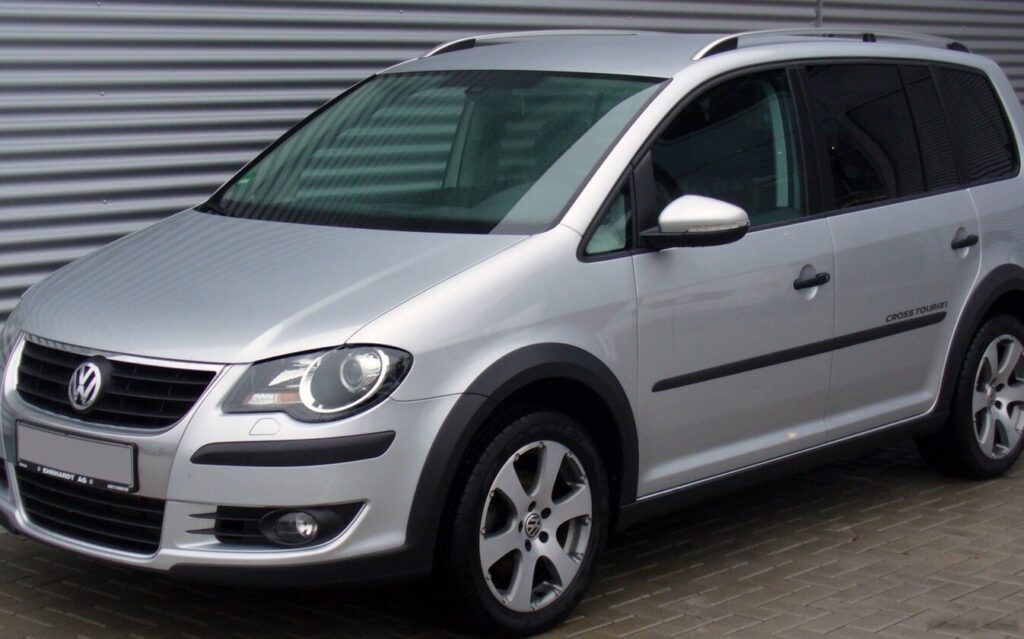
The Volkswagen Cross Touran I 1.4 TSI (150 hp) EcoFuel was a variant of the first-generation Cross Touran, produced between 2009 and 2010. Positioned as an environmentally conscious option within the Touran lineup, it combined a turbocharged and supercharged 1.4-liter gasoline engine with the capability to run on Compressed Natural Gas (CNG). This model aimed to offer a balance between fuel efficiency, reduced emissions, and the practicality of a compact minivan, primarily targeting European markets where CNG infrastructure was more developed. It sat in the mid-range of the Cross Touran offerings, offering a step up in fuel efficiency and alternative fuel capability compared to the standard gasoline engines, but lacking the outright performance of the higher-powered TSI variants.
Technical Specifications
| Brand | Volkswagen |
| Model | Touran |
| Generation | Cross Touran I |
| Type (Engine) | 1.4 TSI (150 Hp) EcoFuel |
| Start of production | 2009 |
| End of production | 2010 |
| Powertrain Architecture | Internal Combustion engine |
| Body type | Minivan |
| Seats | 5 |
| Doors | 5 |
| Fuel consumption (economy) – urban (CNG) (NEDC) | 6.3 kg/100 km |
| Fuel consumption (economy) – extra urban (CNG) (NEDC) | 4.1 kg/100 km |
| Fuel consumption (economy) – combined (CNG) (NEDC) | 4.9 kg/100 km |
| CO2 emissions (CNG) (NEDC) | 133 g/km |
| Fuel Type | Petrol / CNG |
| Acceleration 0 – 100 km/h | 10.5 sec |
| Acceleration 0 – 62 mph | 10.5 sec |
| Acceleration 0 – 60 mph | 10 sec |
| Maximum speed | 198 km/h (123.03 mph) |
| Emission standard | Euro 5 |
| Weight-to-power ratio | 11.2 kg/Hp, 89.6 Hp/tonne |
| Weight-to-torque ratio | 7.6 kg/Nm, 131.4 Nm/tonne |
| Power | 150 Hp @ 5500 rpm |
| Power per litre | 107.9 Hp/l |
| Torque | 220 Nm @ 1500-4500 rpm (162.26 lb.-ft. @ 1500-4500 rpm) |
| Engine layout | Front, Transverse |
| Engine Model/Code | EA111 / CDGA |
| Engine displacement | 1390 cm3 (84.82 cu. in.) |
| Number of cylinders | 4 |
| Engine configuration | Inline |
| Cylinder Bore | 76.5 mm (3.01 in.) |
| Piston Stroke | 75.6 mm (2.98 in.) |
| Compression ratio | 10:1 |
| Number of valves per cylinder | 4 |
| Fuel injection system | Direct injection and Multi-port manifold injection |
| Engine aspiration | Turbocharging and Supercharger, Intercooler |
| Valvetrain | DOHC |
| Engine oil capacity | 3.6 l (3.8 US qt | 3.17 UK qt) |
| Coolant | 5.6 l (5.92 US qt | 4.93 UK qt) |
| Kerb Weight | 1674 kg (3690.54 lbs.) |
| Max. weight | 2210 kg (4872.22 lbs.) |
| Max load | 536 kg (1181.68 lbs.) |
| Trunk (boot) space – minimum | 695 l (24.54 cu. ft.) |
| Trunk (boot) space – maximum | 1989 l (70.24 cu. ft.) |
| Fuel tank capacity | 11 l (2.91 US gal | 2.42 UK gal) |
| CNG cylinder capacity | 24 kg |
| Max. roof load | 100 kg (220.46 lbs.) |
| Permitted trailer load with brakes (8%) | 1700 kg (3747.86 lbs.) |
| Permitted trailer load with brakes (12%) | 1500 kg (3306.93 lbs.) |
| Permitted trailer load without brakes | 750 kg (1653.47 lbs.) |
| Permitted towbar download | 75 kg (165.35 lbs.) |
| Length | 4407 mm (173.5 in.) |
| Width | 1799 mm (70.83 in.) |
| Width including mirrors | 2047 mm (80.59 in.) |
| Height | 1670 mm (65.75 in.) |
| Wheelbase | 2677 mm (105.39 in.) |
| Front track | 1550 mm (61.02 in.) |
| Rear (Back) track | 1531 mm (60.28 in.) |
| Minimum turning circle | 11.2 m (36.75 ft.) |
| Front brakes | Ventilated discs |
| Rear brakes | Disc |
| Drive wheel | Front wheel drive |
| Number of gears and type of gearbox | 6 gears, manual transmission |
INTRODUCTION
The Volkswagen Cross Touran I, launched in 2003, was a more rugged-looking variant of the standard Touran compact minivan. The Cross Touran aimed to bridge the gap between a traditional MPV and a small SUV, offering increased ground clearance and protective body cladding. The 1.4 TSI (150 hp) EcoFuel version, introduced in 2009, represented a significant step towards alternative fuel technology within the Cross Touran range. Built on the Volkswagen Group’s A5 (1HX0) platform, shared with models like the Audi A3 and SEAT Leon, the Cross Touran EcoFuel was primarily sold in European markets with established CNG refueling infrastructure. This variant offered a compelling option for environmentally conscious buyers seeking a practical and versatile family vehicle.
Powertrain & Engine Architecture
The heart of the Cross Touran I 1.4 TSI EcoFuel is the EA111 engine code, specifically the CDGA variant. This 1.4-liter inline-four cylinder engine is notable for its combination of turbocharging and supercharging – a configuration known as “Twincharger.” The supercharger provides immediate boost at low engine speeds, eliminating turbo lag, while the turbocharger takes over at higher RPMs for sustained power delivery. Direct fuel injection and multi-port manifold injection work in tandem to optimize combustion efficiency. The engine produces 150 horsepower at 5500 rpm and 220 Nm (162 lb-ft) of torque between 1500 and 4500 rpm.
When running on CNG, the engine management system automatically switches to utilizing the compressed natural gas. The EcoFuel system is designed to seamlessly transition between gasoline and CNG, maximizing fuel efficiency and minimizing emissions. The engine is paired with a 6-speed manual transmission, which was the only transmission option available for this specific variant. The transmission’s gear ratios are tuned to provide a balance between fuel economy and acceptable acceleration.
Driving Characteristics
The 1.4 TSI EcoFuel Cross Touran offers a driving experience that prioritizes fuel efficiency and smooth power delivery over outright performance. The Twincharger system effectively mitigates turbo lag, providing responsive acceleration from a standstill and during overtaking maneuvers. However, with 150 hp propelling a relatively heavy vehicle (1674 kg / 3690.54 lbs), acceleration is not particularly brisk – 0-62 mph takes 10.5 seconds. The 6-speed manual transmission allows drivers to maintain optimal engine RPMs for efficiency or to extract more power when needed. Compared to the higher-output 1.8 TSI or 2.0 TSI versions of the Cross Touran, the 1.4 TSI EcoFuel feels noticeably less powerful, especially when fully loaded with passengers and luggage. However, the CNG operation provides a quieter and smoother driving experience.
Equipment & Trim Levels
The Cross Touran I 1.4 TSI EcoFuel typically came with a reasonable level of standard equipment, reflecting its position as a mid-range trim. Standard features included air conditioning, power windows, central locking, and an audio system. Safety features such as ABS, traction control, and multiple airbags were also standard. The interior typically featured cloth upholstery, although leather options were available as an extra cost. Optional extras included a sunroof, parking sensors, upgraded audio systems, and navigation. The exterior styling included distinctive black plastic cladding around the wheel arches and along the lower body, giving it a more rugged appearance compared to the standard Touran.
Chassis & Braking
The Cross Touran I featured an independent suspension setup, with McPherson struts at the front and a multi-link suspension at the rear. This configuration provided a comfortable ride quality and decent handling characteristics. The increased ride height of the Cross Touran, compared to the standard Touran, improved its ability to handle rough roads and light off-road conditions. The braking system consisted of ventilated discs at the front and solid discs at the rear. ABS (Anti-lock Braking System) was standard, enhancing braking performance and stability. Stabilizer bars were fitted to both the front and rear axles to reduce body roll during cornering.
Market Reception & Comparison
The Cross Touran I 1.4 TSI EcoFuel was generally well-received by critics as a practical and environmentally friendly family vehicle. Its ability to run on CNG was a major selling point in markets with established CNG infrastructure. Fuel economy on CNG was significantly better than that of comparable gasoline-powered vehicles. However, some critics noted that the performance was somewhat underwhelming, especially when compared to the more powerful TSI variants. Compared to the 1.6 TDI diesel version, the EcoFuel offered a different driving experience, with the gasoline engine providing smoother and quieter operation, but the diesel offering superior fuel economy when running on gasoline alone. The EcoFuel’s reliance on CNG availability was also a potential drawback for some buyers.
Legacy
The Volkswagen Cross Touran I 1.4 TSI EcoFuel represents an early attempt by Volkswagen to integrate alternative fuel technology into its mainstream vehicle lineup. While the model was only produced for a short period (2009-2010), it paved the way for future EcoFuel models and demonstrated Volkswagen’s commitment to reducing emissions. Today, these vehicles are relatively rare on the used car market. The long-term reliability of the EA111 engine is generally good, but potential buyers should be aware of the possibility of issues with the Twincharger system and the CNG fuel system. Proper maintenance and regular servicing are crucial to ensure the continued reliability of these components. The EcoFuel variant remains a niche choice for those seeking a unique and environmentally conscious vehicle.