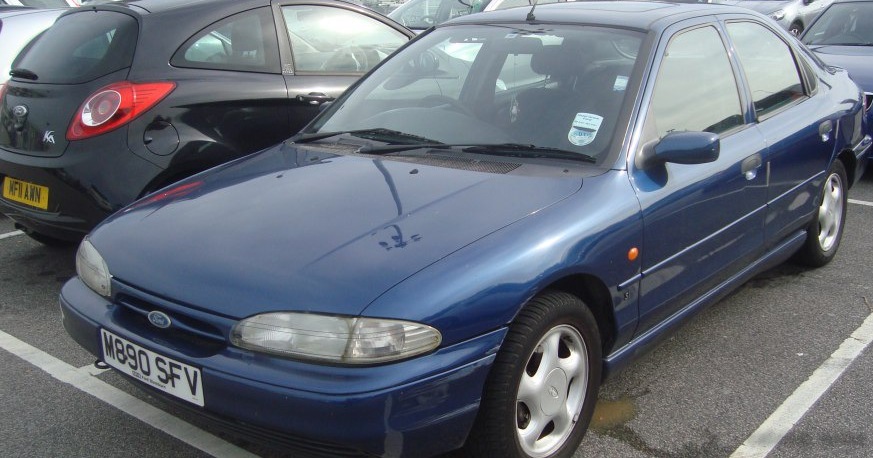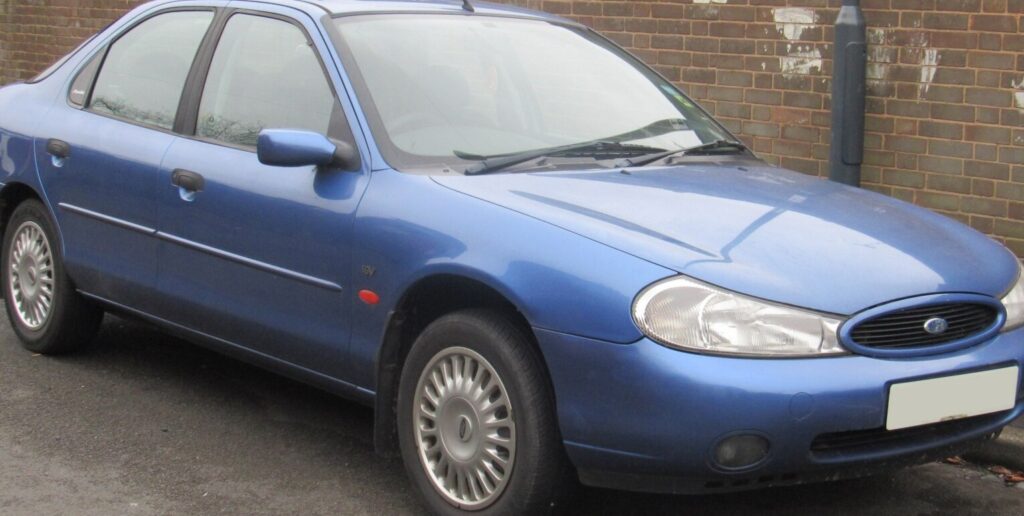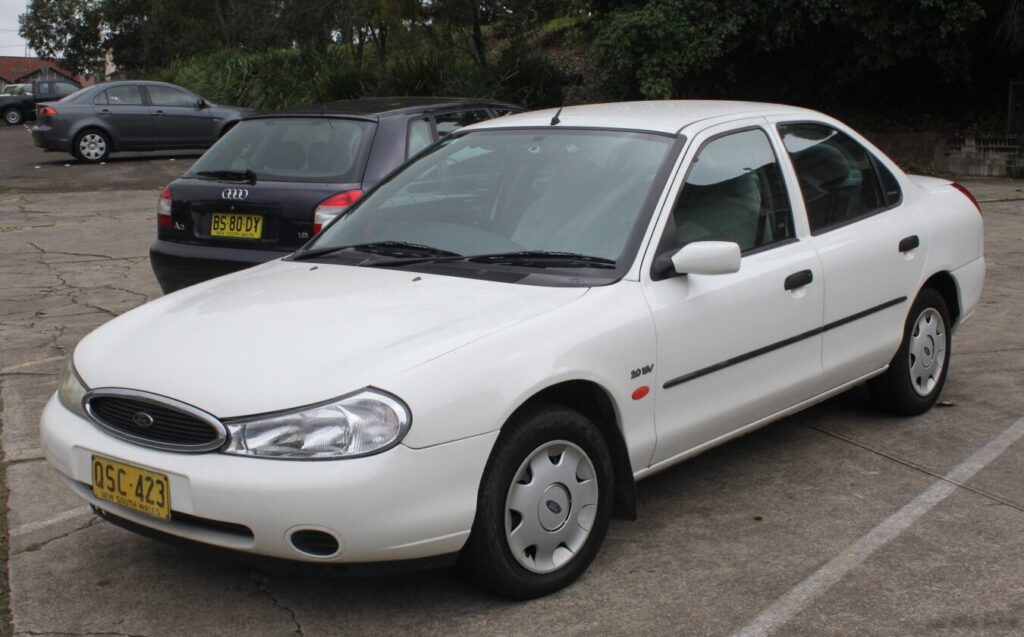
The Ford Mondeo I Sedan, specifically the 1.8 TD variant produced from 1995 to 2001, represented a significant entry point into the Mondeo range, particularly in European markets. Introduced as part of the facelifted first generation (often referred to as the 1996 model year), this version offered a diesel-powered option aimed at buyers prioritizing fuel economy and practicality. The Mondeo itself was a crucial model for Ford, replacing the Sierra and Escort ranges with a single, globally-focused family car. This 1.8 TD trim occupied the lower-mid range of the lineup, positioned below the more powerful gasoline engines and above the base-level models.
Technical Specifications
| Brand | Ford |
| Model | Mondeo |
| Generation | Mondeo I Sedan (facelift 1996) |
| Type (Engine) | 1.8 TD (90 Hp) |
| Start of production | 1995 |
| End of production | 2001 |
| Powertrain Architecture | Internal Combustion engine |
| Body type | Sedan |
| Seats | 5 |
| Doors | 4 |
| Fuel consumption (combined) | 6.3 l/100 km (37.3 US mpg, 44.8 UK mpg, 15.9 km/l) |
| Fuel Type | Diesel |
| Acceleration 0 – 100 km/h | 13.2 sec |
| Acceleration 0 – 62 mph | 13.2 sec |
| Acceleration 0 – 60 mph | 12.5 sec |
| Maximum speed | 181 km/h (112.47 mph) |
| Weight-to-power ratio | 15.1 kg/Hp, 66.2 Hp/tonne |
| Weight-to-torque ratio | 7.6 kg/Nm, 132.5 Nm/tonne |
| Power | 90 Hp @ 4500 rpm |
| Power per litre | 51.3 Hp/l |
| Torque | 180 Nm @ 2000 rpm (132.76 lb.-ft. @ 2000 rpm) |
| Engine layout | Front, Transverse |
| Engine Model/Code | Endura / RFN |
| Engine displacement | 1753 cm3 (106.97 cu. in.) |
| Number of cylinders | 4 |
| Engine configuration | Inline |
| Cylinder Bore | 82.5 mm (3.25 in.) |
| Piston Stroke | 82 mm (3.23 in.) |
| Compression ratio | 21.5:1 |
| Number of valves per cylinder | 2 |
| Fuel injection system | Precombustion chamber injection |
| Engine aspiration | Turbocharger |
| Valvetrain | OHC |
| Engine oil capacity | 5.1 l (5.39 US qt | 4.49 UK qt) |
| Coolant | 9.3 l (9.83 US qt | 8.18 UK qt) |
| Kerb Weight | 1359 kg (2996.08 lbs.) |
| Max. weight | 1855 kg (4089.57 lbs.) |
| Max load | 496 kg (1093.49 lbs.) |
| Trunk (boot) space – minimum | 470 l (16.6 cu. ft.) |
| Fuel tank capacity | 61 l (16.11 US gal | 13.42 UK gal) |
| Length | 4556 mm (179.37 in.) |
| Width | 1751 mm (68.94 in.) |
| Height | 1427 mm (56.18 in.) |
| Wheelbase | 2704 mm (106.46 in.) |
| Front track | 1503 mm (59.17 in.) |
| Rear (Back) track | 1487 mm (58.54 in.) |
| Drivetrain Architecture | The Internal combustion engine (ICE) drives the front wheels of the vehicle. |
| Drive wheel | Front wheel drive |
| Number of gears and type of gearbox | 5 gears, manual transmission |
| Front suspension | Wishbone |
| Rear suspension | Coil spring |
| Front brakes | Ventilated discs |
| Rear brakes | Drum |
| Assisting systems | ABS (Anti-lock braking system) |
| Steering type | Steering rack and pinion |
| Power steering | Hydraulic Steering |
| Tires size | 185/65 R14 |
INTRODUCTION
The Ford Mondeo I Sedan 1.8 TD (90 Hp) was a key component of Ford’s strategy to offer a modern, competitive family car in the mid-size segment. Production spanned from 1995 to 2001, coinciding with the facelift of the original Mondeo. This variant was particularly popular in Europe, where diesel engines held a significant market share due to fuel costs and taxation. The Mondeo aimed to provide a more refined and spacious alternative to traditional Ford offerings, and the 1.8 TD trim catered to buyers seeking a balance between economy and usability.
Powertrain & Engine Architecture
At the heart of the Mondeo 1.8 TD was the Ford Endura-D 1.8-liter inline-four diesel engine, often identified by the engine code RFN. This engine utilized a precombustion chamber injection system, a common technology for diesel engines of that era. This system involved injecting fuel into a small precombustion chamber connected to the main cylinder, promoting more complete combustion and reducing noise. The engine featured an overhead camshaft (OHC) valvetrain operating two valves per cylinder. A turbocharger was employed to boost power output to 90 horsepower at 4500 rpm and 180 Nm (132.76 lb.-ft.) of torque at 2000 rpm. The engine’s relatively high compression ratio of 21.5:1 was typical for indirect injection diesel engines. The 1.8 TD was typically paired with a five-speed manual transmission, although an automatic transmission was also available, albeit less common. The automatic gearbox was a four-speed unit, designed to provide smooth shifts but at the expense of some performance and fuel efficiency compared to the manual.
Driving Characteristics
The 1.8 TD automatic version of the Mondeo offered a comfortable, if not particularly exhilarating, driving experience. Acceleration was modest, with a 0-60 mph time of around 12.5 seconds and a top speed of 112.47 mph. The automatic transmission, while convenient, resulted in noticeable power loss compared to the manual version. Gear ratios were optimized for fuel economy rather than outright performance. The turbocharger provided a noticeable boost in power once spooled up, but there was some degree of turbo lag. The Mondeo’s suspension provided a good balance between ride comfort and handling, making it suitable for both city driving and longer journeys. The steering was light and precise, although lacking in significant feedback.
Equipment & Trim Levels
The 1.8 TD trim level typically included features such as central locking, power steering, and an adjustable steering column. Interior upholstery was generally cloth, with a relatively simple dashboard layout. Optional extras included air conditioning, electric windows, and an upgraded audio system. Higher trim levels, such as the Ghia, offered more luxurious appointments, including leather upholstery, alloy wheels, and additional comfort features. The base trim was fairly spartan, focusing on providing essential transportation at an affordable price.
Chassis & Braking
The Mondeo I Sedan featured a front-wheel-drive layout with independent wishbone suspension at the front and a coil spring rear suspension. The front brakes were ventilated discs, providing adequate stopping power, while the rear brakes were drums. Anti-lock Braking System (ABS) was standard equipment, enhancing safety. The chassis was designed to provide a stable and comfortable ride, with a focus on minimizing body roll. Stabilizer bars were fitted to both the front and rear axles to further improve handling.
Market Reception & Comparison
The Mondeo 1.8 TD automatic was generally well-received by critics as a practical and economical family car. However, it wasn’t praised for its performance. Compared to the higher-output gasoline engines (such as the 2.0L or V6), the 1.8 TD offered significantly less power and acceleration. The manual transmission version of the 1.8 TD was favored by those prioritizing fuel economy and driver engagement. The 1.9 TDI versions, available in some markets, offered a more refined diesel experience with slightly better performance. The 1.8 TD’s main strength was its affordability and fuel efficiency, making it a popular choice for high-mileage drivers.
Legacy
The Ford Mondeo I 1.8 TD, while not a performance icon, proved to be a reliable and durable powertrain. The Endura-D engine, despite its indirect injection system, was generally robust and capable of high mileage with proper maintenance. In the used car market today, these models are often sought after by buyers looking for an affordable and economical classic car. Common issues include wear and tear on the turbocharger and potential problems with the precombustion chamber injection system. However, parts availability remains relatively good, and the Mondeo’s simple mechanical design makes it relatively easy to maintain and repair. The 1.8 TD variant represents a significant step forward for Ford in terms of offering a modern, globally-competitive family car.